BAGHDAD: Government corruption provided Daesh and local militias with the umbrella they needed to seize power in Iraq, officials and lawmakers told Arab News on Thursday.
They said Iraq’s security and political stability will remain threatened as long as corrupt officials continue to control the country’s assets.
Iraq is high on the list of the most corrupt countries. The Iraqi Parliamentary Committee of Integrity told Arab News that the estimated value of “looted” amounts during the past 12 years has been more than $200 billion.
Almost a third of Iraqi territories in the north and west fell into the hands of Daesh militants in June 2014 after the dramatic collapse of the Iraqi Army. That was the result of financial and administrative corruption which undermined the security establishment at the time.
The results of an eight-month-long investigation by the Iraqi Parliamentary Committee for Security and Defense in August 2015 showed that financial and administrative corruption played a key role in widening the gap between the residents and the security services of Mosul, Iraq’s second most populated city.
Corruption led to the fall of the city and its suburbs into the hands of the militants in 2014. The report states that Nuri Al-Maliki, the former Iraqi prime minister, tops the list of officials responsible for the fall of Mosul as he was in charge of “the appointment of incompetent leaders … and the lack of accountability of corrupt security officials.”
Late in November, Iraqi Prime Minister Haider Abadi established a campaign to combat corruption.
“The corrupt (officials and politicians) and those who seized state funds are the ones who caused these disasters (the fall of Mosul and other cities into the hands of militants),” Abadi tweeted last week.
“Daesh was only able to occupy cities because of corruption,” he said.
Iraqi lawmakers involved in the fight against corruption told Arab News that financial and administrative corruption had provided cover for the armed groups, and not vice versa.
“Before the emergence of Daesh, there was a great deal of evidence that the governors of these provinces (the three seized by Daesh) were involved in many thefts of state funds,” Talal Al-Zubaie, the head of the Parliamentary Committee for Integrity, told Arab News.
“The armed groups emerged as a result of this corruption, which aimed to undermine the authority of the state so no one could discover the thefts by some governors, which would make it seem as if Daesh was responsible,” Al-Zubaie said.
“The corruption provided cover for armed groups to ensure that chaos continued to serve the corrupt officials,” he said.
Mossa Faraj, the former head of the Integrity Committee, a governmental body established in 2004 to combat corruption and supervise the government’s performance, agrees with Abadi and Al-Zubaie.
“The relationship between politicians and terrorism in Iraq is direct and cannot be denied. It (the corruption) aims to seize power, not to accumulate money or wealth,” Faraj said.
“Seizing power requires headquarters, weapons, cars, militiamen, TV channels, and thousands of followers. All of these require a lot of money every month,” he said.
“Because of this, all Iraqi political parties have been involved in corruption since 2003,” according to Faraj.


Corrupt politicians and terrorism directly linked in Iraq, say officials
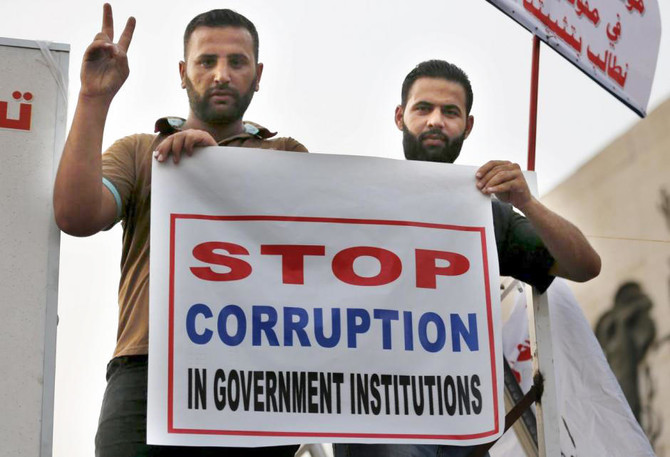
Corrupt politicians and terrorism directly linked in Iraq, say officials


Israel warns Lebanon of ‘heavy price’ as bombardment pounds Beirut suburbs
- Katz said that if the Lebanese government failed to enforce a 2024 agreement to disarm Hezbollah, it and the whole country would suffer
- He added that Israel had no territorial claims against Lebanon
BEIRUT/TEL AVIV: Israel warned Lebanon of a “very heavy price” if it did not rein in Iran-backed Hezbollah on Saturday, as it pounded the group’s strongholds around the country with air strikes and mounted a deadly airborne raid in the east.
Lebanon was dragged into the wider Middle East war on Monday when Hezbollah fired at Israel, which responded with a new military campaign that has forced hundreds of thousands of Lebanese from their homes.
On Saturday morning, more buildings in the Hezbollah-controlled southern suburbs of Beirut lay as mounds of smoking rubble and twisted metal, Reuters video showed, after heavy Israeli bombardment that followed an evacuation order for civilians.
’A NIGHT OF HELL’
Israeli Defense Minister Israel Katz, addressing Lebanon’s President Joseph Aoun in a statement, said that if the Lebanese government failed to enforce a 2024 agreement to disarm Hezbollah, it and the whole country would suffer.
“If the choice is between protecting our civilians and our soldiers or protecting the state of Lebanon — we will choose the protection of our civilians and soldiers, and the Lebanese government and Lebanon will pay a very heavy price,” Katz said.
He added that Israel had no territorial claims against Lebanon, but would not allow a situation where there could be fire targeting Israel from Lebanese territory.
Overnight, Israeli helicopters dropped troops near the town of Nabi Chit in Lebanon’s eastern Bekaa Valley in a rare airborne operation.
Israel’s military said the troops had staged the operation to seek the remains of Ron Arad, an Israeli airforce navigator missing in Lebanon since 1986. However, no findings related to him were recovered, it said.
Hezbollah said in a statement overnight that it had fired on Israeli troops dropped near Nabi Chit by four helicopters, and that the troops had withdrawn. The Israeli military said none of its forces were injured.
Lebanon’s Health Ministry said 41 people had been killed in the last 24 hours in Israeli attacks in the Nabi Chit area. The Lebanese army said three of its personnel were among the dead.
Shawki Al-Masri, who lives in a town adjacent to Nabi Chit, described the overnight bombing in the area as “a night of hell.”
“We heard the helicopters over our house all night — they were so low we thought they would land on us,” he told Reuters.
“People in the town woke up and started shooting at them, then the warplanes started bombing. It was a very violent night and only calmed down when the sun came up,” he said.
Israeli strikes have killed more than 200 people across Lebanon, and orders to evacuate have displaced around 300,000 people, only a third of whom are now living in government shelters.
A senior United Nations official described the displacement as “unprecedented” in comments to Reuters on Friday.
HEZBOLLAH WARNS ISRAELIS NEAR BORDER TO FLEE
Hezbollah has also warned Israeli citizens living in communities near the border to flee their homes, though Katz said on Saturday they should not do so. Many northern Israeli communities were evacuated during crossborder bombardment in 2023-24.
Also on Saturday, Hezbollah issued a more specific warning, telling residents of the northern Israeli city of Kiryat Shimona to evacuate immediately and head south.
The United Nations on Saturday warned that the conflict was set to get “even worse,” and that talks between Israel and Lebanon “must be pursued with urgency” to end hostilities.
Its Special Coordinator for Lebanon, Jeanine Hennis-Plasschaert, said in a statement that it was “clear that ongoing military actions will not deliver a lasting win to anyone.”
“They will only deepen instability and inflict further suffering,” she said.


