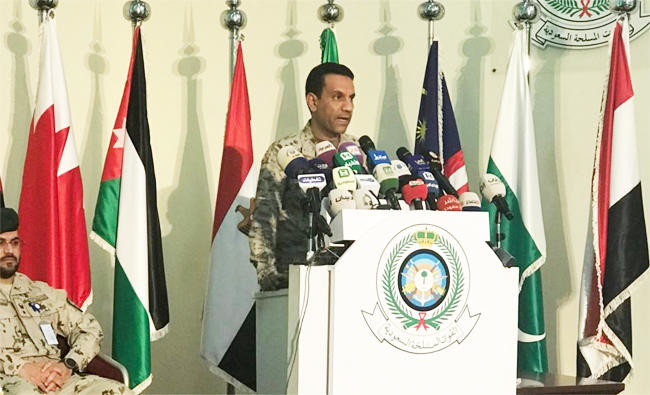
RIYADH: Houthi militias are a constant threat to the Yemeni people, and “have been in contact with the Iranian regime since 1994,” Col. Turki Al-Maliki, spokesman for the Saudi-led coalition, said Wednesday.
At a press conference in Riyadh, he showed through videos that the coalition continues to accurately target the Houthis and their arsenal of weapons, and avoid civilians.
The Houthis are hiding ballistic missiles in deep caves in the Sanaa mountain of Nahdain, and coalition forces are monitoring the area round-the-clock, he added.
The Houthis have fired 86 ballistic missiles at Saudi Arabia, and the latest attempt was thwarted, Al-Maliki said.
He described as incorrect a statement by the UN humanitarian coordinator in Yemen, Jamie McGoldrick, that the coalition campaign has been a “failure.”
All of Shabwa province is now liberated, and the coalition is fighting to oust the Houthis from the remaining 20 percent of Al-Jouf, Al-Maliki said.
While the Houthis are recruiting child soldiers, the coalition has launched a unit to help these children recuperate and reintegrate into civilian life, he added.
Saudi Arabia has provided the Yemeni people with aid by air, land and sea, and all ports are open and receiving humanitarian aid, he said.
Former Yemeni President Ali Abdullah Saleh lost his life protesting the Houthi presence, Al-Maliki added.
The coalition is communicating with many officials in Yemen who have expressed their willingness to desert the Houthis and join the legitimate government, he said.

Saudi-led coalition: Houthis a constant threat to Yemeni people
Holy month shines light on Lebanon’s resilience
- Shared struggles bring families closer amid economic uncertainty as inflation piles pressure on household spending
BEIRUT: The resilience of Lebanese families was brought to the fore as Ramadan and Christian Lent coincided this year amid a deepening economic crisis.
The ability of families to endure and adapt was tested once more, renewing concerns about livelihoods across the country.
Against the backdrop of worsening living conditions, the period has highlighted how the Lebanese people’s resilience and adaptability continue to shape their response to hardship.
On Feb. 17, the government approved increases in the price of gasoline tanks, and raised VAT and customs fees.
The measures sparked public anger, with many describing the increases as “improvised and ill-considered, at the expense of the poor and middle class,” and pledging to protest.
The increases are intended to fund pay raises for public sector employees, military personnel and retirees. As a result, Lebanese citizens will pay an additional 300,000 Lebanese pounds ($3.5) for each tank of gasoline.
Additionally, all bills will increase as the VAT rate rises from 11 to 12 percent. Container fees will also rise to $50 for a 20-foot container and $80 for a 40-foot container.
The 1 percent VAT increase is expected to raise $259 million for the state treasury, provided there is no tax evasion.
The cabinet approved six additional salary increases for public sector employees, raising the total from 13 to 19 times the base salary.
However, implementation of the salary increase is delayed until early March, pending parliamentary approval of the VAT increase.
The promised increase does not exceed $100 and will not be added to base pay.
According to Finance Minister Yassin Jaber, the raise includes 320,000 public sector and military personnel, and “its cost to the treasury amounts to $800 million annually.”
Following the collapse of the Lebanese pound in 2019, a primary school teacher’s base salary is 2.2 million Lebanese pounds.
Multiplying this base salary by 19 would total $456.
The Central Administration of Statistics in Lebanon reported that “annual inflation reached 14.8 percent in 2025, a figure significantly lower than in previous crisis years.”
However, it added that “despite the slowdown, inflation remains high, as it has not been accompanied by meaningful salary increases or improvements.”
The financial collapse that began in October 2019 remains a key driver of these pressures.
The Lebanese pound has lost more than 98 percent of its value amid the absence of clear economic support policies.
The cost of living now exceeds many people’s ability to afford basic necessities.
Frozen bank deposits and declining purchasing power have widened social and economic disparities, changing consumption patterns.
The middle class has declined to unprecedented levels, and tens of thousands of young people have emigrated in search of employment and better living conditions.
Although the minimum wage has increased several times since 2023, most raises have been minimal, offering little real value when converted to US dollars or compared to living costs.
Official data and field reports indicate ongoing food inflation, with red meat, vegetable and fruit prices rising by 10 percent to 15 percent.
Prices may increase further if parliament approves a VAT hike, which requires legislation.
Any salary gains for public sector employees could be offset by higher taxes.
The 21 percent increase in gasoline prices has raised transportation costs for goods. Price increases now affect a wide range of items, including groceries, housing, bread, medicine and school transportation.
Ali Ismail, a vegetable merchant, said that prices began rising before the gasoline price hike. He expects further increases within two weeks, once transportation costs from mountainous regions to the coast are recalculated.
National Farmers Union President Ibrahim Tarshishi said: “Vegetables and fruit remain available for now. The recent gasoline price increase has not yet been reflected in market prices, as transportation costs require time to be fully assessed.
“Fortunately for the Lebanese, the unusually warm February weather during this fasting season is boosting agricultural production and increasing market availability, with the Ministry of Agriculture extending the growing season.”
Economic experts agree that the minimum wage covers less than 30 percent of basic needs.
Economist Jassim Ajaka said: “Rising fuel prices will drive up costs, pushing prices up by 25 percent, and no product or commodity will be spared.”
Lebanon ranks among the region’s most expensive countries.
In Numbeo’s 2025 Cost of Living Index, Beirut scored 42.4 points, ranking 168th worldwide and seventh across the Middle East and North Africa.
A recent World Bank report, “Lebanon Economic Monitor — Spring 2025: Turning the Tide?,” found that Lebanon’s high inflation is increasing pressure on household spending and driving up the cost of living.
Lebanese families face renewed challenges as they cope with rising prices during Ramadan, yet many continue to adapt.
Ramadan traditions remain central to Lebanese family life, motivating many to maintain their iftar gatherings despite rising food prices.
According to the World Food Programme, the cost of a food ration for a family of five rose to about 44.2 million Lebanese pounds ($492) in May 2025, an 8.2 percent increase over five months.
Despite economic challenges, celebrations for the holy month have continued. Decorations light up neighborhoods in both cities and villages, reflecting a desire for moments of joy amid crisis.