Saudi Arabia, Egypt agree to boost parliamentary friendship committee

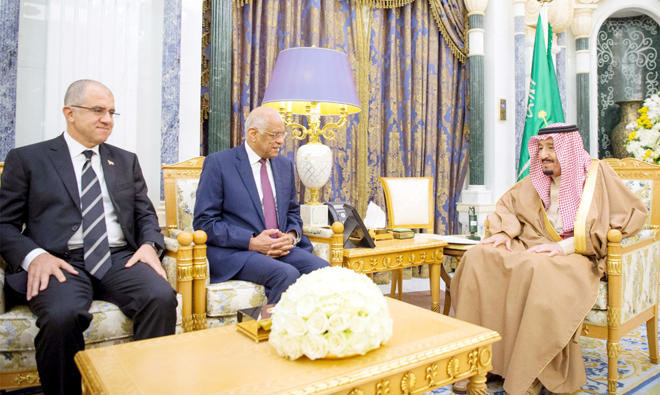
King Salman holds talks with Egypt’s Parliament Speaker Ali Abdel-Aal at Al-Yamamah Palace in Riyadh on Wednesday. (SPA)
Updated 05 January 2018
Follow

Saudi Arabia, Egypt agree to boost parliamentary friendship committee

RIYADH: Saudi Arabia and Egypt have agreed to develop the role of the Saudi-Egyptian Parliamentary Friendship Committee via more mutual visits and coordination on regional and international issues.
This was announced after a meeting in Riyadh between Abdullah Al-Asheikh, Shoura Council speaker, and Ali Abdel-Aal, speaker of the Egyptian Council of Representatives.
The agreement came on the heels of a meeting between King Salman and Abdel-Aal at Al-Yamamah Palace on Wednesday, during which they reviewed relations between the two countries.
King Salman and Abdel-Aal also discussed cooperation between Saudi Arabia and Egypt in the parliamentary field. Al-Asheikh attended the meeting.
Abdel-Aal said: “We are pleased to meet King Salman, who praised Saudi-Egyptian relations and the continuous coordination between the two leaderships in all fields and issues in the region.”
Former Shoura Council member Sadaka Yahya Fadil on Thursday said bilateral ties have benefited both countries, which are united against terrorism and support each other in all areas.
He urged Egyptian businessmen to visit the Kingdom and witness the “promising” Vision 2030 reform plan.
“The relationship is historical. Saudi Arabia is tied to Egypt and Egypt is tied to the Kingdom socially, politically and culturally, among others,” Fadil said, describing Saudis and Egyptians as one people living in two countries. “There’s a lot we can do together,” he added.
“The visit of the Egyptian Council of Representatives is another sign of the steady friendship between the two sides. The two brotherly countries always sign agreements if a visit takes place.”
Saudi Arabia and Egypt have a united position on the global stage, making them stronger and listened to on international issues, Fadil said, adding that both countries are members of the International Parliamentary Union (IPU).
“At the IPU there are many issues discussed, and Saudi Arabia and Egypt need support for their ideas and interests. Egypt has always been a supporter of Saudi Arabia and vice versa,” he said.


Economic growth and resilience at heart of 2nd AlUla Emerging Market Economies Conference

Updated 03 February 2026
Follow

Economic growth and resilience at heart of 2nd AlUla Emerging Market Economies Conference

  • Event on Feb. 8 and 9 will bring together ministers, governors of central banks, policymakers, economic experts and international financial institutions
  • Emerging-market economies a ‘pivotal element’ in global economic system due to effect they have on growth and stability, says Saudi Finance Minister Mohammed Al-Jadaan

RIYADH: The second annual AlUla Conference for Emerging Market Economies, which Saudi Arabia will host next week, offers a platform to exchange views on global developments and discuss policies and reforms that support inclusive growth and strengthen economic resilience, the Kingdom’s finance minister said.

The event on Feb. 8 and 9 will bring together finance ministers, governors of central banks and policymakers, alongside economic experts and representatives of international financial institutions.

Organized by the Saudi Ministry of Finance in partnership with the International Monetary Fund, it takes place as emerging-market economies face mounting challenges amid rapid global economic change.

Finance Minister Mohammed Al-Jadaan said the decision to host the conference reflects Saudi Arabia’s ongoing commitment to efforts that support global financial and economic stability, and highlights the growing influence of emerging economies on worldwide growth.

Emerging-market economies represent a “pivotal element” in the global economic system due to the direct impact they have on economic growth and stability, he added.

“The AlUla Conference for Emerging Market Economies provides a unique platform for exchanging views on global economic developments, and discussing policies and reforms that will support inclusive growth and enhance economic resilience, in light of broader international cooperation that contributes to confronting common challenges,” Al-Jadaan said.

Kristalina Georgieva, managing director of the IMF, said the event would help emerging economies deal with growing uncertainty driven by technological change, demographic shifts and geopolitical tensions.

“The AlUla conference provides a vital platform for emerging economies to discuss how they can navigate the risks and embrace the opportunities ahead,” she said.

“In these times of sweeping transformations in the global economy, policymakers face a more challenging and uncertain environment. Countries should work together to strengthen resilience through sound macroeconomic and financial policies.”