CAIRO: Daesh’s Sinai branch said it executed one of its members for collaborating with the Palestinian Hamas movement, and called for the killing of all Hamas members and anyone cooperating with it.
The “judge” of the Sinai Province terrorist organization described Hamas as an “apostate” group because of its security cooperation with Egypt, its prevention of fighters from moving from Gaza to the Sinai, and its arrests of many Daesh members in Gaza.
Sinai Province said in a video posted on its Telegram account that Mohammed Al-Sa’idi, its second in command, sentenced Moussa Abu Zmat, a Daesh “soldier” from Gaza, to death because he smuggled weapons and equipment for Hamas to and from the territory.
The judge, known as Abu Kazem Al-Maqdisi, announced the death sentence in a video broadcast on Jan. 3.
He said the executioner, Mohammed Al-Dujani from Gaza, is considered a “repentant.” Al-Dujani is the son of Anwar Al-Dujani, a prominent Hamas member.
Following the posting of the video, Al-Dujani family repudiated Mohammed and accused him of committing “an act that violates the law of God.”
Al-Maqdisi described Palestinian movement Fatah as “secular” and “infidel,” and called for the killing of all its members.
The video starts with US President Donald Trump’s announcement of his recognition of Jerusalem as Israel’s capital, followed by Israeli Prime Minister Benjamin Netanyahu saying the city has been the capital for 70 years, and Hamas political leader Ismail Haniyeh declaring his party’s commitment to democracy and legislative elections.
Sinai Province also claimed responsibility for the killing of an Egyptian policeman last Wednesday.
A security source said Capt. Mahmoud Abdul Azim Abu Taleb was slain while dismantling a 50-kg explosive device in western Arish.
The spokesman of the Egyptian armed forces, Col. Tamer Al-Rifa’i, said the third army, in cooperation with the air force, killed two terrorists and captured two others in central Sinai in the last few days.
Ahmad Kamel Al-Behiri, a security and terrorism affairs researcher at Al-Ahram press establishment, warned of an increase in “lone-wolf” attacks by Daesh in the Nile Valley and Delta.
Meanwhile, Egyptian authorities have executed 19 people since Dec. 26. Fifteen of them were convicted of attacking troops and police in the Sinai, while four Muslim Brotherhood members were convicted of exploding a device and killing three cadets at the Military Academy in Kafr El-Sheikh in April 2015.
Egyptian President Abdel Fattah El-Sisi warned of the use of “brutal force” against terrorists following the killing of more than 300 people in an attack on a mosque in the northern Sinai.
Egypt’s Cabinet approved a bill to establish the Supreme Council to Confront Terrorism and Extremism.
El-Sisi announced on Tuesday the extension of the state of emergency in Egypt for three months as of Jan. 13.


Daesh Sinai branch urges killing of all Hamas members
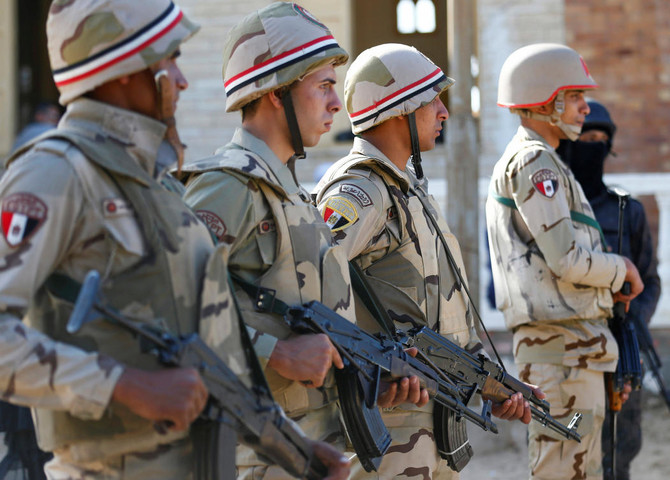
Daesh Sinai branch urges killing of all Hamas members


GCC states ‘face reliance on Saudi Arabia for food imports’
- With 70 percent of food coming through Strait of Hormuz, analysts warn of inevitable shortages
DUBAI: Some Gulf states may have to rely on overland food deliveries from Saudi Arabia if the US-Israel-Iran war continues to disrupt shipping through the Strait of Hormuz and restrict regional airspace, analysts warned on Thursday.
The region is up to 90 percent dependent on food imports, and price surges and scarcity of some goods are expected.
“With over 70 percent of GCC foodstuffs being imported through the Strait of Hormuz, Gulf states face shortages if the war persists,” said Neil Quilliam of the Chatham House think tank.
“While GCC countries have taken steps to diversify suppliers and ensure sufficient stores to withstand disruption, this can only last several months. At this point, price increases and longer lead times will start to hit the markets.”
Commodities analyst Ishan Bhanu said: “The biggest immediate effect will be due to the blockade of Jebel Ali in Dubai, serving about 50 million people. Qatar, Kuwait, Bahrain and Iraq effectively become landlocked and will depend on overland routes through Saudi Arabia.”
Bottlenecks are yet to show and the UAE has said its strategic reserves of vital goods cover four to six months of needs. It urged residents to report unjustified price increases through a dedicated hotline.
Supermarket staff throughout the Gulf said shelves remain largely stocked, though suppliers are taking longer to replenish certain products. Iran’s strikes on the Gulf since Saturday prompted panic buying in supermarkets, a dry run for what could come.
“Perception of risk matters, and even if stocks are sufficient now, public runs on supermarkets can spook the public,” Quilliam said.


