‘Iran is a threat to everyone’ say regime opposition groups in London protest

1 / 9
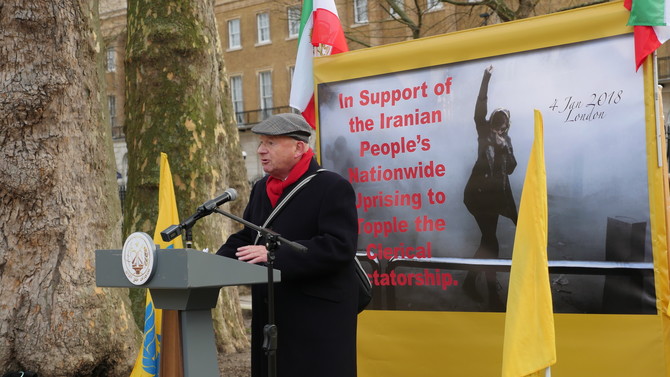
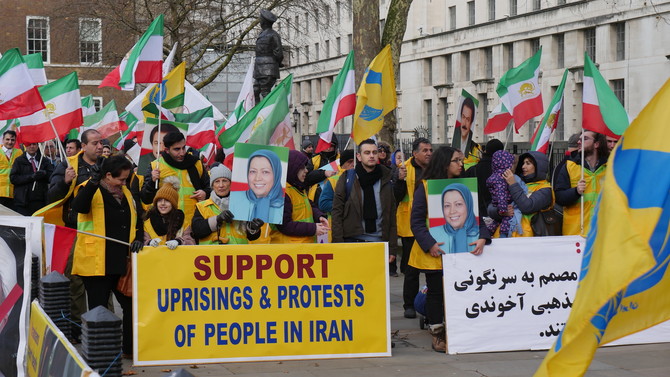
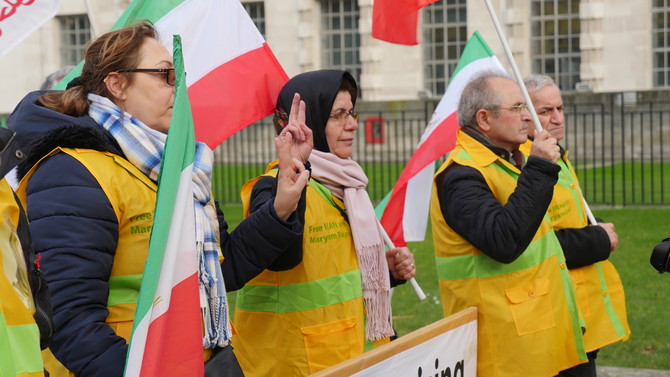
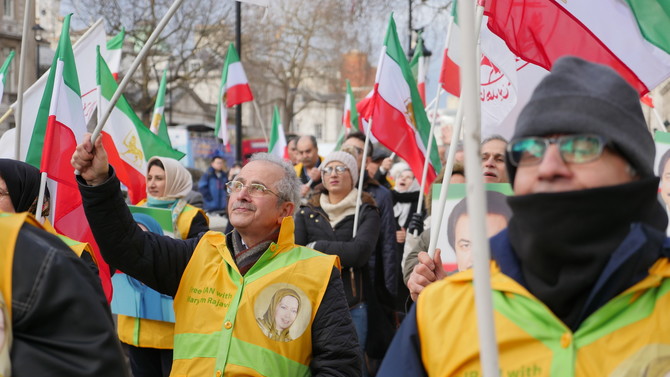
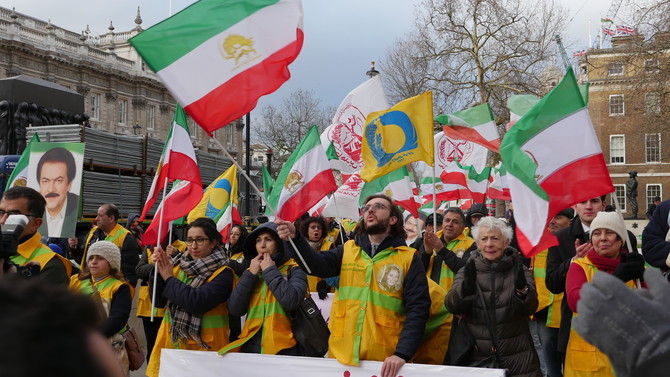
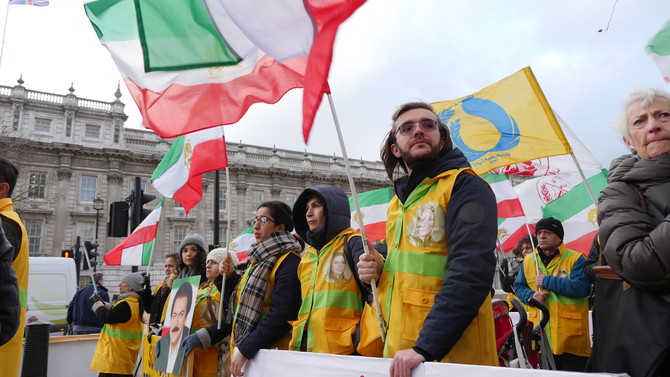
Iranian opposition groups call for UK Prime Minister Theresa May to support protesters in Iran during a demonstration outside Downing Street in London. (AN Photo)
2 / 9
Iranian opposition groups call for UK Prime Minister Theresa May to support protesters in Iran during a demonstration outside Downing Street in London. (AN Photo)
3 / 9
Iranian opposition groups call for UK Prime Minister Theresa May to support protesters in Iran during a demonstration outside Downing Street in London. (AN Photo)
4 / 9
Iranian opposition groups call for UK Prime Minister Theresa May to support protesters in Iran during a demonstration outside Downing Street in London. (AN Photo)
5 / 9
Iranian opposition groups call for UK Prime Minister Theresa May to support protesters in Iran during a demonstration outside Downing Street in London. (AN Photo)
6 / 9
Iranian opposition groups call for UK Prime Minister Theresa May to support protesters in Iran during a demonstration outside Downing Street in London. (AN Photo)
7 / 9
Iranian opposition groups call for UK Prime Minister Theresa May to support protesters in Iran during a demonstration outside Downing Street in London. (AN Photo)
8 / 9
Iranian opposition groups call for UK Prime Minister Theresa May to support protesters in Iran during a demonstration outside Downing Street in London. (AN Photo)
9 / 9
Iranian opposition groups call for UK Prime Minister Theresa May to support protesters in Iran during a demonstration outside Downing Street in London. (AN Photo)
Updated 05 January 2018
Follow

‘Iran is a threat to everyone’ say regime opposition groups in London protest

LONDON: Chanting “down with Khamenei, down with dictators,” Iranian opposition groups gathered outside the prime minister’s residence in London on Thursday to call for the UK government to support protesters in Iran.

Members of 40 opposition groups from the Iranian community in Britain turned out in Westminster for the rally, organized by the National Council of Resistance of Iran (NCRI) and The People’s Mojahedin Organization of Iran (PMOI). 

“We’re here to be the voice of the Iranian people and express our support for the National Council of Resistance of Iran and the PMOI who have been striving for peace and democracy in Iran since the Iranian regime came into power,” said Azadeh Hosseini, a member of the Anglo Iranian Teachers Association.

“The NCRI has the support of many different British parliamentarians across the different parties,” she said.

Around 100 people attended the Downing Street rally and a separate rally also took place outside the Iranian embassy.

Describing itself on its website as “an inclusive and pluralistic Parliament-in-exile” that “aims to establish a secular democratic republic in Iran,” the NCRI is an umbrella organisation that was founded in 1981 in Iran and is now headquartered in France.

The PMOI, an exiled Iranian opposition group which advocates for the overthrow of the regime, is among the NCRI’s affiliates.

“Iranians are very disappointed with the UK prime minister staying silent,” said Laila Jazayeri, director of the Anglo Iranian Women Association in the UK, one of the opposition groups that signed a letter addressed to May and handed over to Downing Street staff during the rally.

“We are calling on her to stand shoulder-to-shoulder with Iranian people, youth and women who are crying for freedom and democratic change.”

NCRI supporter Eti Kia, 47, said: “It’s in the interests of everyone to support the protestors because Iran is a threat to everyone.”

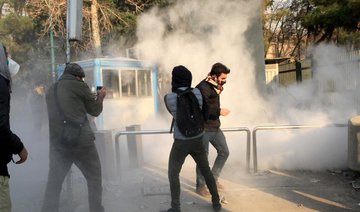
At least 22 people have been killed and more than a thousand have been arrested in clashes with security forces since the protests began on December 28.

Speaking to crowds at the rally, Nagmeh Rajabi, a member of the Anglo-Iranian Youth Association said: “We call on the UK government to strongly condemn the brutal crackdown by the Iranian regime and stand alongside those risking their lives for freedom.”

Mohamad Sulimani, 30, a supporter of the Anglo Iranian Youth Association said: “We are getting there after 40 years of struggle, but people are getting killed.

“Now is the time to stand up for the Iranian people.”

What began as a reaction to Iran’s faltering economy has quickly grown into the largest display of public discontent in the country since the 2009 Green Movement, with tens of thousands of protestors taking to the streets in cities across Iran to challenge the government.

Speaking to Arab News ahead of the rally in Westminster, Hossein Abedini, a member of the NCRI said: “The peaceful protests have been very brutally suppressed by the regime.”

“All of the European politicians, and especially those who have always said that they support human rights and democracy in Iran, should come out and strongly support the people of Iran in the protests.”

Philip Luther, Amnesty International’s Research and Advocacy Director for the Middle East and North Africa, said on Thursday: “Law enforcement officials have the right to defend themselves, and a duty to protect the safety of the public. However, reports of the use of firearms against unarmed protesters by security forces are deeply troubling and would contravene Iran’s human rights obligations under international law.”

“It is time for change and it is time for all Western leaders to wake up to the reality and stop tying their fate to a regime that has no future,” Jazayeri said.

“Years of silence against the violation of human rights, years of appeasement policy helped no one but the regime.”​


US makes plans to reopen embassy in Syria after 14 years

Updated 21 February 2026
Follow

US makes plans to reopen embassy in Syria after 14 years

  • The administration has been considering re-opening the embassy since last year
  • Trump told reporters on Friday that Al-Sharaa was “doing a phenomenal job” as president

WASHINGTON: The Trump administration has informed Congress that it intends to proceed with planning for a potential re-opening of the US Embassy in Damascus, Syria, which was shuttered in 2012 during the country’s civil war.
A notice to congressional committees earlier this month, which was obtained by The Associated Press, informed lawmakers of the State Department’s “intent to implement a phased approach to potentially resume embassy operations in Syria.”
The Feb. 10 notification said that spending on the plans would begin in 15 days, or next week, although there was no timeline offered for when they would be complete or when US personnel might return to Damascus on a full-time basis.
The administration has been considering re-opening the embassy since last year, shortly after longtime strongman Bashar Assad was ousted in December 2024, and it has been a priority for President Donald Trump’s ambassador to Turkiye and special envoy for Syria, Tom Barrack.
Barrack has pushed for a deep rapprochement with Syria and its new leadership under former rebel Ahmad Al-Sharaa and has successfully advocated for the lifting of US sanctions and a reintegration of Syria into the regional and international communities.
Trump told reporters on Friday that Al-Sharaa was “doing a phenomenal job” as president. “He’s a rough guy. He’s not a choir boy. A choir boy couldn’t do it,” Trump said. “But Syria’s coming together.”
Last May, Barrack visited Damascus and raised the US flag at the embassy compound, although the embassy was not yet re-opened.
The same day the congressional notification was sent, Barrack lauded Syria’s decision to participate in the coalition that is combating the Daesh militant group, even as the US military has withdrawn from a small, but important, base in the southeast and there remain significant issues between the government and the Kurdish minority.
“Regional solutions, shared responsibility. Syria’s participation in the D-Daesh Coalition meeting in Riyadh marks a new chapter in collective security,” Barrack said.
The embassy re-opening plans are classified and the State Department declined to comment on details beyond confirming that the congressional notification was sent.
However, the department has taken a similar “phased” approach in its plans to re-open the US Embassy in Caracas, Venezuela, following the US military operation that ousted former President Nicolás Maduro in January, with the deployment of temporary staffers who would live in and work out of interim facilities.