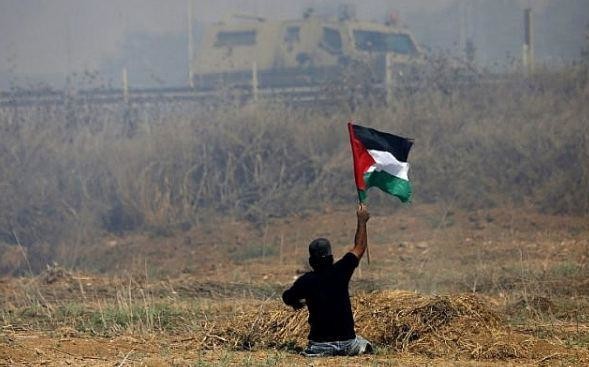
JERUSALEM: The Israeli military said on Thursday it would further investigate the death of a wheechair-bound Palestinian who was killed in clashes over US President Donald Trump’s recognition of Jerusalem as Israel’s capital.
The Dec. 15 death of Ibrahim Abu Thurayeh was denounced by the Palestinians and decried by UN High Commissioner for Human Rights Zeid Ra’ad Al-Hussein, who said the a 29-year-old amputee was shot in the head by Israeli troops close to the Gaza-Israel border fence.
The Israeli military said its own operational investigation, carried out shortly after the incident, had found that it was not possible to say what had killed Abu Thurayeh. It said no live fire had been directed at him during the dispersal of the demonstration, in which protesters hurled explosive devices and rocks and set tires alight.
“In order to further examine the case, including information received from organizations operating in the Gaza Strip, it was decided that the circumstances of Thurayeh’s death will also be examined by a Military Police investigation,” the army said in a statement.
Trump’s announcement on Jerusalem infuriated the Arab world and upset Western allies. It has sparked violent protests on a weekly basis along the Israel-Gaza border and in the occupied West Bank.
Abu Thurayeh was a regular at such demonstrations. In media interviews, he had said he had lost both his legs in a 2008 Israeli missile strike in Gaza.
The status of Jerusalem has been one of the biggest obstacles to a peace agreement between Israel and the Palestinians for generations.
Israel considers all of Jerusalem to be its capital. Palestinians want the eastern part of the city as the capital of a future independent state of their own.

Israeli military to probe death of disabled Palestinian in Gaza
Hoping for better year ahead, Gazans bid farewell to ‘nightmare’
- Humanitarian agencies have warned that shortages of food, clean water and medical supplies persist, while winter conditions are worsening life in overcrowded camps
GAZA CITY: As 2025 draws to a close, Palestinians in Gaza are marking the new year not with celebration, but with exhaustion, grief and a fragile hope that their “endless nightmare” might finally end.
For residents of the battered territory, daily life is a struggle for survival.
Much of Gaza’s infrastructure lies in ruins, electricity remains scarce and hundreds of thousands of people live in makeshift tents after being repeatedly displaced by the two years of fighting that began with Hamas’s attack on Israel in October 2023.
“We in the Gaza Strip are living in an endless nightmare,” said Hanaa Abu Amra, a displaced woman in her thirties living in Gaza City. “We hope that this nightmare will end in 2026 ... The least we can ask for is a normal life — to see electricity restored, the streets return to normal and to walk without tents lining the roads,” she said.
Across Gaza, a territory of more than 2 million people, scenes of hardship are commonplace.
The outgoing year brought relentless loss and fear, said Shireen Al-Kayali.
“We bid farewell to 2025 with deep sorrow and grief,” she said.
“We lost a lot of people and our possessions. We lived a difficult and harsh life, displaced from one city to another, under bombardment and in terror.”
Her experience reflects that of countless Gazans who have been forced to flee repeatedly, often with little warning, taking with them only what they could carry.
Entire families have been uprooted, livelihoods destroyed, and communities fragmented as the war dragged on for two years.
Despite the devastation, some residents cling to the belief that the new year might bring an end to the fighting and a chance to rebuild.
For many Gazans, hope has become an act of resilience, particularly after the truce that came into effect on October 10 and has largely halted the fighting.
“We still hope for a better life in the new year, and I call on the free world to help our oppressed people so we can regain our lives,” said Khaled Abdel Majid, 50, who lives in a tent in Jabalia camp.
Faten Al-Hindawi hoped the truce would finally end the war.
“We will bid farewell to 2025, leaving behind its pain, and we hope that 2026 will be a year of hope, prayer, determination and success stories.”