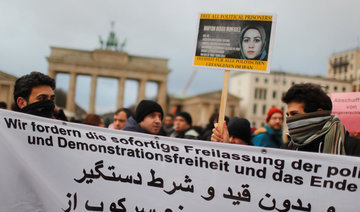
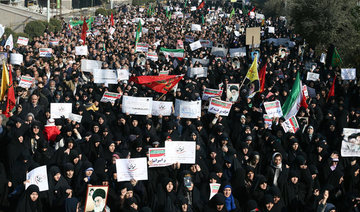
LONDON: Iranian opposition leaders in the UK are “disgusted” at the failure of British politicians, including Prime Minister Theresa May and Labour party leader Jeremy Corbyn to condemn regime brutality as the death toll continues to climb seven days after protests began in Iran.
“Both the prime minister and the opposition party here have stayed completely silent when Iranian youth are being slaughtered in the streets of Iran,” said Laila Jazayeri, director of the Association of Anglo-Iranian Women in the UK.
“It is outrageous and not acceptable.”
Anglo-Iranian communities will gather outside the prime minister’s residence at Downing Street on Thursday to call on May to break her silence.
“We want them to raise their voice of protest against the brutality of the regime against innocent, defenceless protestors and to support the demands of Iranian people for democratic regime change in Iran,” Jazayeri said.
Over the past seven days, government forces have been accused of excessive violence against protestors, with up to 30 people, including teenagers and children killed and more than 1,000 arrested during clashes across the country.
The protests began over economic grievances before turning into calls for the downfall of the regime, with chants of “death to the dictator” in a rallying cry against Supreme Leader Ayatollah Ali Khamenei.
Corbyn, who has previously praised Iran’s “tolerance and acceptance of other faiths, traditions and ethnic groupings in Iran,” and received payments of up to $20,000 for hosting phone-ins on Iranian state-owned broadcaster Press TV, has been criticized for failing to comment on the protests.
“Mr Corbyn, who himself has always said that he supports democracy and freedom…should start putting pressure on the British government to take a very very strong position. Unfortunately this is not happening,” Hossein Abedini of the National Council of Resistance of Iran.
Jazayeri said there are “thousands of Anglo-Iranians living in the UK who are disgusted by Corbyn’s complete silence … how can you stay silent when you can see women and children are being beaten to death?”
UK Foreign Secretary Boris Johnson called for freedom of expression in Iran in a post on Facebook.
“The UK is watching events in Iran closely. We believe that there should be meaningful debate about the legitimate and important issues the protesters are raising and we look to the Iranian authorities to permit this,” he wrote.
“We regret the loss of life that has occurred in the protests in Iran and call on all concerned to refrain from violence and for international obligations on human rights to be observed.”
Groups opposed to the Iranian regime in the UK expressed disappointment at Johnson’s “weak” response and the failure of other leading politicians to speak out.
“I think this is really shameful that some politicians are still quiet and haven’t made any statement in support of the Iranian people … saying that the people have the right to protest is not sufficient,” said Abedini.
“It’s clear that this regime is very strongly despised by the massive majority of the Iranian people.”
“The demonstrations have not stopped; it is gathering more momentum and the people have shown that they want nothing less than the downfall of the Iranian regime and the establishment of a democratic and free Iran.”

Iran opposition figures slam UK’s ‘shameful’ silence on protests
UN nuclear watchdog says it’s unable to verify whether Iran has suspended all uranium enrichment
VIENNA: Iran has not allowed the United Nations nuclear watchdog to access nuclear facilities affected by the 12-day war in June, according to a confidential report by the watchdog circulated to member states and seen Friday by The Associated Press.
The report from the International Atomic Energy Agency stressed that therefore it “cannot verify whether Iran has suspended all enrichment-related activities,” or the “size of Iran’s uranium stockpile at the affected nuclear facilities.”
The IAEA report on Friday warned that due to the continued lack of access to any of Iran’s four declared enrichment facilities, the agency “cannot provide any information on the current size, composition or whereabouts of the stockpile of enriched uranium in Iran.”
The report stressed that the “loss of continuity of knowledge over all previously declared nuclear material at affected facilities in Iran needs to be addressed with the utmost urgency.”
Iran long has insisted its program is peaceful, but the IAEA and Western nations say Tehran had an organized nuclear weapons program up until 2003.
Highly enriched material should be verified regularly
According to the IAEA, Iran maintains a stockpile of 440.9 kilograms (972 pounds) of uranium enriched up to 60 percent purity — a short, technical step away from weapons-grade levels of 90 percent.
That stockpile could allow Iran to build as many as 10 nuclear bombs, should it decide to weaponize its program, IAEA director general Rafael Grossi warned in a recent interview with the AP. He added that it doesn’t mean that Iran has such a weapon.
Such highly enriched nuclear material should normally be verified every month, according to the IAEA’s guidelines.
The IAEA also reported that it had observed, through the analysis of commercially available satellite imagery, “regular vehicular activity around the entrance to the tunnel complex at Isfahan.”
The facility in Isfahan, some 350 kilometers (215 miles) southeast of Tehran, was mainly known for producing the uranium gas that is fed into centrifuges to be spun and purified.
Israel has struck buildings at the Isfahan nuclear site, among them a uranium conversion facility. The US also struck Isfahan with missiles during the war last June.
The IAEA also reported that through the analysis of commercially available satellite imagery, it has observed “activities being conducted at some of the affected nuclear facilities, including the enrichment facilities at Natanz and Fordow,” but it added that “without access to these facilities it is not possible for the Agency to confirm the nature and the purpose of the activities.”
The confidential IAEA report also said Friday that Iran did provide access to IAEA inspectors “to each of the unaffected nuclear facilities at least once since the military attacks of June 2025, with the exception of Karun Nuclear Power Plan, which is in the early stages of construction and does not contain nuclear material.”
IAEA joined Geneva talks between Iran and US
The IAEA reported on Friday that Grossi attended negotiations between the US and Iran on Feb. 17 and Feb. 26 in Geneva at which he “provided advice on issues relevant to the verification of Iran’s nuclear program.” The report said that those negotiations are “ongoing.”
The Trump administration has held three rounds of nuclear talks this year with Iran under Omani mediation. Thursday’s round of talks in Geneva ended without a deal, leaving the danger of another Mideast war on the table as the US has gathered a massive fleet of aircraft and warships in the region.
Oman’s Foreign Minister Badr Al-Busaidi said technical talks involving lower-level representatives would continue next week in Vienna, the home of the IAEA. The agency is likely to be critical in any deal.
The US is seeking a deal to limit Iran’s nuclear program and ensure it does not develop nuclear weapons.
Iran says it is not pursuing weapons and has so far resisted demands that it halt uranium enrichment on its soil or hand over its stockpile of highly enriched uranium.
Similar talks last year between the US and Iran about Iran’s nuclear program broke down after Israel launched what became a 12-day war on Iran, that included the US bombing Iranian nuclear sites.
Before the June war, Iran had been enriching uranium up to 60 percent purity.
The report from the International Atomic Energy Agency stressed that therefore it “cannot verify whether Iran has suspended all enrichment-related activities,” or the “size of Iran’s uranium stockpile at the affected nuclear facilities.”
The IAEA report on Friday warned that due to the continued lack of access to any of Iran’s four declared enrichment facilities, the agency “cannot provide any information on the current size, composition or whereabouts of the stockpile of enriched uranium in Iran.”
The report stressed that the “loss of continuity of knowledge over all previously declared nuclear material at affected facilities in Iran needs to be addressed with the utmost urgency.”
Iran long has insisted its program is peaceful, but the IAEA and Western nations say Tehran had an organized nuclear weapons program up until 2003.
Highly enriched material should be verified regularly
According to the IAEA, Iran maintains a stockpile of 440.9 kilograms (972 pounds) of uranium enriched up to 60 percent purity — a short, technical step away from weapons-grade levels of 90 percent.
That stockpile could allow Iran to build as many as 10 nuclear bombs, should it decide to weaponize its program, IAEA director general Rafael Grossi warned in a recent interview with the AP. He added that it doesn’t mean that Iran has such a weapon.
Such highly enriched nuclear material should normally be verified every month, according to the IAEA’s guidelines.
The IAEA also reported that it had observed, through the analysis of commercially available satellite imagery, “regular vehicular activity around the entrance to the tunnel complex at Isfahan.”
The facility in Isfahan, some 350 kilometers (215 miles) southeast of Tehran, was mainly known for producing the uranium gas that is fed into centrifuges to be spun and purified.
Israel has struck buildings at the Isfahan nuclear site, among them a uranium conversion facility. The US also struck Isfahan with missiles during the war last June.
The IAEA also reported that through the analysis of commercially available satellite imagery, it has observed “activities being conducted at some of the affected nuclear facilities, including the enrichment facilities at Natanz and Fordow,” but it added that “without access to these facilities it is not possible for the Agency to confirm the nature and the purpose of the activities.”
The confidential IAEA report also said Friday that Iran did provide access to IAEA inspectors “to each of the unaffected nuclear facilities at least once since the military attacks of June 2025, with the exception of Karun Nuclear Power Plan, which is in the early stages of construction and does not contain nuclear material.”
IAEA joined Geneva talks between Iran and US
The IAEA reported on Friday that Grossi attended negotiations between the US and Iran on Feb. 17 and Feb. 26 in Geneva at which he “provided advice on issues relevant to the verification of Iran’s nuclear program.” The report said that those negotiations are “ongoing.”
The Trump administration has held three rounds of nuclear talks this year with Iran under Omani mediation. Thursday’s round of talks in Geneva ended without a deal, leaving the danger of another Mideast war on the table as the US has gathered a massive fleet of aircraft and warships in the region.
Oman’s Foreign Minister Badr Al-Busaidi said technical talks involving lower-level representatives would continue next week in Vienna, the home of the IAEA. The agency is likely to be critical in any deal.
The US is seeking a deal to limit Iran’s nuclear program and ensure it does not develop nuclear weapons.
Iran says it is not pursuing weapons and has so far resisted demands that it halt uranium enrichment on its soil or hand over its stockpile of highly enriched uranium.
Similar talks last year between the US and Iran about Iran’s nuclear program broke down after Israel launched what became a 12-day war on Iran, that included the US bombing Iranian nuclear sites.
Before the June war, Iran had been enriching uranium up to 60 percent purity.
© 2026 SAUDI RESEARCH & PUBLISHING COMPANY, All Rights Reserved And subject to Terms of Use Agreement.