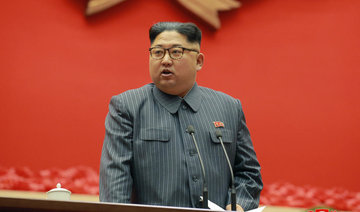
SEOUL: Kim Jong-Un urged North Korea to mass-produce nuclear warheads and missiles in a defiant New Year message Monday suggesting he would continue to accelerate a rogue weapons program that has stoked international tensions.
Pyongyang dramatically ramped up its efforts to become a nuclear power in 2017, despite a raft of international sanctions and increasingly bellicose rhetoric from the United States.
Kim, who said Monday that he always had a nuclear launch button on his desk, has presided over multiple missile tests in recent months and the North’s sixth and most powerful nuclear test — which it said was a hydrogen bomb — in September.
“We must mass-produce nuclear warheads and ballistic missiles and speed up their deployment,” said Kim in his annual address to the nation, reiterating his claims that North Korea had achieved its goal of becoming a nuclear state.
The North says its weapons program is designed to be able to target the US mainland and tested increasingly longer-range intercontinental ballistic missiles (ICBMs) throughout 2017.
US President Donald Trump has responded to each test with his own amplified declarations, threatening to “totally destroy” Pyongyang and taunting Kim, saying the North Korean leader was on “a suicide mission.”
But far from persuading Kim to give up his nuclear drive, analysts say Trump’s tough talk may have prompted the North Korean leader to drive through with his dangerous quest.
“(The North) can cope with any kind of nuclear threats from the US and has a strong nuclear deterrence that is able to prevent the US from playing with fire,” Kim said Monday.
“The nuclear button is always on my table. The US must realize this is not blackmail but reality.”
His comments come after a former top US military officer warned that the United States is now closer than it has ever been to a nuclear war with the North, with little hope of a diplomatic solution to the crisis.
Mike Mullen, a former chairman of the US joint chiefs of staff, said the Trump presidency had helped create “an incredibly dangerous climate,” in an interview on ABC’s “This Week.”
“We’re actually closer, in my view, to a nuclear war with North Korea and in that region than we have ever been,” he said.
Pyongyang claims it needs nuclear weapons to protect itself from a hostile US and sees American military activities in the region — such as the joint drills it takes part in with the South — as a precursor to invasion.
As tensions spiked in the region in recent months, the international community has slapped a range of sanctions on the North aimed at curbing its weapons program and squeezing the country’s leadership.
In December the United Nations Security Council unanimously passed new, US-drafted sanctions to restrict oil supplies vital for the impoverished state.
The third raft of sanctions imposed last year, which the North slammed as an “act of war,” also received the backing of China — the North’s sole major ally and economic lifeline.
But the embargoes have shown little sign of dampening Kim’s enthusiasm for his weapons drive.
Observers say Washington must open talks with the North to defuse tensions — but that remains a challenge.
The North has always said it will only deal with the US from a position of equality as a nuclear state.
Washington has long insisted that it will not accept a nuclear-armed North and Pyongyang must embark on a path toward denuclearization before any talks.