LONDON: Iran warned of a tough crackdown on Sunday against demonstrators who pose one of the most audacious challenges to its clerical leadership since nationwide pro-reform unrest jolted the theocracy in 2009.
Tens of thousands of people have protested across the country since Thursday against the country’s unelected clerical elite and Iranian foreign policy in the region. They have also chanted slogans in support of political prisoners.
Demonstrators initially vented their anger over economic hardships and alleged corruption but they have also begun to call on Supreme Leader Ayatollah Ali Khamenei to step down.
The government said it would temporarily restrict access to the Telegram and Instagram messaging apps, state television quoted an informed source as saying.
Deep level of anger
An Iranian reached by telephone, who asked not to be named, said there was a heavy presence of police and security forces in central Tehran.
“I saw a few young men being arrested and put into police van. They don’t let anyone assemble,” he said.
Video from earlier days posted on social media showed people chanting: “Mullahs, have some shame, leave the country alone.”
The demonstrators also shouted: “Reza Shah, bless your soul.” Such calls are evidence of a deep level of anger and break a taboo. The king ruled Iran from 1925 to 1941 and his Pahlavi dynasty was overthrown in a revolution in 1979 by Ayatollah Ruhollah Khomeini.
The protests are the biggest since unrest in 2009 that followed the disputed re-election of then-President Mahmoud Ahmadinejad.
Demonstrators denounce high prices, corruption and mismanagement. Unemployment stood at 12.4 percent in this fiscal year, up 1.4 percent from the previous year. About 3.2 million Iranians are jobless, out of a total population of 80 million.
The demonstrations are particularly troublesome for President Hassan Rouhani’s government because he was elected on a promise to guarantee rights to freedom of expression and assembly.
His main achievement is a deal in 2015 with world powers that curbed Iran’s nuclear program in return for a lifting of most international sanctions. But it is yet to bring the economic benefits the government promised.
“Those who damage public property, violate law and order and create unrest are responsible for their actions and should pay the price,” state media quoted Interior Minister Abdolreza Rahmani Fazli as saying.
Ali Asghar Naserbakht, deputy governor of Tehran province, was quoted as saying by Tasnim news agency that some protesters had been arrested on Saturday.
Social media videos
Videos posted on social media showed families gathering in front of Evin Prison in Tehran, asking for information about relatives arrested in recent days.
Tehran prosecutor Abbas Jafari Dolatabadi said some of the arrested protesters have confessed “they were carried away by emotions and set fire to mosques and public buildings” and said they will face heavy punishment for the crimes.
“After giving thousands of martyrs for the revolution, the nation will not return to dark era of Pahlavi rule,” he said.
Protests appear spontaneous
Protesters defied the police and Revolutionary Guards who have used violence to crush previous unrest. The demonstrations could be more worrying for authorities because they seem spontaneous and lack a clear leader.
No political party had urged Iranians to take to the streets and opposition leaders who galvanized Iranians during 2009 are under house arrest. In addition, the range of slogans suggests discontent across social classes with government policies.
Iran has a dual system of clerical and republican rule, in which each faction vies for control. The supreme leader rules for life and is commander-in-chief of the armed forces. He also appoints the head of the judiciary and, in all, has more power over foreign and economic policy than the elected president.
Analysts say Iran’s leaders believe they can count on the support of many from a generation that took part as youths in the 1979 revolution and the ensuing eight-year war with Iraq to continue to defend the religious system, despite their advancing age, because of their ideological commitment and the economic gains they have made under the government.
In apparent response to the protests, the government backed down on plans to raise fuel prices, promised to increase cash handouts to the poor and create more jobs in coming years.
“We predict that at least 830,000 jobs will be created in the new year,” government spokesman Mohammed Baqer Nobakht said. He gave no details. Around 3.2 million Iranians are jobless.
Costly interventions in Syria, Iraq rapped
Iranians also expressed anger over their country’s costly interventions in Syria and Iraq.
Videos on social media showed protesters in the city of Shiraz tearing down a banner of Qassem Soleimani, the powerful head of the Quds Force, the branch of the Iranian Revolutionary Guards’ that overseas operations in Iraq, Syria and elsewhere.
The US condemned the scores of arrests of protesters reported by Iranian media.
Trump’s tweets
President Donald Trump tweeted: “The people are finally getting wise as to how their money and wealth is being stolen and squandered on terrorism. Looks like they will not take it any longer. The USA is watching very closely for human rights violations!“
Trump refused in October to certify that Tehran is complying with its 2015 nuclear deal and said he might terminate the agreement. He also detailed a more aggressive approach to Iran over its nuclear and ballistic missile programs and its support for militant groups.
Haley’s statement
Nikki Haley, the US ambassador to the UN, said Iran’s government is “being tested by its own citizens.”
“We pray that freedom and human rights will carry the day,” she said in a statement. “The long-repressed Iranian people are now finding their voice,” she said.
Canadian praise
Canada said it was encouraged by the protests. The country suspended diplomatic relations with Iran in 2012 and called Tehran the biggest threat to global security.
Iranian Foreign Ministry spokesman Bahram Qasemi was quoted as saying by state media that “Canada’s intervention in Iranian affairs is a violation of international conventions.”
British remarks
British Foreign Secretary Boris Johnson on his Twitter page that it was “vital that citizens should have the right to demonstrate peacefully.”
Protesters have attacked banks and government buildings and burned police vehicles. Two demonstrators were shot dead in the western town of Dorud on Saturday night.
Ahmad Khatami, a cleric who leads Friday prayers in Tehran, called for capital punishment for those chanting slogans against the values of the country.


![]()
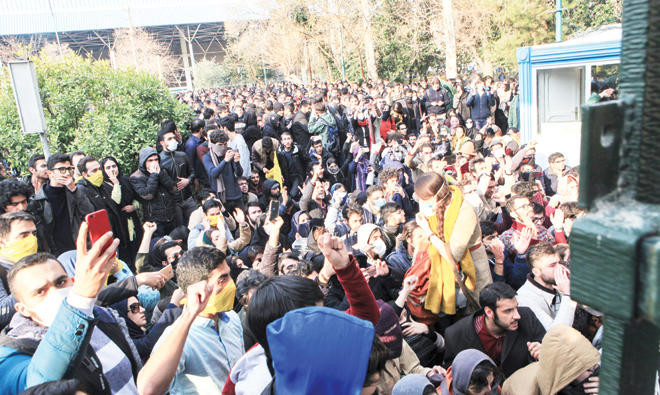
Iran warns protesters against pursuing bold challenge to leadership
Iran warns protesters against pursuing bold challenge to leadership


Latest updates


Recommended


© 2026 SAUDI RESEARCH & PUBLISHING COMPANY, All Rights Reserved And subject to Terms of Use Agreement.