DUBAI: A top cleric in Iran’s second largest city of Mashhad called for tough action by security forces after hundreds of people took to the streets to protest against high prices and shouted anti-government slogans, state news agency IRNA said on Friday.
Police arrested 52 people in Thursday’s protests, the semi-official Fars news agency quoted a judicial official as saying in Mashhad, one of the holiest places in Shiite Islam.
Political protests are rare in Iran. But demonstrations are often held by workers over layoffs or non-payment of salaries and people who hold deposits in non-regulated bankrupt financial institutions.
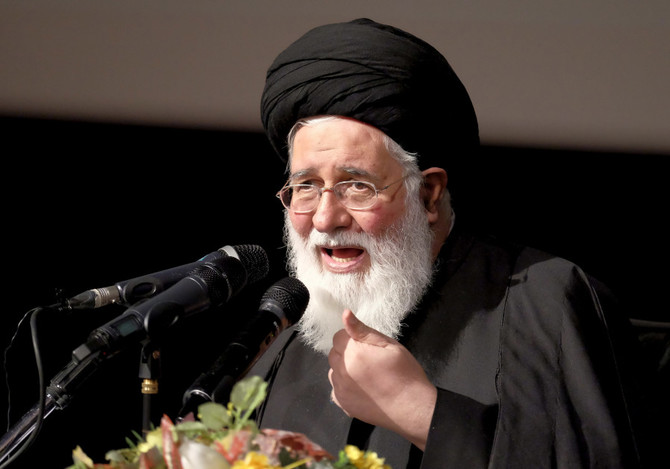
“If the security and law enforcement agencies leave the rioters to themselves, enemies will publish films and pictures in their media and say that the Islamic Republic system has lost its revolutionary base in Mashhad,” IRNA quoted prominent conservative cleric Ayatollah Ahmad Alamolhoda as saying.
Videos posted on social media showed demonstrators chanting “Death to (President Hassan) Rouhani” and “Death to the dictator.” Protests were also held in at least two other northeastern cities.
Alamolhoda, the representative of Supreme Leader Ayatollah Ali Khamenei in northeastern Mashhad, said a few people had taken advantage of Thursday’s protests against rising prices to raise slogans against Iran’s involvement in regional conflicts.
“Some people had came to express their demands, but suddenly, in a crowd of hundreds, a small group that did not exceed 50, shouted deviant and horrendous slogans such as ‘Let go of Palestine’, ‘Not Gaza, not Lebanon, I’d give my life for Iran’,” Alamolhoda said.
Videos on social media also showed demonstrators chanting “Leave Syria, think about us”, criticizing Iran’s military and financial support for President Bashar Assad who is fighting opponents of the government in Syria’s six-year-old civil war.
Vice President Eshaq Jahangiri, a close Rouhani ally, suggested that hard-line opponents of the president may have started the protests.
“When a social and political movement is launched on the streets, those who started it will not necessarily be able to control it in the end,” IRNA quoted Jahangiri as saying. “Those who are behind such events will burn their own fingers. They think they will hurt the government by doing so.”
Rouhani’s signature achievement, a deal in 2015 with world powers to curb Iran’s nuclear program in return for lifting most international sanctions, has yet to bring the broad economic benefits the government says are coming.
Unemployment stood at 12.4 percent in this fiscal year, according to the Statistical Center of Iran, up 1.4 percent from the previous year. About 3.2 million Iranians are jobless, out of a total population of 80 million.
Mashhad governor Mohammad Rahim Norouzian was quoted by the semi-official ISNA news agency as saying that “the demonstration was illegal but the police dealt with people with tolerance.”
Videos posted on social media showed riot police using water cannon and tear gas to disperse crowds.
Norouzian was quoted as saying by state news agency IRNA that the protests were organized by “enemies of the Islamic Republic” and “counter-revolutionaries.”
Political protests of national significance took place most recently in 2009 when Mahmoud Amadinejad’s re-election as president ignited an eight-month firestorm of street demonstrations. His pro-reform rivals said the vote was rigged.


![]()
Iran cleric urges tough action after price protests turn political
Iran cleric urges tough action after price protests turn political
Latest updates



© 2026 SAUDI RESEARCH & PUBLISHING COMPANY, All Rights Reserved And subject to Terms of Use Agreement.