COX’S BAZAR: Health workers in Rohingya refugee camps in Bangladesh are struggling with a shortage of medics able to administer antitoxins to patients infected with diphtheria that has killed nearly two dozen people, aid officials said.
Neighboring Myanmar’s military cracked down on Muslim Rohingya from Rakhine state following Rohingya militant attacks on an army base and police posts on Aug. 25. More than 650,000 Rohingya have fled mainly Buddhist Myanmar to Bangladesh since August, on top of more than 200,000 who fled earlier, according to latest UN data.
Doctors Without Borders (MSF), the lead agency dealing with an outbreak of the bacterial disease in camps sheltering the Rohingya, has treated around 2,000 patients in the past few weeks and is receiving around 100 new cases daily.
The World Health Organization (WHO) describes diphtheria as a widespread, severe infectious disease with epidemic potential and a mortality rate of up to 10 percent. MSF has called diphtheria a disease “long forgotten in most parts of the world thanks to increasing rates of vaccination.”
MSF has managed to provide antitoxins to only around 12 patients daily due to the lack of trained medics, said Crystal van Leeuwen, an MSF emergency medical coordinator now in Cox’s Bazar where the refugee camps are located.
“Once we do have enough people and other organizations start to administer as well, we may get into a situation where we don’t have enough antitoxins anymore,” she told Reuters by phone on Thursday.
“It’s a double-edged sword. We need both the human resources to administer it, and we need more antitoxins at the same time.”
According to a UN report in February, supply of diphtheria antitoxin serum has been limited for many years and the shortage is expected to continue through 2017.
The British government said on Thursday it was sending a team of more than 40 doctors, nurses and firefighters to Cox’s Bazar for six weeks to deal with the diphtheria outbreak following a request by the WHO and Bangladesh government.
The refugees live in densely populated camps and shacks made from bamboo and plastic sheets, with poor access to clean water, sanitation and health services.


![]()
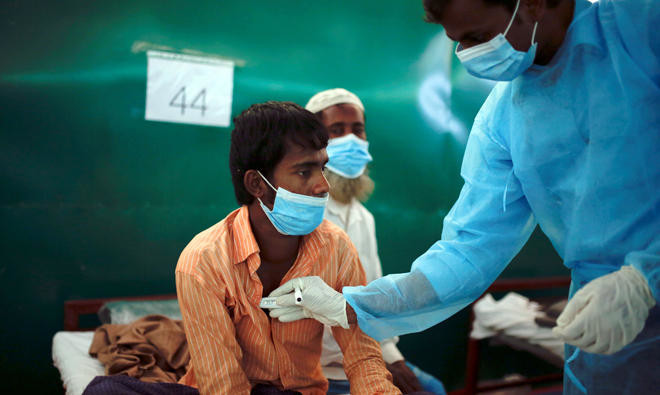

Rohingya at risk of deadly diphtheria, face shortage of medics, antitoxins
Rohingya at risk of deadly diphtheria, face shortage of medics, antitoxins
China raises defense budget by 7 percent for 2026: official report
BEIJING: China said on Thursday its defense budget, the world’s second largest after the United States, will increase by seven percent in 2026, in line with expectations but slightly below last year’s.
Beijing plans to spend 1.9096 trillion yuan ($276.8 billion) on defense — around three times less than the US military budget.
The increase in military spending for the year was announced in a finance ministry budget report that was published on the sidelines of the annual “Two Sessions” political conclave.
It marks a degree of continuity as Beijing pursues a sweeping anti-graft purge of the People’s Liberation Army (PLA) that included the ousting of top general Zhang Youxia in January.
Analysts told AFP the budget would finance military salary increases, training, drills around Taiwan, cyberwarfare capabilities and advanced equipment purchases, among other things.
China has maintained a steady increase in military spending of around seven to eight percent each year since 2016.
The United States is the world’s biggest military spender, shelling out $997 billion in 2024 compared with China’s $314 billion, according to the Stockholm International Peace Research Institute (SIPRI).
China claims its defense policy is solely aimed at protecting its territory, which it says includes self-ruled Taiwan.
It has only one military base abroad, in Djibouti, in contrast to the several hundred held by the United States.
However, China’s military buildup is fueling an arms race in Asia and prompting some countries, particularly those with territorial disputes with China, to draw closer to Washington.
Beijing plans to spend 1.9096 trillion yuan ($276.8 billion) on defense — around three times less than the US military budget.
The increase in military spending for the year was announced in a finance ministry budget report that was published on the sidelines of the annual “Two Sessions” political conclave.
It marks a degree of continuity as Beijing pursues a sweeping anti-graft purge of the People’s Liberation Army (PLA) that included the ousting of top general Zhang Youxia in January.
Analysts told AFP the budget would finance military salary increases, training, drills around Taiwan, cyberwarfare capabilities and advanced equipment purchases, among other things.
China has maintained a steady increase in military spending of around seven to eight percent each year since 2016.
The United States is the world’s biggest military spender, shelling out $997 billion in 2024 compared with China’s $314 billion, according to the Stockholm International Peace Research Institute (SIPRI).
China claims its defense policy is solely aimed at protecting its territory, which it says includes self-ruled Taiwan.
It has only one military base abroad, in Djibouti, in contrast to the several hundred held by the United States.
However, China’s military buildup is fueling an arms race in Asia and prompting some countries, particularly those with territorial disputes with China, to draw closer to Washington.
Latest updates


© 2026 SAUDI RESEARCH & PUBLISHING COMPANY, All Rights Reserved And subject to Terms of Use Agreement.