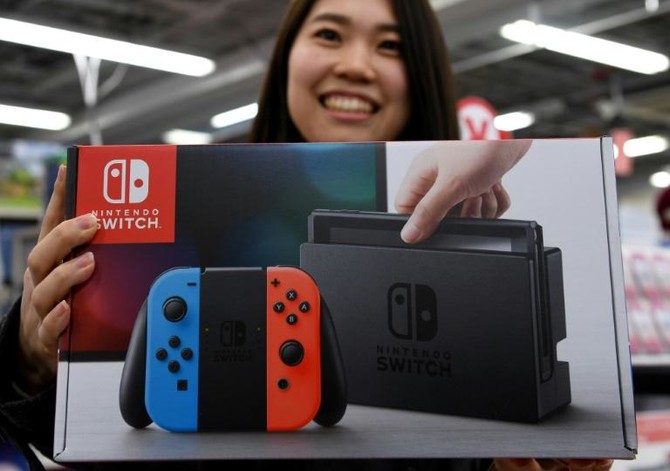
TOKYO: Nintendo is expecting to sell more than 20 million of its new “Switch” consoles in the next fiscal year, the firm’s president said, with sales outpacing its smash-hit Wii console in some places.
Tatsumi Kimishima told Thursday’s Kyoto Shimbun newspaper that the momentum for Switch is stronger in some markets than that of the Wii, a smash-hit household console that sold more than 100 million units worldwide.
Kimishima said he expected Switch to sell “more than 20 million” units in the year to March 2019.
Nintendo launched the console in March 2017 with a price tag of $300 (SR1,125) and aims to sell 14 million units through March 2018.
Switch can be played both as a household console as well as a hand-held device.
It has flown off the shelves and also sold well online, sparking an upgrade in the Kyoto-based company’s annual profit forecast.
“We are seeing momentum beyond our expectations,” Kimishima told the Kyoto Shimbun.
“People have accepted the unique game experience that you cannot find anywhere else, where you can take it outside while also using it as a household console,” he said.
“In some countries, the pace is beyond what we saw with Wii,” he said.
In a separate interview with the Asahi Shimbun, Kimishima said holiday sales had been in line with expectations.
He also said the company was “starting to think” what console would come after the Switch.

Nintendo expects to sell 20 million Switch gaming consoles
Saudi Arabia leads GCC markets in January: Kamco Invest
- Saudi exchange records its biggest monthly climb in five years
RIYADH: Saudi Arabia led Gulf equity gains in January as regional markets outperformed most global benchmarks, buoyed by earnings optimism and strong non-oil growth expectations, according to an analysis.
In its latest report, Kamco Invest said Saudi Arabia’s exchange recorded a monthly gain of 8.5 percent in January, marking its biggest climb in five years.
The strong performance across most regional exchanges came as Gulf Cooperation Council equity markets continue to attract global capital, supported by solid corporate earnings and ongoing economic reforms.
“The benchmark Tadawul All Share Index closed at 11,382.08 points, up 8.5 percent, marking its strongest monthly performance since February 2022,” said Kamco Invest.
It added: “The rally was driven by optimism surrounding earnings in the fourth quarter of 2025, the anticipated opening of the market to foreign investors, and the robust non-oil growth prospects.”
In January, Saudi Arabia’s Capital Market Authority announced that the Kingdom’s stock market would open to all categories of foreign investors from Feb. 1, allowing direct investment in the main market.
To facilitate foreign participation, the CMA introduced several changes, including removing the Qualified Foreign Investor framework — which required a minimum of $500 million in assets under management — and abolishing swap agreements.
The monthly performance chart in Saudi Arabia was led by Almasane Alkobra Mining Co., which rose 32.7 percent, followed by Saudi Arabian Mining Co. and Tourism Enterprise Co., which gained 26.8 percent and 23.4 percent, respectively.
Total trading volume on the Saudi exchange reached 4.9 billion shares in January, representing a 43.3 percent increase from December.
The value of trading stood at SR99.9 billion ($26.63 billion), up 36.2 percent month on month.
According to Kamco Invest, Oman’s exchange rose 7.9 percent, followed by Dubai at 6.4 percent.
Boursa Kuwait posted the biggest decline in January at 3.8 percent, while Bahrain edged down 1.1 percent.
“The MSCI GCC index witnessed one of the strongest monthly performances globally with a monthly gain of 7.8 percent during January 2026, the biggest in almost six years since April 2020. The index closed the month at 791.8 points, the highest monthly close in almost 3.5 years,” said Kamco Invest.
It added: “The rally was consistent with the broader rally in global Emerging Market indices led by double-digit gains in Korea, Taiwan and Brazil, reflecting strong buying in technology stocks.”
At the global level, emerging markets outperformed advanced economies, with the MSCI Emerging Market index rising 8.8 percent.
Markets in the US and Europe remained volatile due to geopolitical tensions and tariff concerns, but staged a late-month rally after sharp declines in the third week, closing January with low single-digit gains.