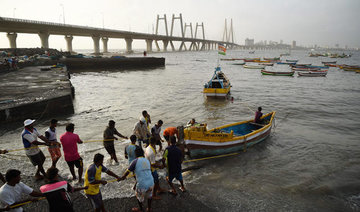
NEW DELHI: More than 660 fisherman remain missing one month after a deadly cyclone battered India’s south coast and parts of neighboring Sri Lanka, Indian authorities said Wednesday.
Cyclone Ockhi has already left a confirmed death toll of more than 250 people from its rampage that started on November 29 in Sri Lanka, where 27 of the dead were reported.
Winds of up to 130 kilometers (80 miles) per hour uprooted trees and damaged electricity and telephone infrastructure as well as tens of thousands of homes.
India’s Defense Minister Nirmala Sitharaman told parliament that 661 fishermen were still missing but did not say whether they were presumed dead.
Four hundred were from Tamil Nadu state and another 261 from Kerala.
She said the military and other services had rescued about 845 people up to Dec. 20.
Hundreds of fishermen in mostly rudimentary boats were caught in the deadly cyclone that emerged in the Bay of Bengal and swept over Sri Lanka and south India before entering the Arabian Sea.
There have been allegations that insufficient warnings were given to fishermen. Relatives of the missing have accused the authorities of not doing enough to find those still unaccounted for.
India’s east coast, including major cities like Chennai, is prone to storms that strike each year between April and December. In 1999 more than 8,000 people were killed when a cyclone battered the eastern state of Orissa.

India says more than 660 missing one month after deadly cyclone
Top Australian writers’ festival canceled after Palestinian author barred
- 180 authors boycotted the event and its director resigned after a Palestinian author was disinvited
SYDNEY: One of Australia’s top writers’ festivals was canceled on Tuesday, after 180 authors boycotted the event and its director resigned saying she could not be party to silencing a Palestinian author and warned moves to ban protests and slogans after the Bondi Beach mass shooting threatened free speech.
Louise Adler, the Jewish daughter of Holocaust survivors, said on Tuesday she was quitting her role at the Adelaide Writers’ Week in February, following a decision by the festival’s board to disinvite a Palestinian-Australian author.
The novelist and academic Randa Abdel-Fattah said the move to bar her was “a blatant and shameless act of anti-Palestinian racism and censorship.”
Prime Minister Anthony Albanese on Tuesday announced a national day of mourning would be held on January 22 to remember the 15 people killed in last month’s shooting at a Jewish Hanukkah celebration on Bondi Beach.
Police say the alleged gunmen were inspired by the Islamic State militant group, and the incident sparked nationwide calls to tackle antisemitism, and prompted state and federal government moves to tighten hate speech laws.
The Adelaide Festival board said on Tuesday its decision last week to disinvite Abdel-Fattah, on the grounds it would not be culturally sensitive for her to appear at the literary event “so soon after Bondi,” was made “out of respect for a community experiencing the pain from a devastating event.”
“Instead, this decision has created more division and for that we express our sincere apologies,” the board said in a statement.
The event would not go ahead and remaining board members will step down, it added.
Former New Zealand Prime Minister Jacinda Ardern, British author Zadie Smith, Australian author Kathy Lette, Pulitzer Prize-winning American Percival Everett and former Greek finance minister Yanis Varoufakis are among the authors who said they would no longer appear at the festival in South Australia state, Australian media reported.
The festival board on Tuesday apologized to Abdel-Fattah for “how the decision was represented.”
“This is not about identity or dissent but rather a continuing rapid shift in the national discourse around the breadth of freedom of expression in our nation following Australia’s worst terror attack in history,” it added.
Abdel-Fattah wrote on social media that she did not accept the apology, saying she had nothing to do with the Bondi attack, “nor did any Palestinian.”
Adler earlier wrote in The Guardian that the board’s decision to disinvite Abdel-Fattah “weakens freedom of speech and is the harbinger of a less free nation, where lobbying and political pressure determine who gets to speak and who doesn’t.”
The South Australian state government has appointed a new festival board.