Medical evacuations begin from besieged Syria rebel bastion

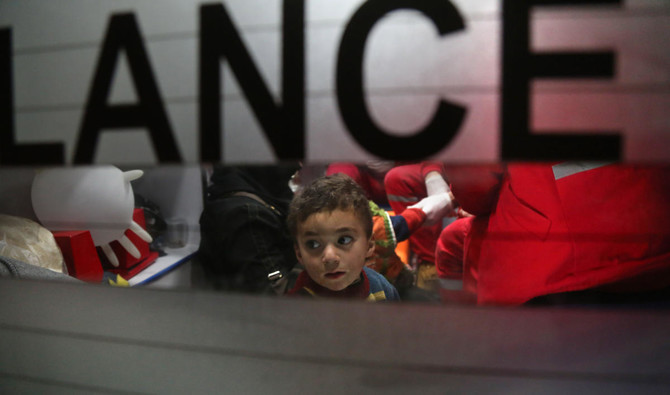
A Syrian child sits in an ambulance during an evacuation operation by the International Committee of the Red Cross in Douma in the eastern Ghouta region on the outskirts of the capital Damascus late on December 26, 2017. Aid workers have begun evacuating emergency medical cases from Syria's besieged rebel bastion of Eastern Ghouta, the International Committee of the Red Cross said, after months of waiting during which the UN said at least 16 people had died. Eastern Ghouta is one of the last remaining rebel strongholds in Syria and has been under a tight government siege since 2013, causing severe food and medical shortages for some 400,000 residents. (AFP)
Updated 27 December 2017
Follow

Medical evacuations begin from besieged Syria rebel bastion

DOUMA, Syria: Aid workers have begun evacuating emergency medical cases from Syria’s besieged rebel bastion of Eastern Ghouta, the Red Cross said on Wednesday, after months of waiting during which the United Nations said at least 16 people died.
Families waited in the darkness in the rebel-held town of Douma for their loved ones to board ambulances bound for hospitals in the capital Damascus.
Under a deal with the government, five workmen detained by the rebels during fierce clashes with the army in March were released in exchange.
Three children were among the first four patients to leave, Red Crescent official Ahmed Al-Saour told AFP.
He said in total 29 seriously ill people were due to be evacuated.
The first four were a girl with haemophilia, a baby with the autoimmune disorder Guillain-Barre, a child with leukaemia, and a man in need of a kidney transplant, he said.
Eight-year-old Ingy, the girl with haemophilia, gave a broad smile as she boarded an ambulance, wearing a woolly hat and gloves against the cold.
In another ambulance, one-year-old Mohammed lay in the lap of a Red Crescent worker, his mother sitting beside them in a long black cloak and a veil showing only her eyes.
“Tonight the @SYRedCrescent with @ICRC team started the evacuation of critical medical cases from #EasternGhouta to #Damascus,” the International Committee of the Red Cross said on its Twitter account.
The Syrian American Medical Society, another medical relief organization, said the evacuations covered “29 critical cases, approved for medical evacuation to Damascus. Four patients were evacuated today.”
It said the remainder would be evacuated in the coming days.
The dominant rebel faction in Eastern Ghouta, Jaish Al-Islam (Army of Islam), said the rebels had agreed to free some of their prisoners in return for the evacuations.
“We have agreed to the release of a number of prisoners... in exchange for the evacuation of the most urgent humanitarian cases,” the group said a statement.

Eastern Ghouta is one of the last remaining rebel strongholds in Syria and has been under a tight government siege since 2013, causing severe food and medical shortages for its nearly 400,000 residents.
While some food is still grown locally, or smuggled in, humanitarian access to the region has been limited despite regular appeals from aid agencies.
Last week, Jan Egeland, the head of the UN’s humanitarian taskforce for Syria, warned that at least 16 people had died while waiting for evacuation from Eastern Ghouta.
He said a list put together several months ago of nearly 500 civilians in desperate need of evacuation was rapidly shrinking.
“That number is going down, not because we are evacuating people, but because they are dying,” he told reporters in Geneva.
“We have confirmation of 16 having died on these lists since they were resubmitted in November, and it is probably higher,” he said, highlighting the case of a baby who died on December 14, as the latest round of Syria peace talks in Geneva ended in failure.
Egeland said evacuations and efforts to bring aid into the region had been blocked by a lack of authorizations from the Syrian authorities.
The Eastern Ghouta region, near the capital Damascus, is one of the last strongholds of rebels fighting the forces of President Bashar Assad.
It is one of four “de-escalation” zones agreed in May in a deal brokered by government backers Russian and Iran and rebel supporter Turkey.
The agreement led to some reduction in fighting but the government kept up its blockade and renewed its bombardment of the enclave in mid-November.
The government stands accused by its critics of using sieges of civilians as a weapon in its war against the rebels.
Rebel fighters pulled out of second city Aleppo and third city Homs, as well as districts of Damascus, only after prolonged blockades caused serious hardship to their families and other civilians.
More than 340,000 people have been killed and millions have been driven from their homes since Syria’s conflict erupted with anti-government protests in 2011.
Israel confirms ban on 37 NGOs in Gaza

A Palestinian woman carries wood for fire in the Nuseirat refugee camp in the central Gaza Strip on December 31, 2025. (AFP)
Updated 54 min 36 sec ago
Follow

Israel confirms ban on 37 NGOs in Gaza

  • UN has warned that this will exacerbate the humanitarian crisis in the war-ravaged Palestinian territory
  • Several NGOS have said the requirements contravene international humanitarian law or endanger their independence

JERUSALEM: Israel on Thursday said 37 humanitarian agencies supplying aid in Gaza had not met a deadline to meet “security and transparency standards,” and would be banned from the territory, despite an international outcry.
The international NGOs, which had been ordered to disclose detailed information on their Palestinian staff, will now be required to cease operations by March 1.
The United Nations has warned that this will exacerbate the humanitarian crisis in the war-ravaged Palestinian territory.
“Organizations that have failed to meet required security and transparency standards will have their licenses suspended,” Israel’s Ministry of Diaspora Affairs and Combating Antisemitism said in a statement.
Several NGOS have said the requirements contravene international humanitarian law or endanger their independence.
Israel says the new regulation aims to prevent bodies it accuses of supporting terrorism from operating in the Palestinian territories.
Prominent humanitarian organizations hit by the ban include Doctors Without Borders (MSF), the Norwegian Refugee Council (NRC), World Vision International and Oxfam, according to a ministry list.
In MSF’s case, Israel accused it of having two employees who were members of Palestinian militant groups Islamic Jihad and Hamas.
MSF said this week the request to share a list of its staff “may be in violation of Israel’s obligations under international humanitarian law” and said it “would never knowingly employ people engaging in military activity.”
‘Critical requirement’ 
NRC spokesperson Shaina Low told AFP its local staff are “exhausted” and international staff “bring them an extra layer of help and security. Their presence is a protection.”
Submitting the names of local staff is “not negotiable,” she said. “We offered alternatives, they refused,” hse said, of the Israeli regulators.
The ministry said Thursday: “The primary failure identified was the refusal to provide complete and verifiable information regarding their employees, a critical requirement designed to prevent the infiltration of terrorist operatives into humanitarian structures.”
In March, Israel gave NGOs 10 months to comply with the new rules, which demand the “full disclosure of personnel, funding sources, and operational structures.”
The deadline expired on Wednesday.
The 37 NGOs “were formally notified that their licenses would be revoked as of January 1, 2026, and that they must complete the cessation of their activities by March 1, 2026,” the ministry said Thursday.
A ministry spokesperson told AFP that following the revocation of their licenses, aid groups could no longer bring assistance into Gaza from Thursday.
However, they could have their licenses reinstated if they submitted the required documents before March 1.
Minister of Diaspora Affairs and Combating Antisemitism Amichai Chikli said “the message is clear: humanitarian assistance is welcome — the exploitation of humanitarian frameworks for terrorism is not.”
‘Weaponization of bureaucracy’
On Thursday, 18 Israel-based left-wing NGOs denounced the decision to ban their international peers, saying “the new registration framework violates core humanitarian principles of independence and neutrality.”
“This weaponization of bureaucracy institutionalizes barriers to aid and forces vital organizations to suspend operations,” they said.
UN Palestinian refugee agency chief Philippe Lazzarini had said the move sets a “dangerous precedent.”
“Failing to push back against attempts to control the work of aid organizations will further undermine the basic humanitarian principles of neutrality, independence, impartiality and humanity underpinning aid work across the world,” he said on X.
On Tuesday, the foreign ministers of 10 countries, including France and Britain, urged Israel to “guarantee access” to aid in the Gaza Strip, where they said the humanitarian situation remains “catastrophic.”
A fragile ceasefire has been in place since October, following a deadly war waged by Israel in response to Hamas’s unprecedented October 7, 2023 attack on Israel.
Nearly 80 percent of buildings in Gaza have been destroyed or damaged by the war, according to UN data.
About 1.5 million of Gaza’s more than two million residents have lost their homes, said Amjad Al-Shawa, director of the Palestinian NGO Network in Gaza.