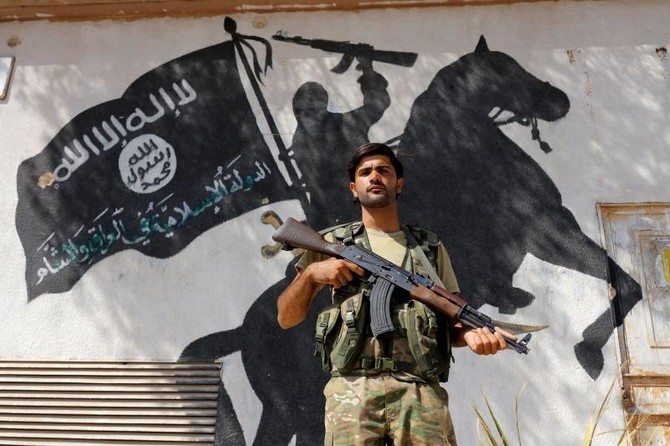
BAGHDAD: Fewer than 1,000 Daesh fighters remain in Iraq and Syria, the US-led international coalition fighting the hard-line militant group said on Wednesday, a third of the estimated figure only three weeks ago.
Iraq and Syria have both declared victory over Daesh in recent weeks, after a year that saw the two countries’ armies, a range of foreign allies and various local forces drive the fighters out of all the towns and villages that once made up their self-proclaimed caliphate.
The US has led an international coalition conducting air strikes against Daesh since 2014 when the group swept across a third of Iraq. US troops have served as advisers on the ground with Iraqi government forces and with Kurdish and Arab groups in Syria.
“Due to the commitment of the Coalition and the demonstrated competence of our partners in Iraq and Syria, there are estimated to be less than 1,000 ISIS terrorists in our combined joint area of operations, most of whom are being hunted down in the desert regions in eastern Syria and Western Iraq,” the US-led coalition told Reuters in an emailed statement.
ISIS is an acronym used for Daesh.
The figure excludes areas in western Syria under the control of President Bashar Assad’s government and his allies.
Assad’s main ally Russia also said on Wednesday the main battle with Daesh in Syria was over. Foreign Minister Sergei Lavrov said the key task in Syria was now destroying another Islamist group, the Nusra Front.
The US-led coalition had said on December 5 that there were less than 3,000 fighters remaining. Iraq declared “final victory” over the group on December 9.
Most of the fighters had been killed or captured over the past three years, the coalition said on Wednesday. It would not respond to a question on whether some fighters could have escaped to other countries, saying it would not “engage in public speculation” but said it was working on preventing that.
“We can tell you that we are working with our partners to kill or capture all remaining ISIS terrorists, to destroy their network and prevent their resurgence, and also to prevent them from escaping to bordering countries,” it said.

Less than 1,000 Daesh fighters remain in Iraq and Syria, US-led coalition says
Fledgling radio station aims to be ‘voice of the people’ in Gaza
- The electricity crisis is one of the most serious and difficult problems in the Gaza Strip, says Shereen Khalifa Broadcaster
DEIR EL-BALAH: From a small studio in the central city of Deir El-Balah, Sylvia Hassan’s voice echoes across the Gaza Strip, broadcast on one of the Palestinian territory’s first radio stations to hit the airwaves after two years of war.
Hassan, a radio host on fledgling station “Here Gaza,” delivers her broadcast from a well-lit room, as members of the technical team check levels and mix backing tracks on a sound deck. “This radio station was a dream we worked to achieve for many long months and sometimes without sleep,” Hassan said.
“It was a challenge for us, and a story of resilience.”
Hassan said the station would focus on social issues and the humanitarian situation in Gaza, which remains grave in the territory despite a US-brokered ceasefire between Israel and Hamas since October.
“The radio station’s goal is to be the voice of the people in the Gaza Strip and to express their problems and suffering, especially after the war,” said Shereen Khalifa, part of the broadcasting team.
“There are many issues that people need to voice.” Most of Gaza’s population of more than 2 million people were displaced at least once during the gruelling war.
Many still live in tents with little or no sanitation.
The war also decimated Gaza’s telecommunications and electricity infrastructure, compounding the challenges in reviving the territory’s local media landscape. “The electricity problem is one of the most serious and difficult problems in the Gaza Strip,” said Khalifa.
“We have solar power, but sometimes it doesn’t work well, so we have to rely on an external generator,” she added.
The station’s launch is funded by the EU and overseen by Filastiniyat, an organization that supports Palestinian women journalists, and the media center at the An-Najah National University in Nablus, in the occupied West Bank.
The station plans to broadcast for two hours per day from Gaza and for longer from Nablus. It is available on FM and online.
Khalifa said that stable internet access had been one of the biggest obstacles in setting up the station, but that it was now broadcasting uninterrupted audio.
The Gaza Strip, a tiny territory surrounded by Israel, Egypt, and the Mediterranean Sea, has been under Israeli blockade even before the attack on Oct. 7, 2023, which sparked the war. Despite the ceasefire, Israel continues to strictly control the entry of all goods and people to the territory.
“Under the siege, it is natural that modern equipment necessary for radio broadcasting cannot enter, so we have made the most of what is available,” she said.