Myanmar army massacred dozens of Rohingya, survivors say

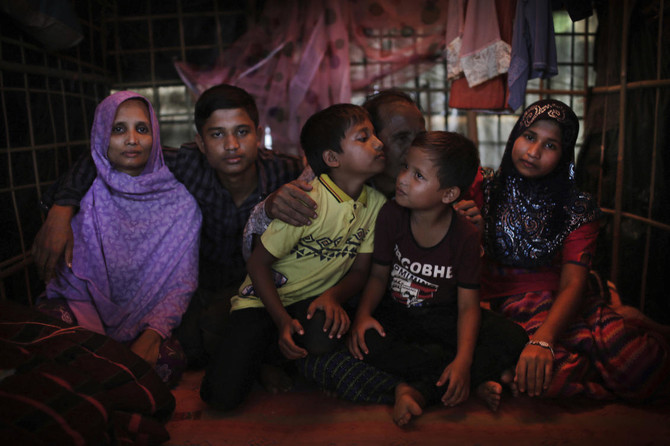
More than 650,000 Rohingya Muslims have fled to Bangladesh from Myanmar since August. (AP)
Updated 21 December 2017
Follow

Myanmar army massacred dozens of Rohingya, survivors say

UHKIA, BANGLADESH: For six hours he hid in an upstairs room, listening to the crackle of gunfire and the screams of people being slaughtered outside his Myanmar home.
With every footstep that drew near, every cry that pierced the air, 52-year-old Bodru Duza braced for the soldiers to find him, to execute him like all the others who had fled to his compound that morning seeking a safe place to shelter. They were being blindfolded and bound, marched away in small groups, then butchered and shot as they begged for their lives.
What had started out as a quiet Sunday in northwestern Myanmar had spiraled into an incomprehensible hell — one of the bloodiest massacres reported in the Southeast Asian nation since government forces launched a vicious campaign to drive out the country’s Rohingya minority in late August.
By the time it was over, there was so much blood on the ground, it had pooled into long rivulets across the uneven earth, among bits of human flesh and the fragments of shattered skulls.
When Duza finally dared to emerge from his hiding place, he wondered how anyone could have survived.
The compound he grew up in was now consumed by an ethereal silence. His wife, daughter, and five young sons were nowhere to be seen. And as he crept toward a backdoor to escape, he stumbled upon the corpse of an unknown boy sprawled on the floor.
“Oh Allah!” he thought. “What have they done to us? What have they done to my family?“
Duza’s family belonged to the ethnic Rohingya Muslim community, which has long been persecuted and denied basic rights in predominantly Buddhist Myanmar. They lived in the village of Maung Nu, where at least 82 Rohingya are believed to have been murdered on Aug. 27.
The massacre was part of a streak of violence that started before dawn two days earlier, when Rohingya insurgents staged an unprecedented wave of 30 attacks on security posts across Rakhine state. At least 14 people were killed.
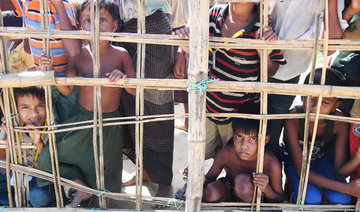
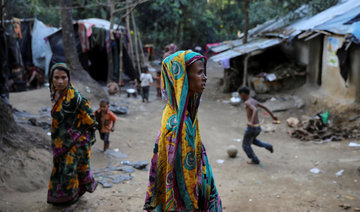
The assaults triggered one of the greatest catastrophes the Rohingya have ever known: an army counter-offensive that has left hundreds of villages burned and driven 650,000 refugees into Bangladesh. The aid group Doctors Without Borders estimates 6,700 Rohingya civilians were killed in the first month of reprisals alone, and human rights groups have documented three large-scale massacres.
The Associated Press has reconstructed the massacre at Maung Nu as told by 37 survivors now scattered across refugee camps in Bangladesh. Their testimony and exclusive video footage from the massacre site obtained by AP offer evidence, also documented by the United Nations and others, that Myanmar armed forces have systematically executed civilians.
Myanmar’s military did not respond to repeated requests for comment on this story, and the government — which prohibits journalists from independent travel to northern Rakhine State — did not reply to an AP request for a visit. The army has insisted in the past that not a single innocent has been slain.


Shooter kills 9 at Canadian school and residence

Updated 11 February 2026
Follow

Shooter kills 9 at Canadian school and residence

  • The shooter was found dead with an apparent self-inflicted gunshot wound
  • A total of 27 people were wounded in the shooting, including two with serious injuries

TORONTO: A shooter killed nine people and wounded dozens more at a secondary school and a residence in a remote part of western Canada on Tuesday, authorities said, in one of the deadliest mass shootings in the country’s history.
The suspect, described by police in an initial emergency alert as a “female in a dress with brown hair,” was found dead with an apparent self-inflicted gunshot wound, officials said.
The attack occurred in Tumbler Ridge, British Columbia, a picturesque mountain valley town in the foothills of the Rockies.
A total of 27 people were wounded in the shooting, including two with serious injuries, the Royal Canadian Mounted Police said in a statement.
Prime Minister Mark Carney said he was “devastated” by the “horrific acts of violence” and announced he was suspending plans to travel to the Munich Security Conference on Wednesday, where he had been set to hold talks with allies on transatlantic defense readiness.
Police said an alert was issued about an active shooter at Tumbler Ridge Secondary School on Tuesday afternoon.
As police searched the school, they found six people shot dead. A seventh person with a gunshot wound died en route to hospital.
Separately, police found two more bodies at a residence in the town.
The residence is “believed to be connected to the incident,” police said.
At the school, “an individual believed to be the shooter was also found deceased with what appears to be a self?inflicted injury,” police said.
Police have not yet released any information about the age of the shooter or the victims.
“We are devastated by the loss of life and the profound impact this tragedy has had on families, students, staff, and our entire town,” the municipality of Tumbler Ridge said in a statement.
Tumbler Ridge student Darian Quist told public broadcaster CBC that he was in his mechanics class when there was an announcement that the school was in lockdown.
He said that initially he “didn’t think anything was going on,” but started receiving “disturbing” photos about the carnage.
“It set in what was happening,” Quist said.
He said he stayed in lockdown for more than two hours until police stormed in, ordering everyone to put their hands up before escorting them out of the school.
Trent Ernst, a local journalist and a former substitute teacher at Tumbler Ridge, expressed shock over the shooting at the school, where one of his children has just graduated.
He noted that school shootings have been a rarity occurring every few years in Canada compared with the United States, where they are far more frequent.
“I used to kind of go: ‘Look at Canada, look at who we are.’ But then that one school shooting every 2.5 years happens in your town and things... just go off the rails,” he told AFP.

‘Heartbreak’ 

While mass shootings are extremely rare in Canada, last April, a vehicle attack that targeted a Filipino cultural festival in Vancouver killed 11 people.
British Columbia Premier David Eby called the latest violence “unimaginable.”
Nina Krieger, British Columbia’s minister of public safety, said it was “one of the worst mass shootings in our province’s and country’s history.”
The Canadian Olympic Committee, whose athletes are competing in the 2026 Winter Games in Italy, said Wednesday it was “heartbroken by the news of the horrific school shooting.”
Ken Floyd, commander of the police’s northern district, said: “This has been an incredibly difficult and emotional day for our community, and we are grateful for the cooperation shown as officers continue their work to advance the investigation.”
Floyd told reporters the shooter was the same suspect police described as “female” in a prior emergency alert to community members, but declined to provide any details on the suspect’s identity.
The police said officers were searching other homes and properties in the community to see if there were additional sites connected to the incident.
Tumbler Ridge, a quiet town with roughly 2,400 residents, is more than 1,100 kilometers (680 miles) north of Vancouver, British Columbia’s largest city.
“There are no words sufficient for the heartbreak our community is experiencing tonight,” the municipality said.