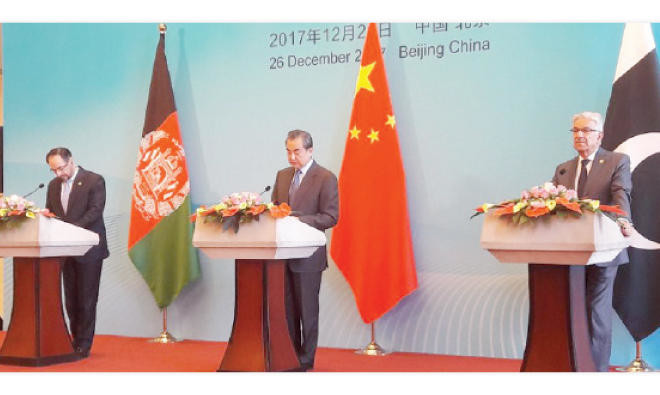
ISLAMABAD: China hosted the foreign ministers of Pakistan and Afghanistan on Tuesday, in a bid to improve the neighbors’ historically fractious relationship.
Foreign Minister Wang Yi of China, Foreign Minister Salahuddin Rabbani of Afghanistan and Pakistani Foreign Minister Khawaja Asif led delegations from their respective countries.
According to a joint communique, the three countries agreed to strengthen counterterrorism coordination and cooperation. “The three sides will communicate and consult on developing a memorandum of understanding for counterterrorism cooperation,” it read.
All three countries urged the Taliban to join the peace process “as soon as possible,” calling a broad-based and inclusive peace and reconciliation process, which is Afghan-led and fully supported regionally and internationally the “most viable solution to end violence in Afghanistan.”
In the first trilateral dialogue between the three countries, the foreign ministers reiterated their “strong determination not to allow any country, organization or individual to use their respective territories for terrorist activities against any other countries,” according to their joint statement.
Speaking at a joint press briefing after their meeting, Asif said: “It was agreed that peace and stability in Afghanistan is essential for our shared objective of development, deepening connectivity and economic prosperity.”
“Pakistan emphasized the importance of border management, the return of Afghan refugees, and intelligence sharing for effective counter-terrorism cooperation.”
Afghanistan’s Rabbani said: “Terrorism is growing by the day and to turn around this trend will require full, sincere and practical cooperation among states in our own region and beyond to defeat this common menace.”
Taliban spokesman Zabihullah Mujahid declined to comment, but the Taliban have previously rejected any offer to participate in the peace process.
China has serious concerns about the often-tense relationship between Pakistan and Afghanistan, in view of its huge investment in the multibillion-dollar China Pakistan Economic Corridor (CPEC), as well as its One Belt One Road (OBOR) initiative.
Pakistani experts believe China has now adopted a proactive regional diplomatic approach to promote peace and reconciliation in war-torn Afghanistan, in cooperation with Pakistan, which would also help ensure security in China’s Xinjiang province, which borders both countries.
China has already hosted a meeting between the Afghan Taliban and Afghan government officials in 2015, and a delegation of Qatar-based Taliban political representatives traveled to China earlier this year, according to a Taliban official.
Sen. Mushahid Hussain, chairman of Pakistan’s Senate Defense Committee, said China is uniquely positioned to play an active role not only in economic development, but also in peace and reconciliation in Afghanistan.
“Unlike others, China carries no extra-baggage, having stayed out of the internecine civil strife in Afghanistan,” Hussain told Arab News. ”Beijing enjoys the confidence of both the Afghan government and the Taliban, as well as Pakistan and the US, which has a diminishing military presence without China’s political and economic clout.”
“China’s economic growth southward, especially the CPEC, is directly impacted by Afghanistan,” said Ishaq Ahmed Khattak, director, intelligence and international security studies, South Asian Strategic Stability Institute (SASSI).
And, given the investment China has made in Afghanistan, it has to play a “predominant role in bringing peace through economic development and negotiations,” he explained.
Foreign Minister Yi visited Kabul and Islamabad in June this year to mend ties between Pakistan and Afghanistan. During that visit, the three countries agreed to establish a mechanism for regular interaction.
In their meeting on Tuesday, the foreign ministers decided that their next gathering would be held in Kabul in 2018.


![]()
China, Pakistan, Afghanistan ask Taliban to join peace process
China, Pakistan, Afghanistan ask Taliban to join peace process

Latest updates


Recommended


© 2026 SAUDI RESEARCH & PUBLISHING COMPANY, All Rights Reserved And subject to Terms of Use Agreement.