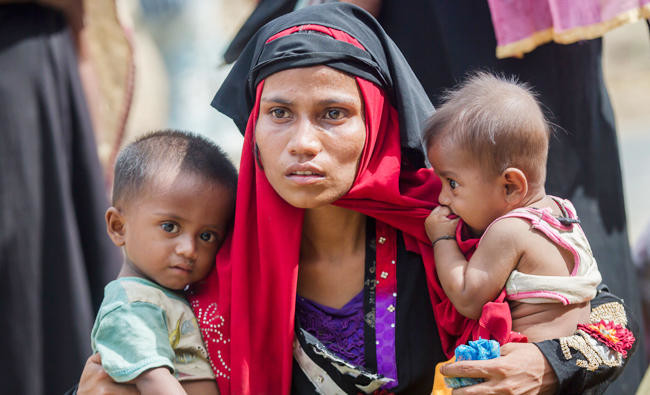
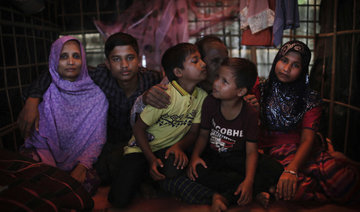
UNITED NATIONS, United States: The UN General Assembly on Sunday urged Myanmar to end a military campaign against Muslim Rohingya and called for the appointment of a UN special envoy, despite opposition from China, Russia and some regional countries.
A resolution put forward by the Organization of Islamic Cooperation (OIC) was adopted by a vote of 122 to 10 with 24 abstentions.
China, Russia, Cambodia, Laos, the Philippines and Vietnam joined Myanmar in voting against the measure as did Belarus, Syria and Zimbabwe.
The resolution calls on the government to allow access for aid workers, ensure the return of all refugees and grant full citizenship rights to the Rohingya.
It requests that UN Secretary-General Antonio Guterres appoint a special envoy to Myanmar.
The measure was adopted by the assembly after its budget committee gave the green light to funds for the new position of UN special envoy to Myanmar.
More than 650,000 Muslim Rohingya have fled the mainly Buddhist country since the military operation was launched in Rakhine state in late August.
Myanmar authorities insist the campaign is aimed at rooting out Rohingya militants who attacked police posts on August 25 but the United Nations has said the violence amounts to ethnic cleansing.
Last week, the UN special rapporteur for Myanmar, Yanghee Lee, said she had been banned from the country and that the government had cut off all cooperation with her.

China, Russia oppose UN criticism of Myanmar over Rohingya
Hegseth says US ‘can’t stop everything’ that Iran fires even as he asserts air dominance
WASHINGTON (AP): Defense Secretary Pete Hegseth acknowledged Wednesday that some Iranian air attacks may still hit their targets even as he asserted that US military superiority is quickly giving it control of the Islamic Republic’s airspace.
The US has spared “no expense or capability” to enhance air defense systems to protect American forces and allies in the Middle East, Hegseth told reporters at the Pentagon days after the US and Israel attacked Iran in a war that has widened throughout the region.
“This does not mean we can stop everything, but we ensured that the maximum possible defense and maximum possible force protection was set up before we went on offense,” he said.
The acknowledgement that additional drone or missile strikes in the region could cause damage and harm to troops comes as President Donald Trump and top defense leaders have warned that additional American casualties were expected in a conflict that could last months.
US service members “remain in harm’s way, and we must be clear-eyed that the risk is still high,” Gen. Dan Caine, chairman of the Joint Chiefs of Staff, said at the same press conference.
Six soldiers were killed when an Iranian drone strike hit an operations center Sunday in the heart of a civilian port in Kuwait, miles away from the main Army base. The husband of one of the slain soldiers, who was part of a supply and logistics unit based in Iowa, says the center was a shipping container-style building and had no defenses.
Hegseth also signaled a possible longer time frame for the conflict than has previously been floated by the Trump administration, saying it could last eight weeks but that the US has the munitions and the equipment to beat Iran in a war of attrition. He declined to set a specific time range, saying the specific duration of the war would depend on how it unfolds.
“You can say four weeks, but it could be six, it could be eight, it could be three,” he said. “Ultimately, we set the pace and the tempo. The enemy is off balance, and we’re going to keep them off balance.”
More forces continue to arrive in the region, including jet fighters and bombers, Hegseth said, and the US “will take all the time we need to make sure that we succeed.”
Tehran has vowed to completely destroy the Middle East’s military and economic infrastructure — signaling the war was nowhere near over and could expand further.
President Donald Trump said this week the campaign are likely to last four to five weeks but that he was prepared “to go far longer than that.”
The US has spared “no expense or capability” to enhance air defense systems to protect American forces and allies in the Middle East, Hegseth told reporters at the Pentagon days after the US and Israel attacked Iran in a war that has widened throughout the region.
“This does not mean we can stop everything, but we ensured that the maximum possible defense and maximum possible force protection was set up before we went on offense,” he said.
The acknowledgement that additional drone or missile strikes in the region could cause damage and harm to troops comes as President Donald Trump and top defense leaders have warned that additional American casualties were expected in a conflict that could last months.
US service members “remain in harm’s way, and we must be clear-eyed that the risk is still high,” Gen. Dan Caine, chairman of the Joint Chiefs of Staff, said at the same press conference.
Six soldiers were killed when an Iranian drone strike hit an operations center Sunday in the heart of a civilian port in Kuwait, miles away from the main Army base. The husband of one of the slain soldiers, who was part of a supply and logistics unit based in Iowa, says the center was a shipping container-style building and had no defenses.
Hegseth also signaled a possible longer time frame for the conflict than has previously been floated by the Trump administration, saying it could last eight weeks but that the US has the munitions and the equipment to beat Iran in a war of attrition. He declined to set a specific time range, saying the specific duration of the war would depend on how it unfolds.
“You can say four weeks, but it could be six, it could be eight, it could be three,” he said. “Ultimately, we set the pace and the tempo. The enemy is off balance, and we’re going to keep them off balance.”
More forces continue to arrive in the region, including jet fighters and bombers, Hegseth said, and the US “will take all the time we need to make sure that we succeed.”
Tehran has vowed to completely destroy the Middle East’s military and economic infrastructure — signaling the war was nowhere near over and could expand further.
President Donald Trump said this week the campaign are likely to last four to five weeks but that he was prepared “to go far longer than that.”
© 2026 SAUDI RESEARCH & PUBLISHING COMPANY, All Rights Reserved And subject to Terms of Use Agreement.