Philippines storm leaves 200 dead and tens of thousands displaced

This handout photograph released by Project LUPAD on December 23, 2017, shows an aerial image taken by a drone of the city of Cagayan de Oro on the Philippines' island of Mindanao on December 22, 2017, after the area was struck by Tropical Storm Tembin. (AFP)
Updated 24 December 2017
Follow

Philippines storm leaves 200 dead and tens of thousands displaced

MANILA: At least 200 people have been killed and scores are missing in the southern Philippines after a tropical storm triggered severe flooding and landslides that also wrecked Christmas for tens of thousands of survivors.
Tropical Storm Tembin lashed Mindanao island, home to 20 million people, on Friday with strong gusts and torrential rain, wiping out at least one mountain village and prompting a massive rescue operation.
Police said 144 people remained missing while more than 40,000 had fled their homes to evacuation camps as Tembin roared out into the South China Sea early Sunday.
A total of 70,000 have been displaced or otherwise affected by the storm according to the International Federation of Red Cross and Red Crescent Societies (IFRC), which warned that continued heavy rain could hamper the search for survivors.
“People left everything behind when they fled for their lives,” the IFRC’s Philippines operations and programs manager Patrick Elliott said in a statement.
The archipelago nation is pummelled by major storms every year, many of them deadly. Mindanao tends to be less affected and officials said this may have caused many to ignore warnings to move to safer ground.
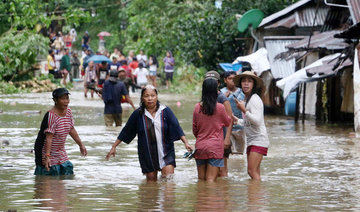
Footage showed vast tracts of land on the island submerged by brown water, often waist-deep, with streets turning into rivers.
Local police said 135 people were killed and 72 missing in the northern section of Mindanao, while 47 were dead and 72 missing in the impoverished Zamboanga peninsula on its western side.
Another 18 people perished in the province of Lanao del Sur in the center of the island.
One of the places hit hardest was the mountain village of Dalama, which was virtually wiped off the map as rampaging floodwaters carried away 103 houses.
Footage on ABS-CBN showed houses there destroyed or engulfed by floodwaters and rescuers retrieving the body of a girl buried in a landslide.
Police, soldiers and volunteers used shovels and their bare hands to dig through mud and debris in their search for survivors.
“The flood was already close and the people were not able to get out from their homes,” Armando Sangcopan, an elderly male survivor, told the station.
“We called for forced evacuation, preemptive evacuation in certain areas. We are saddened by the (large) numbers of casualties,” Romina Marasigan, spokeswoman for the National Disaster Risk Reduction and Management Council told reporters in Manila.
In the town of Kabasalan in Zamboanga, dozens of families huddled in the homes of neighbors on Christmas Eve, two days after floods carried off 40 houses, killing three people with one other missing, said local civil defense chief Junalyn Maravillo.
“This is a disaster. They don’t think about Christmas. All they think about is what they will eat for today,” she told AFP.
The storm swept into the South China Sea before dawn Sunday after hitting the western tourist island of Palawan overnight Saturday, the state weather service said.
“So far zero casualties, but we have accounts of some people missing,” Palawan civil defense chief Zaldy Ablana told DZMM radio on Sunday.
But in a Palawan fishing village, a 53-year-old man was killed by a crocodile while securing his boat in a river.
Tembin struck less than a week after Tropical Storm Kai-Tak left scores dead and more than 20 missing in the central Philippines, straining the disaster-prone nation’s already stretched resources.
The deadliest typhoon to hit the country is still Haiyan, which killed thousands and destroyed entire towns in heavily populated areas of the central Philippines in November 2013.


Proposals on immigration enforcement flood into state legislatures, heightened by Minnesota action

Updated 16 January 2026
Follow

Proposals on immigration enforcement flood into state legislatures, heightened by Minnesota action

  • Oregon Democrats plan to introduce a bill to allow residents to sue federal officers for violating their Fourth Amendment rights against unlawful search and seizure

NASHVILLE, Tennessee: As Democrats across the country propose state law changes to restrict federal immigration officers after the shooting death of a protester in Minneapolis, Tennessee Republicans introduced a package of bills Thursday backed by the White House that would enlist the full force of the state to support President Donald Trump’s immigration crackdown.
Momentum in Democratic-led states for the measures, some of them proposed for years, is growing as legislatures return to work following the killing of Renee Good by an Immigration and Customs Enforcement officer. But Republicans are pushing back, blaming protesters for impeding the enforcement of immigration laws.

Democratic bills seek to limit ICE

Democratic Gov. Kathy Hochul wants New York to allow people to sue federal officers alleging violations of their constitutional rights. Another measure aims to keep immigration officers lacking judicial warrants out of schools, hospitals and houses of worship.
Oregon Democrats plan to introduce a bill to allow residents to sue federal officers for violating their Fourth Amendment rights against unlawful search and seizure.
New Jersey’s Democrat-led Legislature passed three bills Monday that immigrant rights groups have long pushed for, including a measure prohibiting state law enforcement officers from cooperating with federal immigration enforcement. Democratic Gov. Phil Murphy has until his last day in office Tuesday to sign or veto them.
California lawmakers are proposing to ban local and state law enforcement from taking second jobs with the Department of Homeland Security and make it a violation of state law when ICE officers make “indiscriminate” arrests around court appearances. Other measures are pending.
“Where you have government actions with no accountability, that is not true democracy,” Democratic state Sen. Scott Wiener of San Francisco said at a news conference.
Democrats also push bills in red states
Democrats in Georgia introduced four Senate bills designed to limit immigration enforcement — a package unlikely to become law because Georgia’s conservative upper chamber is led by Lt. Gov. Burt Jones, a close Trump ally. Democrats said it is still important to take a stand.
“Donald Trump has unleashed brutal aggression on our families and our communities across our country,” said state Sen. Sheikh Rahman, an immigrant from Bangladesh whose district in suburban Atlanta’s Gwinnett County is home to many immigrants.
Democrats in New Hampshire have proposed numerous measures seeking to limit federal immigration enforcement, but the state’s Republican majorities passed a new law taking effect this month that bans “sanctuary cities.”
Tennessee GOP works with White House on a response
The bills Tennessee Republicans are introducing appear to require government agencies to check the legal status of all residents before they can obtain public benefits; secure licenses for teaching, nursing and other professions; and get driver’s licenses or register their cars.
They also would include verifying K-12 students’ legal status, which appears to conflict with a US Supreme Court precedent. And they propose criminalizing illegal entry as a misdemeanor, a measure similar to several other states’ requirements, some of which are blocked in court.
“We’re going to do what we can to make sure that if you’re here illegally, we will have the data, we’ll have the transparency, and we’re not spending taxpayer dollars on you unless you’re in jail,” House Speaker Cameron Sexton said at a news conference Thursday.
Trump administration sues to stop laws
The Trump administration has opposed any effort to blunt ICE, including suing local governments whose “sanctuary” policies limit police interactions with federal officers.
States have broad power to regulate within their borders unless the US Constitution bars it, but many of these laws raise novel issues that courts will have to sort out, said Harrison Stark, senior counsel with the State Democracy Research Initiative at the University of Wisconsin Law School.
“There’s not a super clear, concrete legal answer to a lot of these questions,” he said. “It’s almost guaranteed there will be federal litigation over a lot of these policies.”
That is already happening.
California in September was the first to ban most law enforcement officers, including federal immigration officers, from covering their faces on duty. The Justice Department said its officers won’t comply and sued California, arguing that the laws threaten the safety of officers who are facing “unprecedented” harassment, doxing and violence.
The Justice Department also sued Illinois last month, challenging a law that bars federal civil arrests near courthouses, protects medical records and regulates how universities and day care centers manage information about immigration status. The Justice Department claims the law is unconstitutional and threatens federal officers’ safety.
Targeted states push back
Minnesota and Illinois, joined by their largest cities, sued the Trump administration this week. Minneapolis and Minnesota accuse the Republican administration of violating free speech rights by punishing a progressive state that favors Democrats and welcomes immigrants. Illinois and Chicago claim “Operation Midway Blitz” made residents afraid to leave their homes.
Homeland Security spokesperson Tricia McLaughlin accused Minnesota officials of ignoring public safety and called the Illinois lawsuit “baseless.”