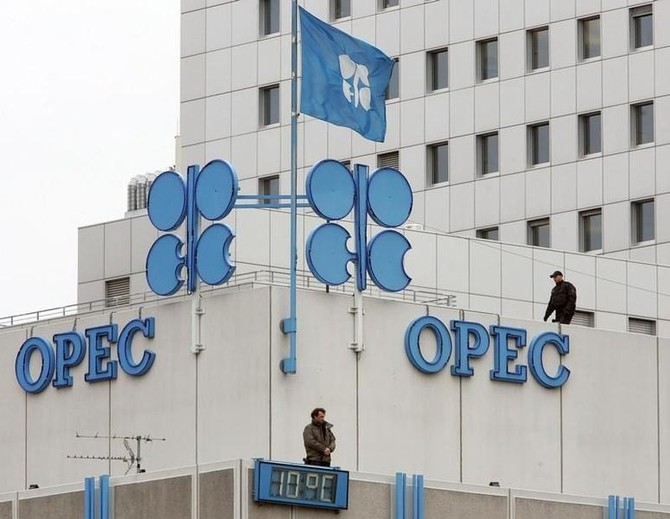
LONDON: OPEC has started working on plans for an exit strategy from its deal to cut supplies with non-member producers, two OPEC sources said, a sign that an eventual winding down of the deal is coming onto producers’ radar, at least in theory.
OPEC, Russia and other non-OPEC producers on Nov. 30 extended an oil output-cutting deal until the end of 2018 to finish clearing a glut. But the market is increasingly interested in how producers will exit the deal once the excess is cleared.
Two OPEC sources said the group’s secretariat in Vienna has been tasked to work on a plan with different options and it was too early now to say what the plan would look like.
“It’s a continuity strategy, rather than exit,” one of the OPEC sources said.
Oil prices have rallied this year and are trading near $64 a barrel, close to the highest since 2015, supported by the OPEC-led effort. This is above the $60 floor that sources say OPEC would like to see in 2018.
Publicly, OPEC ministers say it is too early to talk of an exit strategy. But OPEC has said producers want to continue working together beyond the end of 2018, including on supply management.
While oil prices have risen to levels seen as favorable by OPEC, the stated goal of the supply cut is to reduce inventories in developed economies, which built up after a supply glut emerged in 2014, to the level of the five-year average.
OPEC is making progress and said in October OECD inventories stood 137 million barrels above the five-year average. Since the start of deal in January, the overhang relative to that average is down by 200 million barrels, Kuwait’s oil minister said on Wednesday.
A discussion on exiting the deal may be needed before December 2018 if, as OPEC expects, the world oil market returns to balance by late 2018.
OPEC and its allies hold their next full ministerial meeting in June, which will be a opportunity to review progress.
Non-OPEC Russia, which has been the biggest contributor to cuts from outside the group, has been suggesting a review of the deal as early as June. However, its biggest producer Rosneft said this week the cuts could last into 2019.

OPEC said to start work on oil supply cut exit strategy

Saudi Arabia leads outcome-based education to prepare future-ready generations: Harvard Business Review
- The Riyadh-based school group developed a strategy that links every classroom activity to measurable student competencies, aiming to graduate learners equipped for the digital economy and real-world contexts
RIYADH: Saudi Arabia’s education system is undergoing a sweeping transformation aligned with Vision 2030, shifting from traditional, input-focused methods to outcome-based education designed to equip students with future-ready skills, Harvard Business Review Arabic reported.
The transformation is being adopted and spearheaded by institutions such as Al-Nobala Private Schools, which introduced the Kingdom’s first national “learning outcomes framework,” aimed at preparing a generation of leaders and innovators for an AI-driven future, the report said.
Al-Nobala has leveraged international expertise to localize advanced learning methodologies.
The Riyadh-based school group developed a strategy that links every classroom activity to measurable student competencies, aiming to graduate learners equipped for the digital economy and real-world contexts. The school’s group approach combines traditional values with 21st-century skills such as critical thinking, communication, innovation and digital fluency.
According to the report, the shift addresses the growing gap between outdated models built for low-tech, resource-constrained environments and today’s dynamic world, where learners must navigate real-time information, virtual platforms, and smart technologies.
“This is not just about teaching content, it’s about creating impact,” the report noted, citing how Al-Nobala’s model prepares students to thrive in an AI-driven world while aligning with national priorities.
The report noted that Saudi Arabia’s Ministry of Education has paved the way for this shift by transitioning from a centralized controller to a strategic enabler, allowing schools such as Al-Nobala to tailor their curriculum to meet evolving market and societal needs. This is part of the long-term goal to place the Kingdom among the top 20 global education systems.
Al-Nobala’s work, the report stated, has succeeded in serving the broader national effort to link education outcomes directly to labor market demands, helping to fulfill the Vision 2030 pillar of building a vibrant society with a thriving economy driven by knowledge and innovation.
Last February, Yousef bin Abdullah Al-Benyan, Saudi Arabia’s minister of education, said that the Kingdom was making “an unprecedented investment in education,” with spending aligned to the needs of growth and development. He said that in 2025, education received the second-largest share of the state budget, totaling $53.5 billion.