BEIJING: China and Russia on Tuesday decried President Donald Trump’s first National Security Strategy — which pilloried both nations as challengers to US power — as a “Cold War mentality” with an “imperialist character.”
The two global powerhouses hit back hours after the Trump administration unveiled its approach to the world with biting language framing Beijing and Moscow as global competitors.
“We urge the United States to stop intentionally distorting China’s strategic intentions and to abandon outdated notions such as the Cold War mentality and zero-sum game, otherwise it will only harm itself or others,” Chinese foreign ministry spokeswoman Hua Chunying said.
Moscow issued its own denunciation moments later.
“The imperialist character of this document is obvious, as is the refusal to renounce a unipolar world, an insistent refusal,” Kremlin spokesman Dmitry Peskov told reporters.
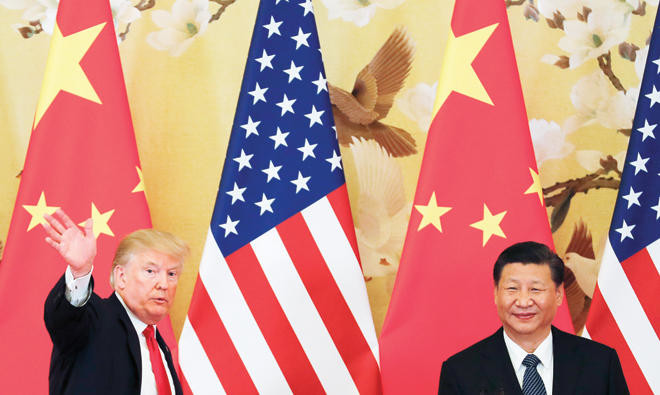
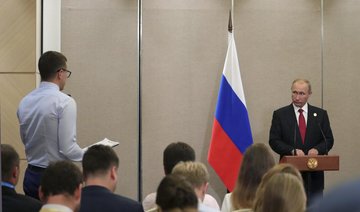
The report’s tough tone contrasts sharply with Trump’s friendlier face-to-face encounters with Chinese President Xi Jinping and Russian leader Vladimir Putin.
“China and Russia challenge American power, influence, and interests, attempting to erode American security and prosperity,” the document says.
Accusing China of seeking “to displace the United States” in Asia, the 68-page strategy is a litany of US grievances, from the Chinese stealing data to spreading “features of its authoritarian system.”
“Contrary to our hopes, China expanded its power at the expense of the sovereignty of others,” it says.
Beijing launched a vigorous defense of its “peaceful development,” saying any report “which distorts the facts, or maliciously slanders will only do so in vain.”
“China will never pursue its own development at the expense of other countries’ interests,” Hua told a regular news briefing.
“At the same time we will never give up our legitimate rights and interests.”
Trump received a lavish welcome during his first state visit to Beijing in November and was full of praise for Xi.
But the two countries have been locked in an increasingly acrimonious battle over trade issues, with Washington taking unprecedented steps to investigate and add tariffs to Chinese-made goods.
There are also lingering US concerns over China’s military activities in the disputed South China Sea, while Washington has angered Beijing with its arms sales to self-ruled Taiwan.
Speaking on Monday after the report’s release, Trump took a strikingly softer tone on Russia, lauding the benefits of counterterror cooperation with Moscow.
Trump claimed that a recent CIA tip-off about a terror attack on a cathedral in Putin’s home town of Saint Petersburg had prevented deaths “in the thousands.”
“They were able to apprehend these terrorists before the event with no loss of life and that’s a great thing, and the way it’s supposed to work,” Trump said, offering the prospect of better ties.
Trump’s presidential campaign is being investigated for possible collusion with Russia in the run-up to his shock 2016 election win — allegations the 45th president has dubbed “fake news.”
His security strategy warns that Russian nuclear weapons are “the most significant existential threat to the United States.”
It also describes the Kremlin as a power that “seeks to restore its great power status and establish spheres of influence near its borders.”
“Russia aims to weaken US influence in the world and divide us from our allies and partners,” it warns.
The Kremlin’s Peskov responded that Russia “cannot accept” being described as a threat to US security.
But Peskov praised “modest” positive features in the report, pointing to what he said was Washington’s readiness to cooperate with Russia in areas such as an exchange of security information.
The national security document — 11 months in the making — is required by law and is designed to form a framework for how America approaches the world.
Previous national security strategies have been released without much fanfare and served as guideposts, rather than doctrinal commandments.
But in this unorthodox administration, the document had taken on extra significance.
Foreign officials in Washington often complain that there are effectively “two administrations” — one that they hear from day-to-day in contacts with the State Department and Pentagon and another coming from Trump, often via Twitter in 280 characters or fewer.
Trump and his advisers often publicly differ starkly on fundamental security issues from the Middle East to talks with North Korea.
But allies looking for clarity about the intentions of the world’s pre-eminent economic and military power are likely to be confused by Trump’s mixed messages.
Where the strategy warns Russia is using “subversive measures” to undermine “transatlantic unity,” Trump again claimed that European allies were “delinquent” in paying for security “while we guarantee their safety and are willing to fight wars for them.”
Where the strategy warned of Moscow’s “destabilizing cyber capabilities” and interference in domestic political affairs, Trump made no such reference.


![]()
China, Russia slam US ‘imperialist’ and ‘Cold War mentality’
China, Russia slam US ‘imperialist’ and ‘Cold War mentality’


Latest updates





© 2026 SAUDI RESEARCH & PUBLISHING COMPANY, All Rights Reserved And subject to Terms of Use Agreement.