

Japan maglev contractors raided in bid-rigging probe

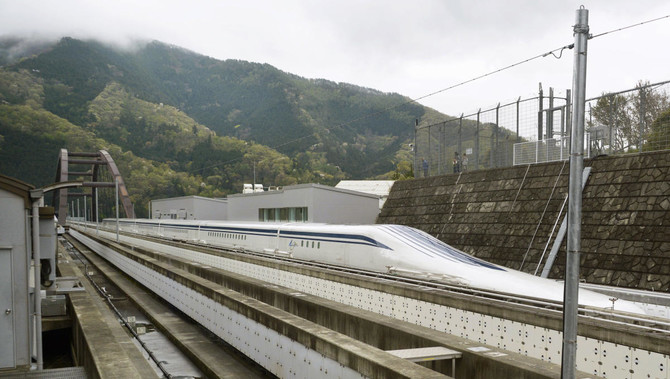
A Japanese maglev train, the fastest passenger train in the world runs on the Maglev Test Line in Tsuru, west of Tokyo. Prosecutors raided the headquarters of several of Japan’s biggest construction companies in an investigation into alleged collusion on bids. (AP)
Updated 19 December 2017
Follow

Japan maglev contractors raided in bid-rigging probe

TOKYO: Prosecutors have raided the headquarters of four of Japan’s biggest construction companies, investigating alleged collusion on bids for a multibillion dollar maglev railway that Prime Minister Shinzo Abe’s government has backed as a showcase project.

TV news reports Tuesday showed dark-suited investigators from the Tokyo District Public Prosecutors Office heading into the headquarters of Taisei and Obayashi, two of four companies targeted in the probe.

Shimizu and Kajima, the two others, issued statements Tuesday acknowledging the raids.

Kajima said it conducts training focused on preventing bid rigging.

“This situation grieves us extremely, and we deeply apologize to all involved from the bottom of our hearts,” it said.

Obayashi responded to a request for comment on reports it had admitted to the bid rigging by saying the company could not give further details because it was under investigation.

All the contractors have promised to cooperate fully with the investigation into the alleged violations of anti-trust laws. Reports said prosecutors are looking into alleged “obstruction of business” because the contracts for the line, called the Linear Chuo Shinkansen, are for private-sector, not public contracts.

The $80 billion magnetic levitation, or maglev, railway between Tokyo and the central Japanese city of Nagoya is a decades-long project that is expected to reduce travel time between the two cities to 40 minutes from the current 100 minutes once it opens in 2027. The line is due to be eventually extended to the western city of Osaka.

Work is being carried out mostly by joint ventures led by the four builders, who are alleged to have colluded to coordinate bidding and ensure each won a similar share of related construction contracts.

The project at the center of this scandal is for construction of an emergency exit for the maglev at Nagoya station.

Bid-rigging remains entrenched in Japan’s construction sector and other industries, despite repeated efforts to crack down and pledges by contractors to eliminate the practice.

The anti-monopoly Japan Fair Trade Commission allows leniency for companies that come forward and admit they have engaged in bid rigging or similar practices. The first company in a case to come forward generally is granted full immunity from fines.


Saudi minister at Davos urges collaboration on minerals

Global collaboration on minerals essential to ease geopolitical tensions and secure supply, WEF hears. (Supplied)
Updated 20 January 2026
Follow

Saudi minister at Davos urges collaboration on minerals

  • The reason of the tension of geopolitics is actually the criticality of the minerals

LONDON: Countries need to collaborate on mining and resources to help avoid geopolitical tensions, Saudi Arabia’s minister of industry and mineral resources told the World Economic Forum on Tuesday.

“The reason of the tension of geopolitics is actually the criticality of the minerals, the concentration in different areas of the world,” Bandar Alkhorayef told a panel discussion on the geopolitics of materials.

“The rational thing to do is to collaborate, and that’s what we are doing,” he added. “We are creating a platform of collaboration in Saudi Arabia.”

Bandar Alkhorayef, Saudi Minister of Industry and Mineral Resources 

The Kingdom last week hosted the Future Minerals Forum in Riyadh. Alkhorayef said the platform was launched by the government in 2022 as a contribution to the global community. “It’s very important to have a global movement, and that’s why we launched the Future Minerals Forum,” he said. “It is the most important platform of global mining leaders.”

The Kingdom has made mining one of the key pillars of its economy, rapidly expanding the sector under the Vision 2030 reform program with an eye on diversification. Saudi Arabia has an estimated $2.5 trillion in mineral wealth and the ramping up of extraction comes at a time of intense global competition for resources to drive technological development in areas like AI and renewables.

“We realized that unlocking the value that we have in our natural resources, of the different minerals that we have, will definitely help our economy to grow to diversify,” Alkhorayef said. The Kingdom has worked to reduce the timelines required to set up mines while also protecting local communities, he added. Obtaining mining permits in Saudi Arabia has been reduced to just 30 to 90 days compared to the many years required in other countries, Alkhorayef said.

“We learned very, very early that permitting is a bottleneck in the system,” he added. “We all know, and we have to be very, very frank about this, that mining doesn’t have a good reputation globally.

“We are trying to change this and cutting down the licensing process doesn’t only solve it. You need also to show the communities the impact of the mining on their lives.”

Saudi Arabia’s new mining investment laws have placed great emphasis on the development of society and local communities, along with protecting the environment and incorporating new technologies, Alkhorayef said. “We want to build the future mines; we don’t want to build old mines.”