Abu Dhabi’s Etihad Airways to end Tehran flights in January

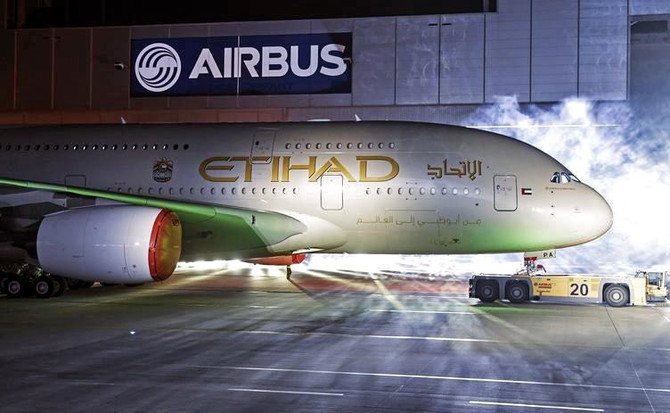
In this file photo, an Airbus A380 rolls out of a paint hangar during a branding ceremony of Etihad Airways at the German headquarters of aircraft company Airbus, in Hamburg-Finkenwerder, Sept.25, 2014. (REUTERS)
Updated 19 December 2017
Follow

Abu Dhabi’s Etihad Airways to end Tehran flights in January

DUBAI: Etihad Airways will scrap flights to Tehran on Jan. 24, the latest route to be dropped as the Abu Dhabi airline pursues a strategy review.
The airline launched the review in 2016 that has also seen it sell or step away from investments in foreign carriers.
Etihad’s five weekly flights to Iran’s capital will be reduced to two a week between Dec. 25 and Jan. 23, before it suspends the route entirely on Jan. 24, an airline spokeswoman said.
She declined to say why the route was being suspended, but said in a statement that affected passengers could switch to an alternative travel date between Dec. 25 and Jan. 23 or be refunded.
Since launching the strategy review, Etihad has said it would cut flights to San Francisco and Dallas-Fort Worth in the United States.
Britain’s top defense buyer Tony Douglas will join Etihad next month as its new group chief executive, as the airline rethinks its rapid expansion strategy.
Two of Etihad’s major foreign investments, Air Berlin and Italy’s Alitalia, filed for administration this year.
Douglas, who joins Etihad from Britain’s Ministry of Defense, has previously served as chief executive of Abu Dhabi’s airport company.
Etihad has made few details public about its strategy review, which since being launched has seen the departure of its James Hogan, its group chief executive who led the airline for a decade.


Iran Guards say will block oil exports as long as war continues

Updated 4 sec ago
Follow

Iran Guards say will block oil exports as long as war continues

  • Shipping traffic through the strategic Strait of Hormuz, through which nearly 20 percent of the world’s crude oil usually transits, has been severely disrupted
TEHRAN: Iranian forces will not allow the export of oil from the region to allies of the United States and Israel as long as the war continues, a Revolutionary Guards spokesman said Tuesday.
“The Iranian armed forces... will not allow the export of a single liter of oil from the region to the hostile side and its partners until further notice,” said Ali Mohammad Naini, according to a report from Iran’s Tasnim news agency.
He said any change would take place based on the conditions of the conflict.
On February 28, the US and Israel launched strikes against Iran that killed its supreme leader Ayatollah Ali Khamenei and triggered a war that has spread across the Middle East.
Iran has responded with drone and missile strikes targeting Israel and US interests across the region.
Shipping traffic through the strategic Strait of Hormuz, through which nearly 20 percent of the world’s crude oil usually transits, has been severely disrupted.
Iranian forces have repeatedly targeted oil tankers passing through the strategic waterway since the war began.
Oil prices have since risen dramatically to over $100 per barrel — the highest since Russia’s invasion of Ukraine in 2022 — before reversing course Monday after US President Donald Trump said military operations would be ending soon.
“Their efforts to reduce and control the price of oil and gas will be temporary and fruitless,” IRGC spokesman Naini said. “Trade in war conditions is hinged on security.”
The Revolutionary Guards late on Monday urged countries to expel their US and Israeli ambassadors to gain passage through the Strait of Hormuz.
“Any Arab or European country that expels the Israeli and American ambassadors from its territory will have complete freedom and authority to pass through the Strait of Hormuz starting tomorrow,” the Guards said, as quoted by Iranian state TV.