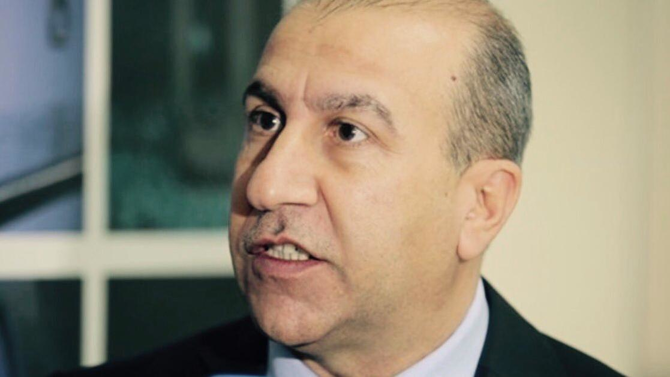
BAGHDAD: The Iraqi Shiite-dominated Popular Mobilization Forces (PMF) will not be incorporated or dissolved, but will be restructured in line with military laws and regulations to ensure that fighters are free of ideological, political and partisan affiliations, Iraqi government spokesman Saad Al-Hadithi told Arab News on Sunday.
“According to the law approved by the Parliament, we have only one mechanism to resolve this case by issuing instructions and regulations to reorganize the work of the PMF,” said Al-Hadithi.
“This issue (the fate of the PMF) is resolved. The law authorized the prime minister to issue the required regulations to restructure this institution and reactivate its work in line with Iraqi law and submit it to the military regulations applied in all the Iraqi military institutions.
“(Resolving) this case is linked to the restructuring measures and (when it is) fully implemented on the ground, and this is what is currently being worked out with the participation of military specialists authorized to make (the required) decisions and representatives of the PMF,” Al-Hadithi, said.
Iraqi Prime Minister Haider Abadi last week declared the full liberation of the Iraqi territories seized by Daesh in the summer of 2014 after the collapse of the Iraqi army. Tens of thousands of Iraqis volunteered to fight Daesh and stop their advance on the capital.
The volunteers, mostly Shiite, have fought the militants alongside the government under the umbrella of the Popular Mobilization Units (PMU), a governmental body established by former Iraqi Prime Minister Nuri Al-Maliki to cover the armed factions who fought Daesh.
Although the PMU consists of tens of thousands of Shiite, Sunni, Turkmen, Christian and Yazidi volunteers, the Shiite militias have represented the backbone of PMF troops.
To subject PMF to the control of the government, the Iraqi Parliament voted on the law late in 2016. The law states that the PMF is a part of the regular Iraqi security establishment and subject to military laws and commanded directly by the commander-in-chief of the armed forces (the prime minister), who is fully responsible for arming, financing and equipping them.
PMF commanders and security officials contacted by Arab News confirmed that talks on the restructuring of the PMU had started weeks ago between the Iraqi Ministry of Defense and the commanders of the PMF.
Al-Hadithi said that as long as the PMF was a part of the Iraqi security establishment, “they must be fully subject to the will and decision of the commander-in-chief of the armed forces and central security institutions.”
The number of registered fighters on the payroll of the PMF is 120,000. Shiite-armed factions have played a key role in the three-year fight against Daesh.
The Iraqi government spokesmen said that all armed factions, individuals and parties that had fought Daesh alongside the government and were formally covered by the PMF, have no option but to legalize their existence and give up their political and ideological affiliations. This was “fundamental” for the work of the PMF, and the government was “fully keen to implement this.”
Al-Hadathi said that the commanders of the armed factions in the PMF had expressed their commitment to keep working under the umbrella of the PMF and to dismantle any political or ideological ties between the fighters and their parent organizations.
“Actually, the announced situations (of the commands of the Shiite-armed factions within PMF) related to this issue (to abandon affiliations), all have poured in this direction.
“We hope that there will be an understanding of the government’s position at this time and the necessity of taking this step during the next stage. The situations were all positive and we look forward to translating these positions into action,” Al-Hadithi said.
Al-Hadithi said that although there was no time limit to achieve this goal, the government was keen to accomplish it “as soon as possible.”
The Iraqi government estimated the cost of reconstruction and rehabilitation of the areas affected by terrorism, and the military operations to terminate the militants, at $100 billion. The support of the international community is vital for the Iraqi government to secure these funds, mainly by attracting foreign investment and donations from the international community.
“We look forward to bringing investors and international companies to work in Iraq. The existence of any armed manifestations outside the framework of state institutions sends a negative message (for the international community).
“The Iraqi government cannot alone provide the required funds of reconstruction and provide the basic services. Therefore, it is necessary to obtain international aid through (the recruitment) of major investment companies ... which can provide hundreds of thousands of jobs.
“Any step taken by any side that contradicts the will of the government to disarm (the armed factions) will damage the economy, the peace and security of the community and will negatively impact investment opportunities in Iraq.
“The Iraqi government will confront any armed faction operating outside the official system of the state, and will take all necessary legal measures to prevent its activity regardless of its title (name or affiliation),” Al-Hadithi said.


Iraqi mobilization forces will not be incorporated or dissolved: govt spokesman
Iraqi mobilization forces will not be incorporated or dissolved: govt spokesman


UN Security Council members blast Israel’s West Bank plans on eve of Trump’s Board of Peace meeting
- Pakistan denounced Israel’s contentious West Bank settlement project during the meeting as a “clear violation of international law”
- Pakistan is the only country on the 15-member council that also accepted an invitation to join US President Trump's Board of Peace
UNITED NATIONS: Members of the United Nations Security Council called Wednesday for the Gaza ceasefire deal to become permanent and blasted Israeli efforts to expand control in the West Bank as a threat to prospects of a two-state solution, coming on the eve of President Donald Trump’s first Board of Peace gathering to discuss the future of the Palestinian territories.
The high-level UN session in New York was originally scheduled for Thursday but was moved up after Trump announced the board’s meeting for the same day and it became clear that it would complicate travel plans for diplomats planning to attend both. It is a sign of the potential for overlapping and conflicting agendas between the United Nations’ most powerful body and Trump’s new initiative, whose broader ambitions to broker global conflicts have raised concerns in some countries that it may attempt to rival the UN Security Council.
Pakistan, the only country on the 15-member council that also accepted an invitation to join the Board of Peace, denounced Israel’s contentious West Bank settlement project during the meeting as “null and void” and said it constitutes a “clear violation of international law.”
“Israel’s recent illegal decisions to expand its control over the West Bank are gravely disturbing,” Pakistani Foreign Minister Ishaq Dar said.
The foreign ministers of the United Kingdom, Israel, Jordan, Egypt and Indonesia also attended the Security Council’s monthly Mideast meeting after many Arab and Islamic countries requested last week that it discuss Gaza and the West Bank before some of them head to Washington.
“Annexation is a breach of the UN Charter and of the most fundamental rules of international law,” Palestinian UN Ambassador Riyad Mansour said. “It is a breach of President Trump’s plan, and constitutes an existential threat to ongoing peace efforts.”
Israeli Foreign Minister Gideon Saar said that attention was not on the UN session and that the focus of the international world would be on the Board of Peace meeting.
Saar also accused the council of being “infected with an anti-Israeli obsession” and insisted that no nation has a stronger right than its “historical and documented right to the land of the Bible.”
Bigger ambitions for the Board of Peace
The board to be chaired by Trump was originally envisioned as a small group of world leaders overseeing his 20-point plan for Gaza’s future. But the Republican president’s new vision for the board to be a mediator of worldwide conflicts has led to skepticism from major allies.
While more than 20 countries have so far accepted an invitation to join the board, close US partners, including France, Germany and others, have opted not to join yet and renewed support for the UN, which also is in the throes of major reforms and funding cuts.
British Foreign Secretary Yvette Cooper said there is an opportunity for the UN’s most powerful body to help build “a better future” for Israelis and Palestinians despite the “cycle of violence and suffering” over the more than two-year war between Israel and Hamas.
“Gaza must not get stuck in a no man’s land between peace and war,” Cooper said as she opened the meeting.
Mike Waltz, the US ambassador to the UN, appeared to criticize countries that had not yet signed on to the Board of Peace, saying that unlike the Security Council, the board is “not talking, it is doing.”
“We are hearing the chattering class criticizing the structure of the board, that it’s unconventional, that it’s unprecedented,” Waltz said Wednesday. “Again, the old ways were not working.”
The Security Council is meeting a day after nearly all of its 15 members — minus the United States — and dozens of other diplomats joined Palestinian ambassador Mansour as he read a statement on behalf of 80 countries and several organizations condemning Israel’s latest actions in the West Bank, demanding an immediate reversal and underlining “strong opposition to any form of annexation.”
In the last several weeks, Israel has launched a contentious land regulation process that will deepen its control in the occupied West Bank. Israeli Energy Minister Eli Cohen said it amounts to “de facto sovereignty” that will block the establishment of a Palestinian state.
Outraged Palestinians, Arab countries and human rights groups have called the moves an illegal annexation of the territory, home to roughly 3.4 million Palestinians who seek it for a future state.
‘A pivotal moment in the Middle East’
The UN meeting also delved into the US-brokered ceasefire deal that took effect Oct. 10. UN political chief Rosemary DiCarlo and Israeli and Palestinian civil society representatives gave briefings for the first time since the Hamas-led Oct. 7, 2023, attacks that launched the war.
Hiba Qasas, a Palestinian who is founding executive director of Geneva-based Principles for Peace Foundation, and Nadav Tamir, a former Israeli diplomat who is executive director of J Street Israel, both said they represent a strong coalition of Israelis and Palestinians who believe the only way to end the conflict is through a two-state solution.
“Israel cannot remain the democratic homeland of the Jewish people if Palestinians are denied a homeland of their own. Our futures are interdependent,” Tamir said.
DiCarlo of the UN said this is “a pivotal moment in the Middle East” that opens the possibility for the region to move in a new direction. “But that opening is neither assured nor indefinite,” she said, and whether it will be sustained depends on decisions in the coming weeks.
“The Board of Peace meeting in Washington, D.C., tomorrow is an important step,” she said.
Aspects of the ceasefire deal have moved forward, including Hamas releasing all the hostages it was holding and increased amounts of humanitarian aid getting into Gaza, though the UN says the level is insufficient. A new technocratic committee has been appointed to administer Gaza’s daily affairs.
But the most challenging steps lie ahead, including the deployment of an international security force, disarming Hamas and rebuilding Gaza.
Trump said this week that the Board of Peace members have pledged $5 billion toward Gaza reconstruction and will commit thousands of personnel to international stabilization and police forces for the territory. He didn’t provide details. Indonesia’s military says up to 8,000 of its troops are expected to be ready by the end of June for a potential deployment to Gaza as part of a humanitarian and peace mission.