Killer of British diplomat in Lebanon arrested

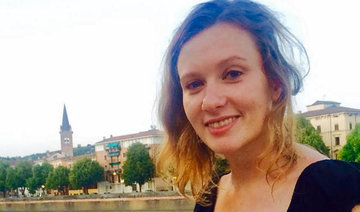
This undated family photo released on Sunday, Dec 17, 2017 by the Britain’s Foreign and Commonwealth Office (FCO) in London, shows Rebecca Dykes. (Britain’s Foreign and Commonwealth Office/AP)
Updated 18 December 2017
Follow

Killer of British diplomat in Lebanon arrested

BEIRUT: Lebanese security forces have arrested a Lebanese taxi driver for killing Rebecca Dykes, a British woman who worked at the British Embassy in Beirut and was found dead on the Metn Expressway on Saturday Morning.
The arrest was confirmed by the Lebanese National News Agency (NNA) correspondent. “The Information Branch of the Internal Security Forces managed to arrest the killer. He was identified as Tarek H., a taxi driver,” said the news agency.
The agency quoted its correspondent as saying that “Tareq had picked up Dykes on Friday evening from Beirut’s Gemmayzeh district where she was on a night out. He drove her from Ashrafieh to the Metn Expressway where he attempted to rape her. He then strangled her with a rope and threw her body away.”
The NNA correspondent said that the Information Branch managed to identify and arrest the killer — who admitted to the crime — after following his car on the Traffic Management Center’s road monitoring cameras between Ashrafieh and Nahr Al-Mot area.
According to a source quoted by Reuters, “the motive was purely criminal, not political.”
Dykes had worked at the British Embassy for the Department for International Development, her LinkedIn page said.
British ambassador to Lebanon Hugo Shorter said on Sunday: “The whole embassy is deeply shocked, saddened by this news.”
Dykes’ family said in a statement issued by Britain’s Foreign Ministry: “We are devastated by the loss of our beloved Rebecca. We are doing all we can to understand what happened.”


UN chief condemns Israeli law blocking electricity, water for UNRWA facilities

Updated 01 January 2026
Follow

UN chief condemns Israeli law blocking electricity, water for UNRWA facilities

  • The agency provides education, health and aid to millions of Palestinians in Gaza, the West Bank, Jordan, Lebanon and Syria

United Nations Secretary General Antonio Guterres condemned on Wednesday a move by Israel to ban electricity or water to facilities owned by the UN Palestinian refugee agency, ​a UN spokesperson said.
The spokesperson said the move would “further impede” the agency’s ability to operate and carry out activities.
“The Convention on the Privileges and Immunities of the United Nations remains applicable to UNRWA (United Nations Relief and Works Agency for Palestine Refugees in the Near East), its property and assets, and to its officials and other personnel. Property used ‌by UNRWA ‌is inviolable,” Stephane Dujarric, spokesman for the ‌secretary-general, ⁠said ​while ‌adding that UNRWA is an “integral” part of the world body.
UNRWA Commissioner General Phillipe Lazzarini also condemned the move, saying that it was part of an ongoing “ systematic campaign to discredit  UNRWA and thereby obstruct” the role it plays in providing assistance to Palestinian refugees.
In 2024, the Israeli parliament passed a law banning the agency from operating in ⁠the country and prohibiting officials from having contact with the agency.
As a ‌result, UNRWA operates in East Jerusalem, ‍which the UN considers territory occupied ‍by Israel. Israel considers all Jerusalem to be part ‍of the country.
The agency provides education, health and aid to millions of Palestinians in Gaza, the West Bank, Jordan, Lebanon and Syria. It has long had tense relations with Israel but ties have deteriorated ​sharply since the start of the war in Gaza and Israel has called repeatedly for UNRWA to ⁠be disbanded, with its responsibilities transferred to other UN agencies.
The prohibition of basic utilities to the UN agency came as Israel also suspended of dozens of international non-governmental organizations working in Gaza due to a failure to meet new rules to vet those groups.
In a joint statement, Canada, Denmark, Finland, France, Iceland, Japan, Norway, Sweden, Switzerland and the United Kingdom said on Tuesday such a move would have a severe impact on the access of essential services, including health care. They said one in ‌three health care facilities in Gaza would close if international NGO operations stopped.