AMMAN: The UN Security Council is expected to vote on Monday on a draft resolution on the status of Jerusalem, with Palestinian leaders confident of overwhelming support from 14 of the council’s 15 members.
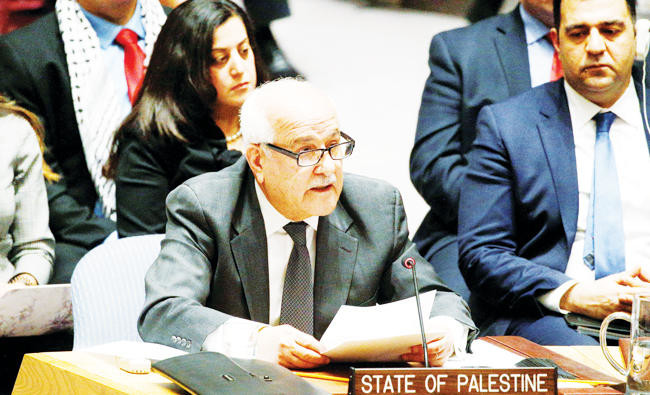
“We have been in touch with Security Council members and we have been assured of their unity behind the Jerusalem resolution, which at its heart reaffirms the council’s previous resolutions,” Riyad Mansour, the Palestinian envoy to the UN, told Arab News.
The Palestinian delegation to the UN, along with Egypt, the draft resolution’s sponsor, have worked at taking into consideration the requests of member states, Mansour said.
“The Europeans in particular asked us to avoid terms like ‘denounce’ and ‘condemn,’ and not to mention the US by name. We acceded to their request but kept the active clauses rejecting all changes to Jerusalem and the reaffirmation of previous decisions.”
The draft UN resolution “affirms that any decisions and actions which purport to have altered the character, status or demographic composition of the Holy City of Jerusalem have no legal effect, are null and void and must be rescinded in compliance with relevant resolutions of the Security Council.”
It follows the unilateral US recognition this month of Jerusalem as the capital of Israel.
The US is likely to veto the draft resolution, but the Palestinians say they have options to deal with that. One is to invoke a rarely used article of the UN Charter that calls for parties with “a dispute” not to cast a veto, although this is viewed as unlikely.
The Palestinians are more likely to take the issue to the UN General Assembly under Resolution 377A, known as the “Uniting for Peace” resolution.
This states that if there no unanimity among the five permanent members of the Security Council, the General Assembly may act itself to maintain international peace and security, and may convene an emergency session.
Resolution 377A was passed in 1950 and used to authorize the deployment of US troops in Korea.
It was last invoked in the 1980s when Palestinians attempted to circumvent the US veto of a resolution on the Jabal Abu Ghneim settlement south of Jerusalem. The emergency session convened then was left in suspension and may be reopened at any time, Mansour said.
“If the resolution is vetoed, the Palestinian delegation can send a letter to the UN Secretary General and ask him to resume the emergency session.”
Israel’s permanent representative to the UN, Danny Danon, condemned the Egyptian draft resolution.
“No vote or debate will change the clear reality that Jerusalem always has been and always will be the capital of Israel. Together with our allies, we will continue to fight, once again, for historical truth,” he said.
In other developments, a special Arab League committee to react to the US declaration on Jerusalem will comprise the foreign ministers of Jordan, Palestine, Egypt, Saudi Arabia, Morocco and the UAE, along with the organization’s Secretary General.
The committee will meet in Amman this week to finalize its strategy and actions, Arab League spokesman Mahmoud Afify said.


‘Overwhelming support’ for UN resolution on Jerusalem
‘Overwhelming support’ for UN resolution on Jerusalem



In major policy shift on Syria, UN Security Council lifts sanctions on Hayat Tahrir Al-Sham
- Move reflects evolving Syrian political landscape in the post-Assad era, ending a global freeze on assets, travel ban and arms embargo
NEW YORK CITY: The UN Security Council on Friday removed Al-Nusra Front, the militant group that evolved into Hayat Tahrir Al-Sham, from its so-called Daesh and Al-Qaeda Sanctions List.
The move signals a major shift in international policy toward Syria’s evolving political landscape in the post-Assad era, and ends a global freeze on assets, travel ban and arms embargo that have been imposed on the group since 2014.
Al-Nusra Front and Hayat Tahrir Al-Sham were led by Ahmad Al-Sharaa, formerly Abu Mohammed Al-Julani, who is now Syria’s president and was a leading figure in the offensive that toppled the Assad regime.
The consensus decision by the Security Council’s sanctions committee was announced by the UK, which holds the presidency of the Security Council this month and was acting in the absence of the chair of the committee. It followed a request by the new Syrian authorities to delist “Al-Nusrah Front for the People of the Levant.”
The decision means measures that were applied to Hayat Tahrir Al-Sham under Security Council Resolution 2734, adopted in 2024, no longer apply. As a result, UN member states are notrequired to freeze the group’s funds, restrict the movement of its representatives, or block the supply or transfer of arms and related materiel.
Al-Nusra Front was added to the sanctions list for its ties to Al-Qaeda and involvement in the financing and execution of militant activities during the war in Syria. The UN initially continued to treat the group’s successor organization, Hayat Tahrir Al-Sham, as a listed alias.
Al-Sharaa has said the group severed all prior transnational jihadist links and is now solely focused on local Syrian matters.