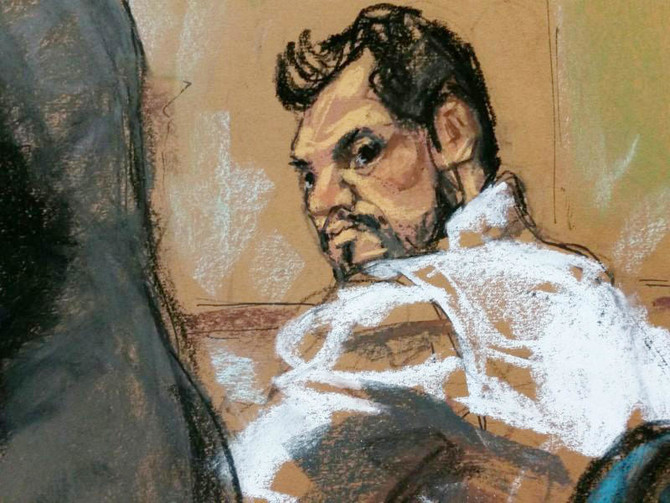
NEW YORK: A judge on Friday belittled a Turkey official’s claims that a Turkish cleric living in Pennsylvania is behind a banker’s trial in an Iran economic sanctions conspiracy, labeling it an “illogical foreign conspiracy theory.”
US District Judge Richard M. Berman commented as he rejected a defense mistrial request after a former Turkish police official testified he fled Turkey because he had discovered government corruption, resulting in his own arrest, and feared for his safety.
Defense lawyers for Turkish banker Mehmet Hakan Atilla said in court papers that testimony earlier this week by Huseyin Korkmaz was prejudicial and “guaranteed to inflame the jury against the defendant.”
The judge accused a defense lawyer of joining “a rather far-fetched conspiracy theory bandwagon” by questioning Korkmaz, a former deputy police inspector in Istanbul, about cleric Fethullah Gulen, a green-card holder living in self-imposed exile in Pennsylvania.
Mahir Unal, a deputy chairman of Turkey President Recep Tayyip Erdogan’s ruling party, recently described the New York trial as a “political” one lacking legal basis. Unal renewed a Turkish government claim that US judicial officials were cooperating with Gulen’s network against Turkey.
Erdogan has accused Gulen of being behind a botched coup and has sought his extradition. Gulen has denied the allegations, and US officials have rebuffed Turkey’s extradition demands, citing a lack of evidence.
When Korkmaz was questioned by a prosecutor as to whether he was released from a Turkish prison after Gulen sent the judge a letter, Korkmaz responded: “This sounds very illogical to me. I don’t know Fethullah Gulen.”
Asked if he was ever a member of the Gulen organization, he responded: “No, never.”
The judge said the defense, which first raised the subject of Gulen, was attempting to introduce an “illogical foreign conspiracy theory” with no foundation in the record as a diversion from issues in the case. He called the tactic “unpersuasive and borderline unprofessional.”
The development came after Atilla began testifying on Friday in his defense, denying claims by prosecutors that he was the brains behind a scheme that began in 2011 as he and others at his employer, the state-run Halkbank, helped to launder billions of dollars in Iranian oil revenue.
Prosecutors say the FBI began investigating after the US Department of the Treasury realized in 2013 that Atilla, wealthy gold trader Reza Zarrab and others were conspiring to use front companies, forged documents and fake transactions involving gold or humanitarian shipments of food to get around US economic sanctions imposed on Iran.
Korkmaz testified that his investigation turned up evidence against three government ministers and Erdogan, who was then prime minister, but he did not have authority to build a case against them. After arrests were made in December 2013, the investigation was shut down and Erdogan dismissed police and prosecutors conducting the probe. Korkmaz was transferred and later arrested and imprisoned for a year-and-a-half.
Zarrab, who has pleaded guilty to charges and testified against Atilla, said last week that he had paid tens of millions of dollars in bribes to government officials and others in the scheme.
Korkmaz testified that he fled the country with his wife and child and gave evidence he smuggled out of the country to US law enforcement officials after reaching the US.

Iran sanctions trial judge slams ‘foreign conspiracy theory’
Iran FM in Geneva for second round of US talks
GENEVA: Iran’s foreign minister has arrived in Geneva ahead of a second round of negotiations with the United States, Iranian state television said Monday, as Washington keeps up pressure on the Islamic republic.
According to Tehran, “indirect” Iran-US nuclear talks mediated by Oman will be held on Tuesday, although Washington has previously pushed for other topics to be discussed including Iran’s ballistic missiles and support for regional proxies.
Tehran and Washington restarted negotiations this month after previous talks collapsed when Israel launched an unprecedented bombing campaign against Iran last June.
Considerable uncertainty surrounds the fate of Iran’s stockpile of more than 400 kilogrammes of 60-percent enriched uranium that was last seen by nuclear watchdog inspectors in June.
“The foreign minister has arrived in Geneva at the head of a diplomatic and expert delegation to take part in the second round of nuclear negotiation,” Iran’s state-run IRIB wrote on its Telegram channel.
During his visit to Geneva, Abbas Araghchi is expected to hold talks with his Swiss and Omani counterparts as well as the head of the International Atomic Energy Agency, Rafael Grossi, and other international officials, Iran’s foreign ministry said.
Washington has dispatched Middle East envoy Steve Witkoff and President Donald Trump’s son-in-law Jared Kushner, the White House confirmed on Sunday.
The latest talks follow repeated threats from Trump of military action against Tehran, first over Iran’s deadly crackdown on anti-government protests, and then more recently over the country’s nuclear program.
The West fears the program is aimed at making a bomb, which Tehran denies.
On Friday, Trump said a change of government in Iran would be the “best thing that could happen,” as he sent a second aircraft carrier to the Middle East to ratchet up military pressure.
Iran’s deputy foreign minister told the BBC that Tehran would consider compromises on its uranium stockpile if Washington lifts sanctions that have crippled the Islamic republic’s economy.
“If we see the sincerity on their (American) part, I am sure we will be on a road to have an agreement,” said Majid Takht-Ravanchi.
Israeli Prime Minister Benjamin Netanyahu said on Sunday that any deal must involve the removal of all enriched uranium from Iran as well as Tehran’s ability to enrich more.
“There should be no enrichment capability... dismantle the equipment and the infrastructure that allows you to enrich in the first place,” he said during a speech in Jerusalem.
- ‘Viable’ deal -
On February 6, Araghchi led the Iranian delegation in indirect talks with Witkoff and Kushner in Muscat.
Switzerland has played a key role in diplomatic relations between Iran and the United States for decades.
It has represented US interests in Iran since Washington broke off relations with Tehran after the 1980 hostage crisis, a year after the Iranian revolution.
Iranian deputy foreign minister for economic diplomacy Hamid Ghanbari said Tehran was seeking a deal with the United States that would generate economic benefits for both countries, particularly in sectors such as aviation, mining and oil and gas, the Fars news agency reported.
“For the agreement to be viable, it is essential that the United States also be able to benefit from it in areas with strong and rapid economic return potential,” he was quoted as saying.
According to Tehran, “indirect” Iran-US nuclear talks mediated by Oman will be held on Tuesday, although Washington has previously pushed for other topics to be discussed including Iran’s ballistic missiles and support for regional proxies.
Tehran and Washington restarted negotiations this month after previous talks collapsed when Israel launched an unprecedented bombing campaign against Iran last June.
Considerable uncertainty surrounds the fate of Iran’s stockpile of more than 400 kilogrammes of 60-percent enriched uranium that was last seen by nuclear watchdog inspectors in June.
“The foreign minister has arrived in Geneva at the head of a diplomatic and expert delegation to take part in the second round of nuclear negotiation,” Iran’s state-run IRIB wrote on its Telegram channel.
During his visit to Geneva, Abbas Araghchi is expected to hold talks with his Swiss and Omani counterparts as well as the head of the International Atomic Energy Agency, Rafael Grossi, and other international officials, Iran’s foreign ministry said.
Washington has dispatched Middle East envoy Steve Witkoff and President Donald Trump’s son-in-law Jared Kushner, the White House confirmed on Sunday.
The latest talks follow repeated threats from Trump of military action against Tehran, first over Iran’s deadly crackdown on anti-government protests, and then more recently over the country’s nuclear program.
The West fears the program is aimed at making a bomb, which Tehran denies.
On Friday, Trump said a change of government in Iran would be the “best thing that could happen,” as he sent a second aircraft carrier to the Middle East to ratchet up military pressure.
Iran’s deputy foreign minister told the BBC that Tehran would consider compromises on its uranium stockpile if Washington lifts sanctions that have crippled the Islamic republic’s economy.
“If we see the sincerity on their (American) part, I am sure we will be on a road to have an agreement,” said Majid Takht-Ravanchi.
Israeli Prime Minister Benjamin Netanyahu said on Sunday that any deal must involve the removal of all enriched uranium from Iran as well as Tehran’s ability to enrich more.
“There should be no enrichment capability... dismantle the equipment and the infrastructure that allows you to enrich in the first place,” he said during a speech in Jerusalem.
- ‘Viable’ deal -
On February 6, Araghchi led the Iranian delegation in indirect talks with Witkoff and Kushner in Muscat.
Switzerland has played a key role in diplomatic relations between Iran and the United States for decades.
It has represented US interests in Iran since Washington broke off relations with Tehran after the 1980 hostage crisis, a year after the Iranian revolution.
Iranian deputy foreign minister for economic diplomacy Hamid Ghanbari said Tehran was seeking a deal with the United States that would generate economic benefits for both countries, particularly in sectors such as aviation, mining and oil and gas, the Fars news agency reported.
“For the agreement to be viable, it is essential that the United States also be able to benefit from it in areas with strong and rapid economic return potential,” he was quoted as saying.
© 2026 SAUDI RESEARCH & PUBLISHING COMPANY, All Rights Reserved And subject to Terms of Use Agreement.