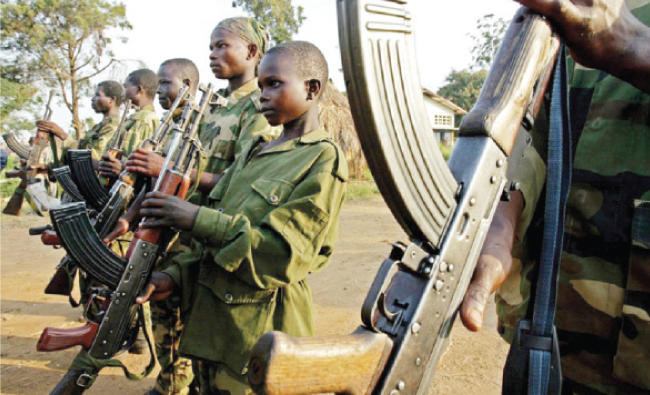
THE HAGUE: International war crimes judges on Friday awarded $10 million in landmark reparations to “hundreds or thousands” of former child soldiers left brutalized and stigmatized after being conscripted into a ruthless Congolese militia.
Warlord Thomas Lubanga, 56, was jailed for 14 years after being convicted in 2012 at the International Criminal Court (ICC) of abducting boys and girls and press-ganging them into his Union of Congolese Patriots (UPC) in the eastern Ituri region of the Democratic Republic of Congo (DR Congo).
The judges said Friday that Lubanga, who is serving his sentence in a Congolese prison, was also liable for compensation to 425 victims, identified by the court. At the time of the crimes in 2002-2003, all were under 15.
They stressed, though, that it was difficult to determine the exact number of child soldiers drawn into Lubanga’s militia — many of whom were exploited as bodyguards or sex slaves — saying there were “hundreds or even thousands of additional victims.”
Each of the 425 named victims had suffered harm amounting to $8,000, giving a total of $3.4 million, presiding judge Marc Perrin de Brichambaut said.
But in a surprise move, the judges then awarded a further $6.6 million to help any others who may now come forward.
The award is collective, and will be used in projects to help victims rebuild their lives and integrate back into society.
Local rights groups welcomed the award, saying it was a relief for victims, many of whom are now in their 30s with children of their own.
“What is important to us, is not the amount attached to this award... the main thing is that it has been recognized that there are victims in this case,” said Xavier Maki from the Justice Plus group.
The award, equivalent to €8.5 million, will be administered by the independent Trust Fund for Victims, which has already drawn up a three-year project to help Lubanga’s victims, and set aside €1 million for the case.
Fund director Pieter de Baan told AFP the $10 million award was a victory for the victims.
“It is really important that this is an acknowledgement that if harm is suffered on a mass scale by victims, you need to take it seriously, you need to recognize that and you need to put an amount to it,” he said.
But the fund, which is solely supported by donations from ICC member states, said it would be “challenging” to come up with the money, after the court also declared Lubanga penniless.
“We don’t have $10 million. We didn’t know what was coming, we had no idea. We have in our reserves €5.5 million,” he said, adding he would be appealing for more funds from ICC member-states.
The fund will assess the needs of each victim, and provide medical and psychological treatment. Other forms of help will include educational and vocational training.
The NGO Child Soldiers International, which works to stop children being used in conflicts, welcomed Friday’s award as the “recognition of the great suffering experienced by the children exploited and abused” by Lubanga.
They hoped it would “act as a catalyst in showing that those who recruit and exploit children in conflict will be held accountable for their crimes,” said program manager Sandra Olsson.
Ituri remains “a highly militarised province” and the use of child recruits remains prevalent, she warned, urging the authorities and international bodies “to ramp up” efforts to free children and prosecute abusers. Lubanga can appeal the decision, and his lawyers have argued he should not pay anything.
“Who are these victims that the court is going to compensate?” asked Pele Kaswara Tahigomu, a leading member of Lubanga’s party in Bunia, adding the ruling was “just another move against” Lubanga.
Lubanga’s is the ICC’s third reparations award. In March, judges awarded $250 each to 297 victims of another Congolese warlord, Germain Katanga.
And in August, the court ruled a Malian militants caused €2.7 million in damage when he destroyed several Timbuktu shrines in 2012.


![]()
ICC awards DR Congo child soldiers $10m in damages
ICC awards DR Congo child soldiers $10m in damages

Latest updates


© 2026 SAUDI RESEARCH & PUBLISHING COMPANY, All Rights Reserved And subject to Terms of Use Agreement.