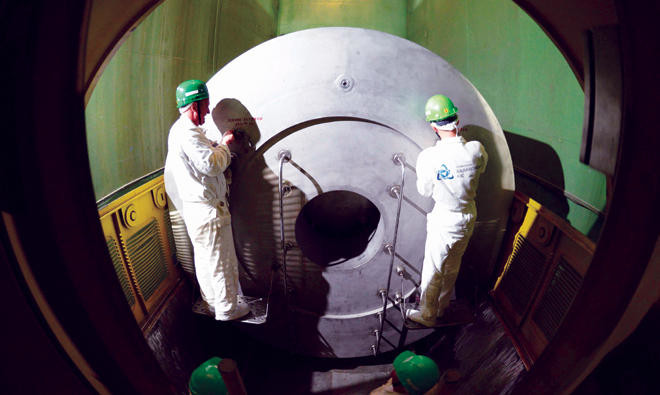
LONDON: Saudi Arabia and Russia have signed a roadmap deal to implement a civil nuclear cooperation program that was inked in Moscow in October when King Salman met President Vladimir Putin.
A statement from Russian state-owned nuclear company Rosatom said on Thursday the countries aim to cooperate in the field of small and medium-sized nuclear reactors that can be used for both power generation and water desalination.
“The parties also plan to cooperate in training personnel for the Saudi nuclear industry and developing the Kingdom’s nuclear infrastructure,” Rosatom said.
Additionally, Russia and Saudi Arabia would look to establish a center for nuclear science and technology in KSA, one based on a Russian-design research reactor, said Rosatom in an announcement on its website.
Evgeny Pakermanov — president of Rusatom Overseas, a subsidiary of Rosatom responsible for promoting Russian nuclear technologies in overseas markets — and Maher Abdullah Alodan, chief atomic energy officer of the King Abdullah City for Atomic and Renewable Energy (K.A.CARE), signed the document on behalf of Russia and Saudi Arabia respectively.
Jane Kinninmont, a senior research fellow specializing in the Middle East at London-based Chatham House, told Arab News: “As the Saudi king’s unprecedented visit to Moscow in October indicated, these days most players prefer to hedge their bets, balancing different relationships and avoiding over-aligning with any single power.”
The nuclear roadmap comprises a set of steps to be implemented by the parties in order to promote cooperation in areas designated in the accord, signed into effect in Moscow on Oct. 5, 2017.
The historic summit in the Russian capital indicated a thawing of relations between the two countries, which are on different sides in the Syrian civil war — but which, nevertheless, have a common interest in maintaining a stable oil price and have other joint commercial and geopolitical interests.
At the time of that meeting, Russian Energy Minister Alexander Novak said: “We (and Saudi Arabia) have a vast potential for developing cooperation in nuclear power. Nuclear power may become one of the basic sources and an extra catalyst for the development of various industries and innovation technologies in Saudi Arabia.”
Nabi Abdullaev, associate director at Control Risks in London, told Arab News: “With trade between Russia and Iran being below $2 billion (compared to $40 billion with Turkey), Russia is interested in balancing Tehran politically and in exploring economic opportunities with Saudi Arabia.”


![]()
Saudi Arabia, Russia cement nuclear energy ties
Saudi Arabia, Russia cement nuclear energy ties
Latest updates


Recommended


© 2026 SAUDI RESEARCH & PUBLISHING COMPANY, All Rights Reserved And subject to Terms of Use Agreement.