LONDON: Chris Froome has admitted that his adverse drugs test during his victory at the Vuelta a Espana is “damaging” as the four-time Tour de France winner battles to clear his name.
The British rider had twice the permissible amount of asthma medication Salbutamol in his system during the Grand Tour race he won in September.
Cycling’s governing body UCI has asked the Team Sky rider to provide more information but in line with World Anti-Doping Agency guidelines has not suspended him.
If Froome fails to provide a satisfactory answer the UCI could proceed with an anti-doping rule violation case, which could strip him of his Vuelta victory and result in him missing a large chunk of next season.
“This is damaging. It’s come as a huge shock to me as well,” Froome told Sky Sports.
“At the same time I know within me that fundamentally I have followed the protocol, I have not overstepped any boundaries and I hope by the end of this process that will be clear to everyone and I’ll be exonerated of any wrongdoing.
“I can’t say what other people are going to think at the end of this. I can only obviously control my input to the situation.”
Team Sky said in a statement on Wednesday that Froome experienced “acute asthma symptoms” during the final week of the Vuelta and increased his dosage of Salbutamol, within permissible limits, on medical advice.
“Coming into the last week of La Vuelta I began to feel a lot more symptomatic — my asthma was playing up a lot more and that’s when the doctor advised me to increase the number of puffs — obviously staying well in the legal limit of the maximum allowed number of puffs you can take during the race,” said Froome.
“So we did increase it and that’s why we’re faced with this question of ‘I did stay within the limits but obviously the test results show a different reading’ so we’re trying to evaluate what has happened.”
Froome, widely considered the greatest Tour rider of his generation, is scheduled to race the Giro d’Italia in May 2018 ahead of defending his Tour de France title in July 2018.
The test raises fresh questions about British cycling following the scandal surrounding Bradley Wiggins, who received therapeutic use exemptions (TUEs) to take a corticosteroid in 2011, 2012 and 2013, including before his 2012 Tour de France win.
Wiggins and Sky have repeatedly denied any wrongdoing, saying the drug was prescribed to treat a longstanding pollen allergy.


Chris Froome admits failed drugs test at Vuelta is "damaging"
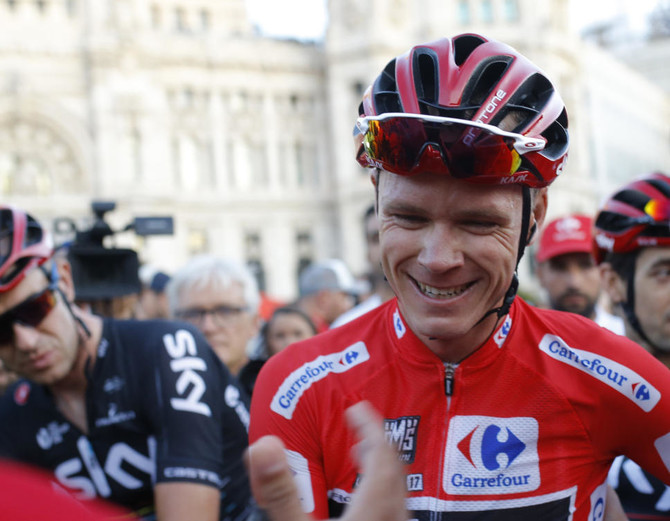
Chris Froome admits failed drugs test at Vuelta is "damaging"


San Siro prepares for last dance with Winter Olympics’ opening ceremony
- Friday’s ceremony will likely be the last major international sporting event hosted at a stadium which is so beloved it is nicknamed ‘Football’s La Scala’ after Milan’s historic opera house
- The iconic old ground is on course to be replaced by a shiny new arena after a century of hosting Inter Milan and AC Milan matches
MILAN: One of the world’s most famous stadiums is set for a last hurrah on the international stage with the opening ceremony of the 2026 Winter Olympics at the San Siro on Friday.
Long considered one of the temples of football, the San Siro will introduce the Milan-Cortina Games to the world with a ceremony featuring an athletes’ parade held in all four “clusters” of a sprawling Olympics being held across a vast area of northern Italy.
But the iconic old ground is on course to be replaced by a shiny new arena after a century of hosting Inter Milan and AC Milan matches.
In September the local government of Italy’s economic capital approved a 197-million-euro ($229.5 million) sale of just over 28 hectares (70 acres) of public land, on which the San Siro sits, to the two clubs.
Inter and AC Milan will abandon the iconic ground once their new stadium is built, the idea being that it be finished in time to host matches at the 2032 European Championship to be jointly held in Italy and Turkiye.
The two Milan clubs — European football royalty now both owned by American investment funds — — are planning the construction of a modern 71,500-capacity stadium to the immediate west of the current San Siro, on an area currently occupied by matchday car parking and a local park.
Once the new ground is constructed, San Siro will be almost entirely demolished to make way for new parkland, office space and entertainment facilities.
The current stadium no longer meets European football governing body UEFA’s requirements to host major events and was denied the 2027 Champions League final.
That means Friday’s ceremony will likely be the last major international sporting event hosted at a stadium which is so beloved it is nicknamed “Football’s La Scala” after Milan’s historic opera house.
Milanese icon
The San Siro was inaugurated with a derby match between Inter and AC Milan on September 19, 1926 and over the years it has hosted World Cup and European Championship matches, as well as dozens of fixtures for the Italian national team.
Initially owned by AC Milan before being bought by the city in the 1930s, with Inter making it their home in 1947, the San Siro has been renovated several times, with the last major works being carried out ahead of the 1990 World Cup.
That restyling, which added a third tier to the stadium, gave the San Siro the futuristic look — with spiralling external columns and a striking red roof — that still catches the eye over three decades later.
The San Siro also doubles up as one of Italy’s premier concert venues, where some of the world’s biggest pop music stars have strutted their stuff since reggae icon Bob Marley became the first in 1980.
From the Rolling Stones and David Bowie, right up to contemporary superstars Beyonce and Taylor Swift, the stadium attracts massive crowds for summertime performances from international hit machines and local favorites like Grammy-winning rock band Maneskin.
The new stadium should it be built as scheduled by the end of 2030, but with a final project a long way from being approved by the city, nothing is certain, especially with local elections coming next year.
Politicians on the local and national stage have repeatedly expressed anger at the idea of knocking down a symbol of Milan and in 2023 succeeded in torpedoing a previous attempt by the clubs to build a new stadium on the same site.


