

Aid group: At least 6,700 Rohingya killed in Myanmar

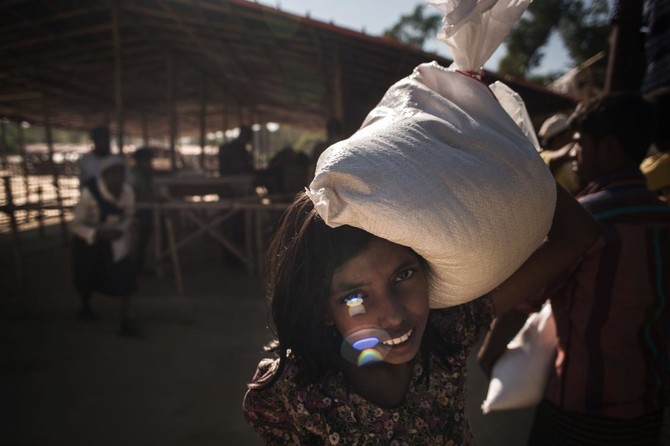
A Rohingya migrant collects a sack of rice from a relief centre at the Balukhali refugee camp at Cox's Bazar on November 30, 2017. Rohingya are still fleeing into Bangladesh even after an agreement was signed with Myanmar to repatriate hundreds of thousands of the Muslim minority displaced along the border, officials said on November 27. (AFP)
Updated 14 December 2017
Follow

Aid group: At least 6,700 Rohingya killed in Myanmar

BANGKOK: International aid group Doctors Without Borders said its field survey has found at least 6,700 Rohingya Muslims were killed between August and September in a crackdown by Myanmar’s security forces.
The group, known by its French acronym MSF, said in a statement made available Thursday that it conducted the survey in refugee camps in Bangladesh. It estimated that at least 9,000 Rohingya had died of various causes in Myanmar’s Rakhine state between Aug. 25 and Sept. 24, and that more than 70 percent of the deaths were the result of violence.
According to MSF, the dead included at least 730 children younger than 5.
More than 630,000 Rohingya Muslims have fled Buddhist-majority Myanmar into Bangladesh to escape what the United Nations has called “ethnic cleansing.”
“The peak in deaths coincides with the launch of the latest ‘clearance operations’ by Myanmar security forces in the last week of August,” MSF medical director Sidney Wong said in a statement.
She said the findings were staggering, both in terms of the numbers of people who reported a family member dead as a result of violence and the horrific ways in which they said they were killed or severely injured.
MSF said that among children below the age of 5, more than 59 percent who were killed during that period were reportedly shot, 15 percent burnt to death in their homes, 7 percent beaten to death and 2 percent died due to land mine blasts.

Myanmar’s Information Ministry has said that 400 people died following attacks by a militant Rohingya group on police posts on Aug. 25. It said most of the 400 were “extremist terrorists” who died during military “clearance operations.”
International aid and rights groups have accused the military of arson, killings and rapes of Rohingya villagers. Myanmar authorities have blamed Rohingya militants for the violence.
More than 1 million ethnic Rohingya Muslims have lived in Myanmar for generations. They have been stripped of their citizenship, denied almost all rights and labeled stateless.
Since the Myanmar’s military conducted operations against the Rohingya in Rakhine state, the civilian government has barred most journalists, international observers and humanitarian aid workers from independently traveling to the region.
MSF said the number of deaths is likely to be an underestimation “as we have not surveyed all refugee resettlements in Bangladesh and because the surveys don’t account for the families who never made it out of Myanmar.”


Archbishop of York says he was ‘intimidated’ by Israeli militias during West Bank visit

Archbishop of York Stephen Cottrell poses for a photograph with York Minster’s Advent Wreath.
Updated 5 sec ago
Follow

Archbishop of York says he was ‘intimidated’ by Israeli militias during West Bank visit

  • “We were … intimidated by Israeli militias who told us that we couldn’t visit Palestinian families in the occupied West Bank,” the archbishop said

LONDON: The Archbishop of York has revealed that he felt “intimidated” by Israeli militias during a visit to the Holy Land this year.

“We were stopped at various checkpoints and intimidated by Israeli militias who told us that we couldn’t visit Palestinian families in the occupied West Bank,” the Rev. Stephen Cottrell told his Christmas Day congregation at York Minster.

The archbishop added: “We have become — and really, I can think of no other way of putting it — we have become fearful of each other, and especially fearful of strangers, or just people who aren’t quite like us.

“We don’t seem to be able to see ourselves in them, and therefore we spurn our common humanity.”

He recounted how YMCA charity representatives in Bethlehem, who work with persecuted Palestinian communities in the West Bank, gave him an olive wood Nativity scene carving.

The carving depicted a “large gray wall” blocking the three kings from getting to the stable to see Mary, Joseph and Jesus, he said.

He said it was sobering for him to see the wall in real life during his visit.

He continued: “But this Christmas morning here in York, as well as thinking about the walls that divide and separate the Holy Land, I’m also thinking of all the walls and barriers we erect across the whole of the world and, perhaps most alarming, the ones we build around ourselves, the ones we construct in our hearts and minds, and of how our fearful shielding of ourselves from strangers — the strangers we encounter in the homeless on our streets, refugees seeking asylum, young people starved of opportunity and growing up without hope for the future — means that we are in danger of failing to welcome Christ when he comes.”