MANILA: Philippine lawmakers on Wednesday overwhelmingly backed President Rodrigo Duterte’s plan to extend martial law for all of next year in Mindanao, an island he called a “flashpoint for trouble” and atrocities by radical and communist rebels.
The extension, until Dec. 31 next year, would mark the longest period of martial law since the 1970s era of late strongman Ferdinand Marcos, one of the darkest and most oppressive chapters of the country’s recent history.
At a joint session of Congress, 240 out of 267 lawmakers agreed with Duterte on the need for tough measures to stop Muslim militants recruiting fighters and preparing a new wave of attacks after occupying Marawi City for five months this year.
Duterte thanked Congress for its support and said the communist New People’s Army and militants loyal to Daesh were equally threatening.
“There is a need for me to come up with something, otherwise Mindanao will blow apart,” he told reporters.
The government worries that mountainous, jungle-clad Mindanao, a region the size of South Korea that is home to the Muslim minority, could attract international extremists.
The Marawi City assault was the Philippines’ biggest security crisis in decades, killing more than 1,100 people, mostly militants. The armed forces took 154 days to win the battle, and 185 extremists are estimated to still be at large.
Duterte enjoys massive public support, but his frequent threats to expand martial law are contentious in a country that suffered nine years of oppression under Marcos before his ouster in 1986.
Marcos was accused of inventing security threats to justify tightening his grip on power and crushing detractors.
Duterte’s opponents lament his authoritarian streak and speculate that his end game is to emulate Marcos by declaring martial law nationwide, as he has often threatened. Asked several times on Wednesday if he was prepared to go that far, he said, “It depends on the enemies of the state.”
Minority lawmakers said the extension of martial law was illegal because Duterte had cited security threats, rather than rebellion or invasion, the conditions under which martial law can be invoked.
Duterte scoffed at the notion that the conflict in Mindanao, his home for most of his life, did not constitute rebellion.
“There is actually rebellion in Mindnanao, it is ongoing, the fighting is going on,” he said.
Congressman Tom Villarin said martial law would cost a huge amount of money, calling broad support for it a “death blow to our democracy.”
“We have made martial law the new normal, absent of any proof of invasion or rebellion,” he said. “Martial law now desensitizes the people to wrongly equate it with good governance and democracy.”
In his request to Congress on Monday, Duterte had argued that a little-known operative active in Mindanao, Abu Turaifie, was “said to be” Daesh’s potential point man in Southeast Asia.


![]()
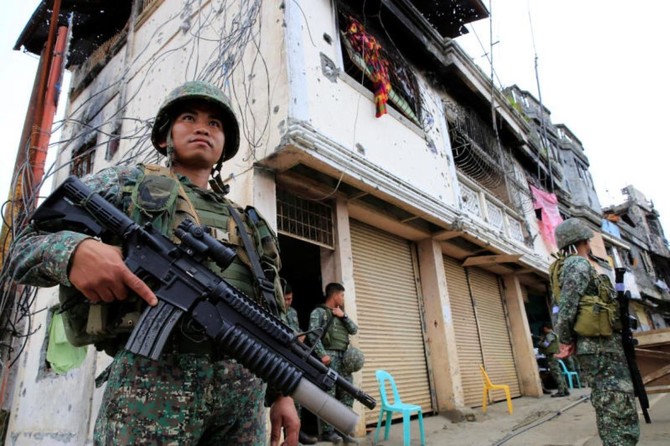
Philippine Congress votes to extend martial law in Mindanao
Philippine Congress votes to extend martial law in Mindanao

Latest updates


© 2026 SAUDI RESEARCH & PUBLISHING COMPANY, All Rights Reserved And subject to Terms of Use Agreement.