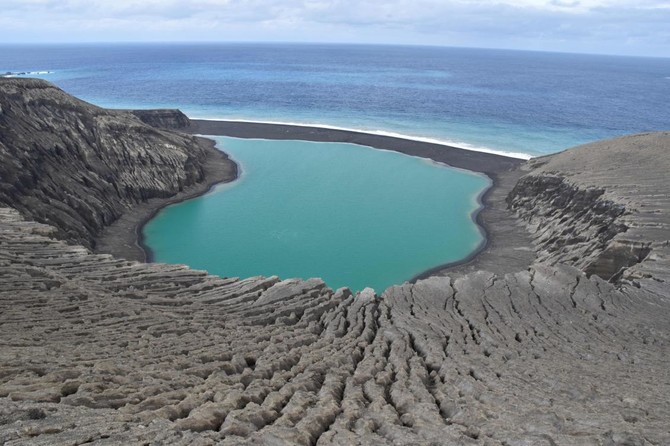
WELLINGTON: The world’s newest island — formed during a volcanic eruption in the remote Pacific four years ago — may offer clues to how life potentially developed on Mars, NASA said Wednesday.
The island of Hunga Tonga Hunga Ha’apai rose from the seabed about 65 kilometers (40 miles) northwest of the Tongan capital Nuku’alofa in late 2014-early 2015.
Scientists initially expected the island — created when vast quantities of rock and dense ash spewed from the Earth’s crust — to wash away within a few months.
But NASA said it had proved more resilient than expected, possibly because warm sea water combined with ash during the volcanic explosion to create a concrete-like substance known as “tuff.”
While the island — which initially measured one kilometer wide, two kilometers long and about 100 meters high — has undergone significant erosion, it is now expected to last anywhere from six to 30 years.
Jim Garvin, the chief scientist at NASA’s Goddard Space Flight Center, said it was a rare chance to study the life cycle of a newly created island.
He said Mars had many similar volcanic islands that appeared to have been surrounded by water when they were created.
Garvin said such spots may be prime locations to look for evidence of past life because they combined a wet environment with heat from volcanic processes.
Examining how life gained a foothold on the Tongan island could help scientists pinpoint where to look for evidence of life on Mars, he said.
“Islands like this might have worked on Mars two or three billion years ago — lakes and small seas filling depressions, persistent surface waters,” he said.
“(It’s) stuff we really strive to understand because it could have produced the conditions necessary for microbial life.”
NASA’s studies on the island were presented at a meeting of the American Geophysical Union in New Orleans this week.
It comes after US President Donald Trump on Monday directed NASA to send Americans to the Moon for the first time since 1972, in order to prepare for future trips to Mars.


![]()
New island offers clues in search for life on Mars: NASA
New island offers clues in search for life on Mars: NASA


Latest updates


© 2026 SAUDI RESEARCH & PUBLISHING COMPANY, All Rights Reserved And subject to Terms of Use Agreement.