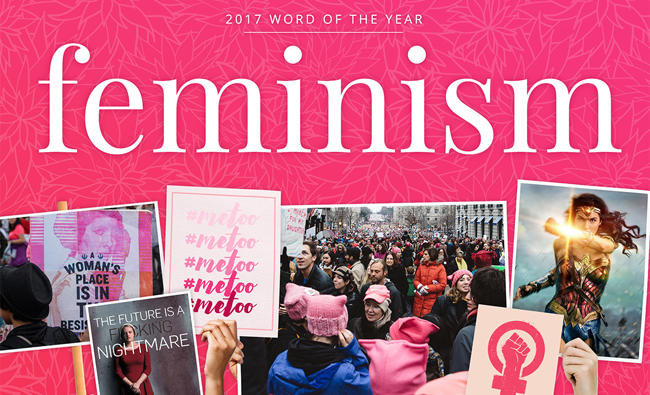
‘Feminism’ is US dictionary ‘Word of the Year’

Courtesy image
Updated 16 December 2017
Follow

‘Feminism’ is US dictionary ‘Word of the Year’

NEW YORK: In the year that Donald Trump’s inauguration triggered nationwide women’s protests and powerful men were toppled by a firestorm of sexual misconduct allegations, the leading US dictionary named “feminism” its word of 2017.
Merriam-Webster bestows the “Word of the Year” honor on the word or term with the sharpest spike in look-ups over the previous year.
This year the dictionary announced a 70 percent increase in online searches for “feminism” compared to 2016, recording multiple spikes corresponding to a string of news reports and events.
Searches rose following the Women’s March on Washington and other US cities on January 21, the day after Trump was sworn in as president, the dictionary said Tuesday.
There was another spike when White House adviser Kellyanne Conway, the first woman to run a successful US presidential campaign, said in February that she did not consider herself a feminist.
Interest was also driven by “The Handmaid’s Tale,” the Hulu series about a dystopian future in which a woman lives as a concubine during a time of dictatorship, and Hollywood blockbuster “Wonder Woman” starring Israel’s Gal Gadot.
Merriam-Webster said more look-ups followed the outpouring of sexual harassment allegations that have unseated well-known figures in Hollywood, politics, business, and triggered the #MeToo social media campaign by women all over the world.
The dictionary’s current definitions of feminism are “the theory of the political, economic, and social equality of the sexes” and “organized activity on behalf of women’s rights and interests.”
Another top trending word for 2017 was “complicit,” connected to Trump’s sacking of FBI director James Comey, Russian interference in the 2016 election, and Ivanka Trump’s comment that she did not know what the word meant — which was then parodied in a skit for television show “Saturday Night Live.”
Among the other spikes recorded was one for the word “dotard,” which North Korean leader Kim Jong-Un used in a statement about Trump in September.


Cambodia takes back looted historic artifacts handled by British art dealer

Updated 28 February 2026
Follow

Cambodia takes back looted historic artifacts handled by British art dealer

  • The objects were returned under a 2020 agreement between the Ministry of Culture and Fine Arts and the family of the late Douglas Latchford, a British art collector and dealer who allegedly had the items smuggled out of Cambodia

PHNOM PENH, Cambodia: Cambodian officials on Friday received more than six dozen historic artifacts described as part of the country’s cultural heritage that had been looted during decades of war and instability.
At a ceremony attended by Deputy Prime Minister Hun Many, the 74 items were unveiled at the National Museum in Phnom Penh after their repatriation from the United Kingdom.
The objects were returned under a 2020 agreement between the Ministry of Culture and Fine Arts and the family of the late Douglas Latchford, a British art collector and dealer who allegedly had the items smuggled out of Cambodia.
“This substantial restitution represents one of the most important returns of Khmer cultural heritage in recent years, following major repatriations in 2021 and 2023 from the same collection,” the Culture Ministry said in a statement. “It marks a significant step forward in Cambodia’s continued efforts to recover, preserve, and restore its ancestral legacy for future generations.”
The artifacts were described as dating from the pre-Angkorian period through the height of the Angkor Empire, including “monumental sandstone sculptures, refined bronze works, and significant ritual objects.” The Angkor Empire, which extended from the ninth to the 15th century, is best known for the Angkor Wat archaeological site, the nation’s biggest tourist attraction.
Latchford was a prominent antiquities dealer who allegedly orchestrated an operation to sell looted Cambodian sculptures on the international market.
From 1970 to the 1980s, during Cambodia’s civil wars and the communist Khmer Rouge ‘s brutal reign, organized looting networks sent artifacts to Latchford, who then sold them to Western collectors, dealers, and institutions. These pieces were often physically damaged, having been pried off temple walls or other structures by the looters.
Latchford was indicted in a New York federal court in 2019 on charges including wire fraud and conspiracy. He died in 2020, aged 88, before he could be extradited to face charges.
Cambodia, like neighboring Thailand, has benefited from a trend in recent decades involving the repatriation of art and archaeological treasures. These include ancient Asian artworks as well as pieces lost or stolen during turmoil in places such as Syria, Iraq and Nazi-occupied Europe. New York’s Metropolitan Museum of Art is one of the prominent institutions that has been returning illegally smuggled art, including to Cambodia.
“The ancient artifacts created and preserved by our ancestors are now being returned to Cambodia, bringing warmth and joy, following the country’s return to peace,” said Hun Many, who is the younger brother of Prime Minister Hun Manet.