Al Jazeera coverage of Trump’s Jerusalem move ‘promoting hatred’

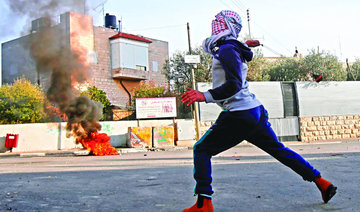
Al Jazeera coverage of a protest in Gaza showed a demonstrator taking out two pistols in front of the camera. (Screengrab)
Updated 12 December 2017
Follow

Al Jazeera coverage of Trump’s Jerusalem move ‘promoting hatred’

LONDON: Al Jazeera’s coverage of President Donald Trump’s recent decision to move the US Embassy in Israel to Jerusalem has been criticized for “promoting hatred and furthering tensions.”
As Trump’s decision sparked global outrage, with world leaders denouncing the move, international media gave extensive attention to global demonstrations.
However, the Qatari-owned channel’s reporting of the issue has been described as irresponsible for giving airtime to extremist views.
“The concern with Al Jazeera Arabic’s coverage of Trump’s Jerusalem announcement is that it gives airtime to some very extreme and violent comments, including calls by the terrorist group Hamas,” Tom Wilson, media commentator and fellow at the Henry Jackson Society, told Arab News.
During its daily evening program, Al Jazeera aired a tweet by Hamas — which is designated as a terrorist organization by some countries — calling the Arab and Muslim nations to mark last Friday as a “day of anger against the occupation.”
“If news agencies publicize such views in an uncritical manner, without sufficiently challenging them, then this can risk promoting hatred and furthering tensions,” Wilson said.
The Arabic news channel also aired an interview with a demonstrator who said that Palestine will be liberated only by the “child who holds a knife, and by the martyr who sacrificed his life for Palestine.”
In another report, a protester tells an Al Jazeera reporter that the US president will “meet the jihad by Muslims and Arabs.”
In another segment, the channel broadcasted a protest from Gaza where a demonstrator took out two pistols in front of the camera.
“At such a volatile time in the region channels like Al Jazeera Arabic should avoid the kind of coverage that further enflames feelings that might contribute to violence,” Wilson said. Al Jazeera’s reporting has previously been criticized for inciting hate and giving a platform to extremists and terrorists. Al Jazeera featured the Muslim Brotherhood cleric Yusuf Qaradawi, who used to promote anti-Semitism and infamously blessed suicide attacks in a 2013 interview.

Media experts accused Al Jazeera of misrepresenting information under the guise of freedom of expression and accuracy.
“All broadcasters have a responsibility to inform the public in a way that is fair and balanced and that does not involve any kind of incitement,” Wilson said.
Dalia Al-Aqidi, a media analyst and political talk-show host, said that the Qatari network had played a “dirty role” in regional conflicts.
“Manipulating the emotions of its viewers was one of the reasons behind the popularity of Al Jazeera TV, which played a dirty role in the Middle Eastern conflicts, starting with its coverage of the war in Iraq, insulting the people who were happy to get rid of the late President Saddam Hussein,” she said.
Al Jazeera has supported Osama bin Laden and other terrorists, who have “killed more innocent Muslims than what they call ‘the enemy’ —  whoever the enemy is — spreading hatred and sectarianism by legitimizing violence under the pretext of liberating Palestine.”
She added: “We just need to watch its coverage about the violent demonstrations and type of speakers they host, to realize that it’s quite clear ... Al Jazeera is taking a firm stand against the United States and Saudi Arabia. (It is) using the suffering of the people to serve its political agenda.”
Abdellatif El-Menawy, an Egyptian media analyst, pointed to the dangers of media stoking violence.
“I fully respect the anger of the Palestinian people, Arab peoples and many sympathizers around the world,” he told Arab News.
“But the mistake is when some media deal with these positions for incitement that will not lead to a positive outcome but will complicate the situation even more.”
Al Jazeera did not respond to a request for ­comment.


Gems of Arabia magazine launched to spotlight talents shaping Saudi Arabia’s evolving cultural landscape

Updated 15 January 2026
Follow

Gems of Arabia magazine launched to spotlight talents shaping Saudi Arabia’s evolving cultural landscape

  • The publication features established and emerging talents elevating the region across design, fashion, art, tech, music, architecture and media
  • Saudi fashion designer Hatem Alakeel seeks to highlight the richness of the Kingdom, and wider modern Arab culture to global audiences

DUBAI: When Saudi fashion designer Hatem Alakeel interviewed Princess Reema bint Bandar Al-Saud before her appointment as Saudi ambassador to the US, the longtime advocate of women’s empowerment made a powerful prediction: “I look forward to the day that the Saudi woman is no longer the story but rather a phenomenal achievement.”

That moment would become the foundation for Gems of Arabia, an arts and culture audio-visual podcast that spotlights the creative talents shaping the landscape of Saudi Arabia and the broader region.

Over six years, Gems of Arabia has documented the sweeping transformation of the Kingdom’s art and culture scene, and is now evolving into a full-fledged magazine.

Hatem Alakeel is a Saudi fashion designer. (Supplied)

“It started off as a column I used to write, and from there, it turned into a podcast. Now it is growing into a magazine,” Dubai-based Alakeel, the magazine’s founder and editor-in-chief, told Arab News ahead of the launch of the digital publication on Thursday.

Besides spotlighting celebrated regional artists, Alakeel said Gems of Arabia is in search of the “hidden gems” elevating the region across design, fashion, art, tech, music, architecture and media.

The magazine serves as a platform for talented, authentic creatives and tech entrepreneurs unable to articulate their work “because they don’t have the public relations or capacity to promote themselves even through social media.”

Alakeel added: “Our job is to identify all these authentic people; you don’t have to be famous, you just have to be authentic, and have a great story to tell.”

The digital publication offers a dynamic blend of short-form podcasts, coverage of regional cultural events, in-depth features and editorials, long-form interviews and artist profiles — spotlighting both celebrated and emerging talents. This is complemented by social media vox pops and bite-sized coverage of art events across the region.

Alakeel, who also runs Authenticite, a consulting and creative production agency connecting creators and brands who want to understand Saudi culture, said the magazine content is “carefully curated” to feature topics and personalities that resonate in the region.

What differentiates Gems of Arabia, he said, is its story of continuity and substance amassed over the years that has captured the evolution of the wider regional landscape.

“The website represents an archive of nearly 150 articles compiled through years of podcasts and long-form conversations that show continuity and depth changes,” he said.

“So, it’s an evolution and it’s another home for all our content and our community.”

Growing up in France, Alakeel said his mission started early on when he felt the need to represent his Saudi culture “in a way where it can hold its own internationally.”

Through his first brand, Toby, he sought to bring the traditional thobe into modern designs and introduce it to the luxury fashion world. This mission was accomplished when his thobe designs were placed alongside global labels such as Harvey Nichols, Dolce & Gabbana and Prada.

What began as a personal design mission would soon expand into a broader platform to champion Saudi talent. 

“I was articulating my culture through fashion and it just felt natural to do that through the incredible people that the region has,” Alakeel said, adding that the magazine aims to highlight the richness of the Kingdom, and wider modern Arab culture to global audiences.

“Art is such a great way of learning about a culture and a country,” he said. 

On the ground in Saudi Arabia, the publication hosts GEMS Forum, a series of live cultural gatherings that bring together prominent artistic figures for in-depth conversations later transformed into podcast episodes recorded with a live audience.

Alakeel said the print edition of Gems of Arabia will debut in March, designed as a collectible coffee-table quarterly distributed across the Gulf.

He envisions the platform growing into a long-term cultural record.

“It's a Saudi-centric magazine, but the idea is to make it inclusive to the region and everyone authentic has a seat at the table,” said Alakeel.