Netanyahu sees Europeans following Trump on Jerusalem

Israel’s Prime Minister Benjamin Netanyahu and European Union foreign policy chief Federica Mogherini brief the media at the European Council in Brussels, Belgium Dec. 11, 2017. (Reuters/Francois Lenoir)
Updated 11 December 2017
Follow

Netanyahu sees Europeans following Trump on Jerusalem

BRUSSELS: Israeli Prime Minister Benjamin Netanyahu said Monday that recognizing Jerusalem as his country’s capital “makes peace possible,” after widespread international criticism of the US decision to do so.
US President Donald Trump’s announcement last week has been followed by days of protests and clashes in the Palestinian territories, as well as demonstrations across the Islamic world.
The EU expressed alarm at the decision, which upends seven decades of US policy on the disputed holy city, and the bloc’s foreign ministers are set to urge Netanyahu to resume dialogue with the Palestinians as he meets them over breakfast in Brussels.
The Israeli premier said what Trump had done was to “put facts squarely on the table” by acknowledging Jerusalem had been the capital of the Israeli state for 70 years and of the Jewish people for 3,000 years.
“It doesn’t obviate peace, it makes peace possible, because recognizing reality is the substance of peace, it’s the foundation of peace,” he said in a statement alongside EU diplomatic chief Federica Mogherini.
Mogherini, who last week warned the Jerusalem decision could take the situation “backwards to even darker times,” restated the EU’s position that a two-state solution with Jerusalem as capital for both Israelis and Palestinians was the only sustainable way to resolve the conflict.
Netanyahu pointed to a new US peace initiative as a possible way forward.
“There is now an effort under way to bring forward a new peace proposal by the American administration. I think we should give peace a chance. I think we should see what is presented and see if we can advance this peace,” he said.
Trump’s son-in-law and senior adviser Jared Kushner has been working with a small team to develop a new US proposal to revive peace talks between Israel and the Palestinians, but it is not clear what progress he is making.
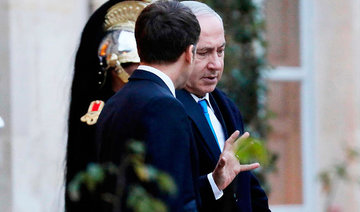
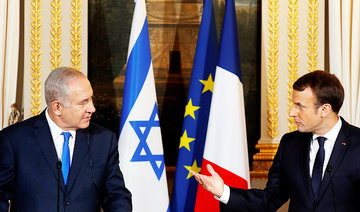
Netanyahu’s visit to Brussels comes after he met French President Emmanuel Macron in Paris on Sunday. Macron called on him to freeze settlement building and to re-engage with Palestinians.
Both Israelis and Palestinians claim Jerusalem as their capital and previous peace plans have stumbled over debates on whether and how to divide sovereignty or oversee holy sites.


Jordan condemns Israel’s seizure of planning powers at Ibrahimi Mosque

Updated 9 sec ago
Follow

Jordan condemns Israel’s seizure of planning powers at Ibrahimi Mosque

  • Announcement on Wednesday by Israeli Civil Administration said it had transferred planning powers from Palestinian Authority-run Hebron Municipality to its own Supreme Planning Council

AMMAN: Jordan’s Ministry of Foreign and Expatriates Affairs on Friday strongly condemned Israel’s decision to revoke the planning and construction authorities of the Hebron Municipality at the Ibrahimi Mosque, the Jordan News Agency reported.

The ministry described the move as a blatant violation of international law and the historical and legal status quo at the holy site, JNA added.

The condemnation follows an announcement on Wednesday by the Israeli Civil Administration the body overseeing the occupied West Bank, that it had transferred planning powers from the Palestinian Authority-run Hebron Municipality to its own Supreme Planning Council.

The decision was accompanied by approval for a project to construct a roof over the mosque’s internal courtyard, a move that has drawn fierce Palestinian opposition.

The Hebron Municipality also condemned the Israeli decision, describing it as a “serious and illegal violation” and part of a systematic effort to alter the status quo at the mosque and weaken the authority of Palestinian institutions responsible for its management.

In a statement, the Jordanian ministry said Israel, as the occupying power, was acting unlawfully by unilaterally approving construction works at the Ibrahimi Mosque and stripping Palestinian authorities of their administrative powers, warning that the measures undermine the Islamic administration of the site.

The ministry’s official spokesperson, Fouad Al-Majali, affirmed Jordan’s “absolute rejection and severe condemnation” of Israel’s continued illegal unilateral measures in the occupied West Bank, most recently those targeting the Ibrahimi Mosque in Hebron.

Al-Majali added that the actions constituted clear violations of international law and international humanitarian law, including the 1954 Hague Convention for the Protection of Cultural Property in the Event of Armed Conflict, as well as relevant United Nations resolutions.

He also pointed to UNESCO’s 2017 decision to inscribe Hebron’s Old City and the Ibrahimi Mosque on the List of World Heritage in Danger.

He called on the international community to shoulder its “legal and moral responsibilities” by compelling Israel to halt its illegal measures in the occupied Palestinian territory, protect the cultural and religious heritage of the Ibrahimi Mosque, and preserve its outstanding universal value, which he said is under increasing threat due to Israeli actions.

Al-Majali further emphasized that achieving security and a just and comprehensive peace would remain impossible without fulfilling the legitimate rights of the Palestinian people to self-determination, including the establishment of an independent, sovereign Palestinian state on 1967 lines, with East Jerusalem as its capital.