BAGHDAD: Iraq’s armed forces held a military parade in Baghdad on Sunday to celebrate the victory announced by Prime Minister Haider Abadi over Daesh.
Abadi on Saturday declared victory in Iraq’s three-year war to expel the terrorist group that at its height endangered the country’s existence.
Iraqi army units marched through the main square in central Baghdad as helicopters and fighter jets flew overhead, witnesses said.
The parade was not broadcast live and only state media were allowed to attend.
Abadi had declared Sunday a public holiday after making his announcement, in which he said Iraq had defeated the terrorists “through our unity and our determination.”
Daesh seized control of large parts of Iraq and neighboring Syria in 2014, declaring a cross-border “caliphate” and committing widespread atrocities.
Backed by a US-led coalition, Iraqi forces gradually retook control of all territory lost to the militants over the last three years.
The top US-led coalition commander congratulated Iraq on defeating Daesh.
In a statement released by the coalition Sunday, US Lt. Gen. Paul E. Funk II pledged that coalition forces would continue to support Iraq.
Funk said “much work remains, and we will continue to work by, with and through our Iraqi partners to ensure the enduring defeat of Daesh and prevent its ability to threaten civilization, regionally and globally.”
Iraqi forces retook the last Daesh strongholds in Iraq’s western deserts earlier Saturday and secured the country’s border with Syria.
Experts warn that Daesh still remains a threat, with the capacity as an insurgent group to carry out high-casualty bomb attacks using sleeper cells.
“Everything remains to be done to dry out the earth on which Daesh flourished,” said Karim Bitar, a regional expert at the Paris-based Institute for International and Strategic Affairs.
“The jihadists have been deprived of oxygen and defeated militarily but the womb from which they emerged remains fertile.”
Now the fighting is finished, the list of demands facing Iraq’s authorities is daunting — and includes many key challenges that Baghdad has failed to address for years.
“It involves first of all consolidating the power of the central authorities while pursuing inclusive policies that do not marginalize any community,” Bitar said.
“Then it is necessary to tackle reconstruction, economic and social problems, stem corruption and ensure the equitable distribution of oil incomes.”
Iraq expert Ould Mohamedou, a professor at Geneva’s Graduate Institute, cautioned that even the victory on the battlefield might not be as definitive as its seems.
“The question of IS (Daesh) is not going to disappear. The military aspect is far from over, and in this type of conflict, hostilities remain for a long time at a level that requires a substantial commitment,” Mohamedou said.
“The work of reconstruction, in this case, is as much social as in terms of infrastructure,” he added.
Kirk Sowell, an expert who publishes Inside Iraqi Politics, said: “The biggest security challenge is internal, because many of the myriad of Hashed groups are turning into local mafias, setting up illegal checkpoints, toll roads, and the like, to support themselves financially.”
He said: “In this sense, IS is more relevant to the rest of the world, but for Iraqis, a local armed gang which needs money is far more dangerous.”


![]()
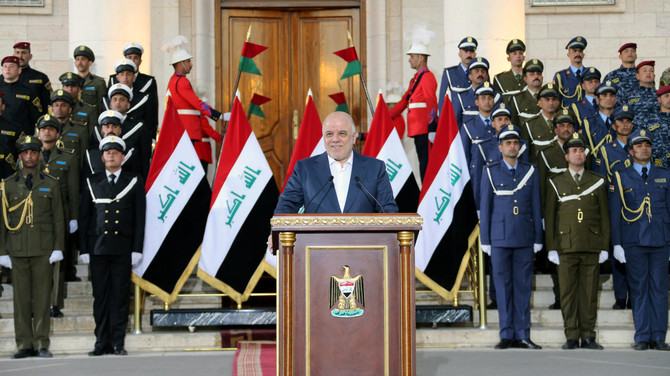
Iraq holds military parade to celebrate victory against Daesh
Iraq holds military parade to celebrate victory against Daesh
Latest updates



© 2026 SAUDI RESEARCH & PUBLISHING COMPANY, All Rights Reserved And subject to Terms of Use Agreement.