LONDON: India is often viewed as peaceful and disinterested spectator of security issues in the Arab world – but that may be about to change according to analysts.
India has started to consider taking more strategic positions in light of the rapidly changing diplomatic, security and military landscape in the Middle East, Asharq Al-Awsat reported.
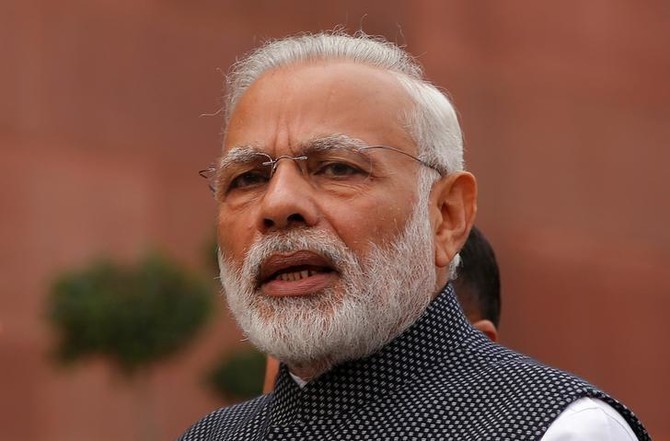
Indian Prime Minister Narendra Modi has sought to bring the country closer to West Asia as a key plank of its foreign policy.
He has visited Saudi Arabia, Iran and Israel in recent years. The country has also signed security and defense agreements with Saudi Arabia, the UAE, Oman and Qatar.
In Syria it has provided what is perceived as a kind of silent support for President Bashar Assad, and has occupied the middle ground between the West and Russia on this issue.
Kabir Taneja, an associate fellow at the Observer Research Foundation in New Delhi, said: “India’s modern ambitions are challenging the notion of how it approaches the region.
“It is becoming harder for India to portray itself as a neutral power in the region for navigating the complex rivalries of the Middle East, particularly when India is keen to claim greater influence for itself in the world.”
Former diplomat G. Parthasarthy agrees that the country has been adept at maintaining ties with most of the region’s powers – some of them belligerents – even if that fine balancing act may become increasingly difficult to maintain.
“Modi has skillfully ensured that India is perhaps the only country in the world, which has growing, good relations with all major regional powers— Iran, Saudi Arabia, the UAE, Israel and Egypt yet maintaining this geopolitical balance in the Gulf will continue to prove challenging for India in the present scenario. “
Hindustan Times Foreign Editor Pramit Pal Chaudhuri said that developing India’s foreign policy in the region may not be straightforward.
“India has been cautious about expanding its military presence in the Gulf and Arabian Sea area. The region’s various governments are sharply divided in their support for the various local protagonists in the civil wars of Syria, Iraq and Yemen.
“Any Indian military activity, regardless of how low-key, would be interpreted as favoring one country or another, something New Delhi remains sensitive about.”