Jordan’s plan of shiny city in the desert met by skepticism

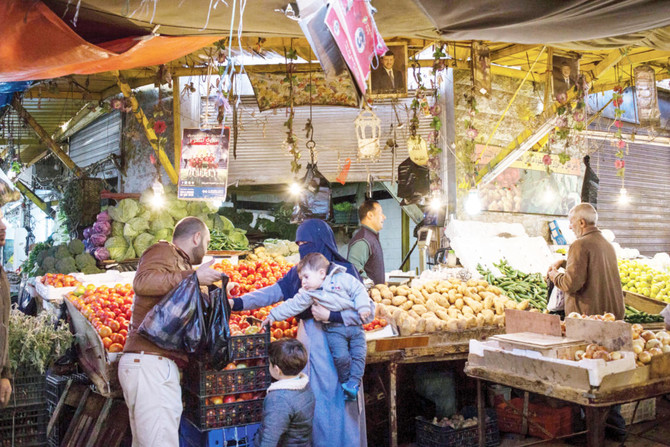
A family buys vegetables in downtown Amman. A shiny new high-tech utopian city is planned to rise from Jordan’s bleak desert over the next 30 years. (AP)
Updated 09 December 2017
Follow

Jordan’s plan of shiny city in the desert met by skepticism

MADOUNEH: A shiny new city is to arise from Jordan’s desert over the next three decades, potentially rivaling the kingdom’s capital of Amman, a rapidly growing and increasingly unwieldy metropolis of 4 million people.
Announcing plans for what it portrays as a high-tech utopia, Jordan joined other Middle Eastern countries betting on multimillion-dollar mega projects as an investment magnet and quick economic fix.
Yet some urban planners warn that “cities from scratch” are risky endeavors and argue it is more efficient to improve existing cities.
In Jordan, the government promises the yet-to-be-named city will draw population away from Amman, relieve its crippling traffic jams, provide middle-class housing and inject momentum into a sluggish economy plagued by high unemployment.
But authorities have released only snippets of information since the prime minister mentioned the new city for the first time, seemingly casually, in a meeting with local journalists in late October.
This perceived secrecy and “top-down” approach has drawn widespread criticism.
Few Jordanians have shown much enthusiasm, even among Amman residents who complain constantly of the city’s traffic. Some suspect the new city is largely meant to benefit Jordan’s powerful and their business cronies. Government officials deny that.
This week, Amman Mayor Yousef Shawarbeh defended the rocky rollout in a meeting with business people, diplomats and representatives of the energy and environmental sectors, many of whom seemed skeptical.
“The topic hasn’t been fully studied yet,” the mayor said when pressed for details. “When we conclude the studies, we will announce plans and have clear roles for government, citizens, investors, and so on.”
Shawarbeh insisted that Amman would not be neglected as Jordan, buckling under record public debt, shifts scarce resources to the new project. “The new city is not a new Amman,” he said. But it is needed, he argued, to relieve pressure on the capital.
Amman was a hamlet just a century ago and is seen as an upstart among the region’s ancient cities, such as Baghdad and Cairo. Today, Amman is home to more than 40 percent of Jordan’s population of 9.5 million.
Almost every hour of the day is rush hour and urban sprawl is rapidly devouring precious green areas. Districts of mid-rise, sand-colored residential buildings spread over hills and valleys, with a few high-rise towers marking the city center.
Rapid growth has been driven by an influx of hundreds of thousands of Palestinian, Syrian and Iraqi refugees in recent decades.
It is also linked to accelerated urbanization across the Middle East and North Africa, where populations flock from underdeveloped rural areas into cities looking for greater job opportunities. By 2050, more than two-thirds of the region’s anticipated 646 million people will live in cities, compared to 56 percent of 357 million people in 2010, according to UN projections.
In the past two decades, some two dozen new city projects were announced in the Middle East. About half remain “power point cities” existing only on websites, said Sarah Moser, an urban geography professor at McGill University in Montreal. Others are well behind schedule.
She said builders of new cities often underestimate challenges, including raising huge sums of capital and finding the necessary expertise. In such for-profit enterprises, plans for less lucrative public transport systems often remain on paper.
“I would suggest Jordan proceed with caution,” Moser said.
Egypt’s multi-billion-dollar plan for a new capital, announced in 2015, fell behind schedule after the country switched contractors. But President Abdel-Fattah El-Sisi is determined to forge ahead. He plans to rule from the new city by 2019, leaving behind unruly Cairo, the Arab world’s largest city.
When pressed why the government is spending huge sums at a time of economic hardship, he said recently: “Isn’t it our right to have a dream? Is it wrong to have 13 cities like this or what? Don’t we deserve it?”
Jordan’s new city would be built about 30 km east of Amman on a desolate desert plain flanked by roads leading to Saudi Arabia, Iraq and — in the future — the country’s main airport. It’s to be built as a public-private partnership on state land, with first tenders to be submitted by mid-2018.
Officials have said little about how it will look other than describing it as a “smart city” running on renewable energy and boasting public transport. Eventually it would cover 390 square km, an area a little smaller than the borough of Queens in New York City.
The first phase is to be completed by 2030 and the entire project by 2050, but the government has not announced a target population size. Many government departments and public institutions are to relocate there, it said. Housing cooperatives of civil servants, professionals and former members of the security forces would be able to build in the new city.
During a visit last week, the earmarked area was largely deserted, except for the occasional truck and car passing. The closest human activity is a truck station called Madouneh, though further out in the deserts beyond the site lie the Azraq camp for Syrian refugees, a military base and scattered abandoned ancient fortresses called qasr.


A look back at how Arab News marked its 50th anniversary

Updated 25 sec ago
Follow

A look back at how Arab News marked its 50th anniversary

  • In a year crowded with news, the paper still managed to innovate and leverage AI to become available in 50 languages
  • Golden Jubilee Gala, held at the Diplomatic Quarter in Riyadh, now available to watch on YouTube

RIYADH: In 2025, the global news agenda was crowded with headlines concerning wars, elections and rapid technological change.

Inside the newsroom of Arab News, the year carried additional weight: Saudi Arabia’s first English-language daily marked its 50th anniversary.

And with an industry going through turmoil worldwide, the challenge inside the newsroom was how to turn a midlife crisis into a midlife opportunity. 

For the newspaper’s team members, the milestone was less about nostalgia than about ensuring the publication could thrive in a rapidly changing and evolving media landscape.

“We did not want just to celebrate our past,” said Faisal J. Abbas, editor-in-chief of Arab News. “But more importantly, we were constantly thinking of how we can keep Arab News relevant for the next five decades.”

Faisal J. Abbas, editor-in-chief of Arab News. (Supplied)

The solution, he added, came down to two words: “Artificial intelligence.”

For the Arab News newsroom, AI was not a replacement for journalism but as a tool to extend it.

“It was like having three eyes at once: one on the past, one on the present, and one on the future,” said Noor Nugali, the newspaper’s deputy editor-in-chief.

Noor Nugali, deputy editor-in-chief of Arab News. (Supplied)

One of the first initiatives was the 50th anniversary commemorative edition, designed as a compact historical record of the region told through Arab News’ own reporting.

“It was meant to be like a mini history book, telling the history of the region using Arab News’ archive with a story from each year,” said Siraj Wahab, acting executive editor of the newspaper.

The issue, he added, traced events ranging from the outbreak of the Lebanese civil war in 1975 to the swearing-in of Donald Trump, while also paying homage to former editors-in-chief who shaped the newspaper’s direction over five decades.

The anniversary edition, however, was only one part of a broader strategy to signal Arab News’ focus on the future.

To that end, the paper partnered with Google to launch the region’s first AI-produced podcast using NotebookLM, an experimental tool that synthesizes reporting and archival material into audio storytelling.

The project marked a regional first in newsroom-led AI audio production.

The podcast was unveiled during a special 50th anniversary ceremony in mid-November, held on the sidelines of the Arab Media Forum, hosted by the Dubai Future Foundation. The event in the UAE’s commercial hub drew regional media leaders and officials.

Remarks at the event highlighted the project as an example of innovation in legacy media, positioning Arab News as a case study in digital reinvention rather than preservation alone.

“This is a great initiative, and I’m happy that it came from Arab News as a leading media platform, and I hope to see more such initiatives in the Arab world especially,” said Mona Al-Marri, director-general of the Government of Dubai Media Office, on the sidelines of the event.

“AI is the future, and no one should deny this. It will take over so many sectors. We have to be ready for it and be part of it and be ahead of anyone else in this interesting field.”

Behind the scenes, another long-form project was taking shape: a documentary chronicling Arab News’ origins and its transformation into a global, digital-first newsroom.

“While all this was happening, we were also working in-house on a documentary telling the origin story of Arab News and how it transformed under the current editor into a more global, more digital operation,” said Nugali.

The result was “Rewriting Arab News,” a documentary examining the paper’s digital transformation and its navigation of Saudi Arabia’s reforms between 2016 and 2018. The film charted editorial shifts, newsroom restructuring and the challenges of reporting during a period of rapid national change.

The documentary was screened at the Frontline Club in London, the European Union Embassy, Westminster University, and the World Media Congress in Bahrain. It later became available on the streaming platform Shahid and onboard Saudi Arabian Airlines.

The grand slam of the anniversary year was the Golden Jubilee of Arab News gala, held in late September in Riyadh’s Diplomatic Quarter. (AN photo)

It was also nominated for an Association for International Broadcasting award.

In early July, a special screening of the documentary took place at the EU Embassy in Riyadh. During the event, EU Ambassador to Saudi Arabia Christophe Farnaud described the film as an “embodiment” of the “incredible changes” that the Kingdom is undergoing.

“I particularly appreciate … the historical dimension, when (Arab News) was created in 1975 — that was also a project corresponding to the new role of the Kingdom,” Farnaud said. “Now the Kingdom has entered a new phase, a spectacular phase of transformation.”

Part of the documentary is narrated by Prince Turki Al-Faisal, the former Saudi ambassador to the US, who in the film delves into the paper’s origins.

Prince Turki Al-Faisal, the former Saudi ambassador to the US. (AN photo)

The grand slam of the anniversary year was the Golden Jubilee of Arab News gala, held in late September in Riyadh’s Diplomatic Quarter.

Hosted by the Dean of Diplomatic Corps in Saudi Arabia and Ambassador of Djibouti to Riyadh Dya-Eddine Said Bamakhrama, the evening featured a keynote address by Prince Turki, who spoke about Arab News’ founding under his father, the late King Faisal, and its original mission to present the Kingdom to the English-speaking world.

The Dean of Diplomatic Corps in Saudi Arabia and Ambassador of Djibouti to Riyadh Dya-Eddine Said Bamakhrama (far left). (AN photo)

Arab News was established in Jeddah in 1975 by brothers Hisham and Mohammed Ali Hafiz under the slogan to give Arabs a voice in English while documenting the major transformations taking place across the Middle East.

The two founders were honored with a special trophy presented by Prince Turki, Assistant Media Minister Abdullah Maghlouth, Editor-in-Chief Abbas, and family member and renowned columnist Talat Hafiz on behalf of the founders. 

During the gala, Abbas announced Arab News’ most ambitious expansion yet: the launch of the publication in 50 languages, unveiled later at the World Media Congress in Madrid in cooperation with Camb.AI.

The grand slam of the anniversary year was the Golden Jubilee of Arab News gala, held in late September in Riyadh’s Diplomatic Quarter. (AN photo)

The Madrid launch in October underscored Arab News’ aim to reposition itself not simply as a regional paper, but as a global platform for Saudi and Middle Eastern perspectives.

The event was attended by Princess Haifa bint Abdulaziz Al-Mogrin, the Saudi ambassador to Spain; Arab and Spanish diplomats; and senior editors and executives.

As the anniversary year concluded, Arab News released the full video of the Golden Jubilee Gala to the public for the first time, making the event accessible beyond the room in which it was held.

For a newspaper founded in an era of typewriters and wire copy, the message of its 50th year was clear: longevity alone is not enough. Relevance, the newsroom concluded, now depends on how well journalism adapts without losing sight of its past.