Jordan’s king calls for Amman embassy shooter to face trial

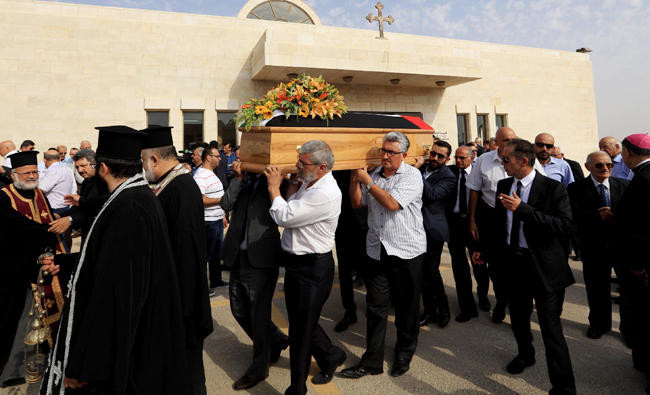
Jordanian mourners attend a funeral of Bashar Hamarneh, a doctor who was in the residential quarter of the Israeli embassy at the time of an attack on the weekend, during his funeral in Madaba on July 27, 2017 after he died of his injuries. (AFP / Khalil Mazraawi)
Updated 28 July 2017
Follow

Jordan’s king calls for Amman embassy shooter to face trial

AMMAN: Jordan’s King Abdallah has called on Israeli Prime Minister Benjamin Netanyahu to put on trial an embassy security guard who shot dead two Jordanians.
He said the way the incident was handled would affect ties between the two countries.
In a statement, the Jordanian king said Netanyahu’s behavior toward the security guard, whom he embraced in a hero’s welcome on his return to Israel under diplomatic immunity, was “provocative on all fronts and enrages us, destabilizes security and fuels extremism.”
“We demand that the Israeli prime minister abides by his commitment and takes all measures to ensure the trial of the killer and not to handle this like a political show to achieve personal political gains,” he said.
In an incident testing already tense relations between the two neighbors, the guard shot dead a Jordanian teenager at Israel’s embassy in Amman on Sunday while a second Jordanian — the landlord of the house in the compound where the security guard lived — was also shot dead.
Jordanian police said on Monday that the security guard had fired on the teenager after the young man, who worked for a furniture firm and was delivering an order, got into a brawl and attacked him.
But they rejected Israel’s account that he had used a screwdriver to stab the guard in what Israeli officials described as a “terrorist attack.”
Jordan had wanted to question the guard, but Israel said he had diplomatic immunity and repatriated him.
King Abdallah vowed that the state would “do everything within its means” to get justice for the two slain Jordanians.
Jordan is one of two Arab states with which Israel has peace treaties. In what was a rare outburst against Israel, Abdullah also cited a previous incident in which a Jordanian judge was shot in March 2014 by an Israeli soldier while crossing a border crossing that outraged Jordanians.
No investigation was ever conducted.
“The way Israel handles the embassy case and the judges killing and other cases will have a direct impact on the nature of our relationship,” King Abdallah said.
Many Jordanians have criticized the authorities for handing over the security guard in what they said was an affront to national sovereignty. Lawmakers walked out of Parliament in protest at what they saw as inadequate response by the government.


Ceasefire with Kurdish-led force extended for another 15 days, Syrian army says

Updated 25 January 2026
Follow

Ceasefire with Kurdish-led force extended for another 15 days, Syrian army says

  • The defense ministry said the extension was in support of an operation by US forces to transfer accused Daesh militants to Iraq
  • The Kurdish-led Syrian Democratic Forces confirmed the ceasefire extension

RAQQA, Syria: Hours after the expiration of a four-day truce between the Syrian government and Kurdish-led fighters Saturday, Syria’s defense ministry announced the ceasefire had been extended by another 15 days.
The defense ministry said in a statement that the extension was in support of an operation by US forces to transfer accused Daesh militants who had been held in prisons in northeastern Syria to detention centers in Iraq.
The Kurdish-led Syrian Democratic Forces confirmed the ceasefire extension.
“Our forces affirm their commitment to the agreement and their dedication to respecting it, which contributes to de-escalation, the protection of civilians, and the creation of the necessary conditions for stability,” the group said in a statement.
Over the past three weeks, there have been intense clashes between government forces and the SDF, in which the SDF lost large parts of the area they once controlled.
Earlier in the day, the Kurdish-led force called on the international community to prevent any escalation.
The end of the truce came as government forces have been sending reinforcements to Syria’s northeast.
Syria’s interim government signed an agreement last March with the SDF for it to hand over territory and to eventually merge its fighters with government forces. In early January, a new round of talks failed to make progress over the merger, leading to renewed fighting between the two sides.
A new version of the accord was signed last weekend, and a four-day ceasefire was declared Tuesday. Part of the new deal is that SDF members will have to merge into the army and police forces as individuals.
The SDF said in a statement Saturday that military buildups and logistical movements by government forces have been observed, “clearly indicating an intent to escalate and push the region toward a new confrontation.” The SDF said it will continue to abide by the truce.
On Saturday, state TV said authorities on Saturday released 126 boys under the age of 18 who were held at the Al-Aqtan prison near the northern city of Raqqa that was taken by government forces Friday. The teenagers were taken to the city of Raqqa where they were handed over to their families, the TV station said.
The prison is also home to some of the 9,000 members of the Daesh group who are held in northeastern Syria. Most of them remain held in jails run by the SDF. Government forces have so far taken control of two prisons while the rest are still run by the SDF.
Earlier this week, the US military said that some 7,000 Daesh detainees will be transferred to detention centers in neighboring Iraq.
On Wednesday, the US military said that 150 prisoners have been taken to Iraq.