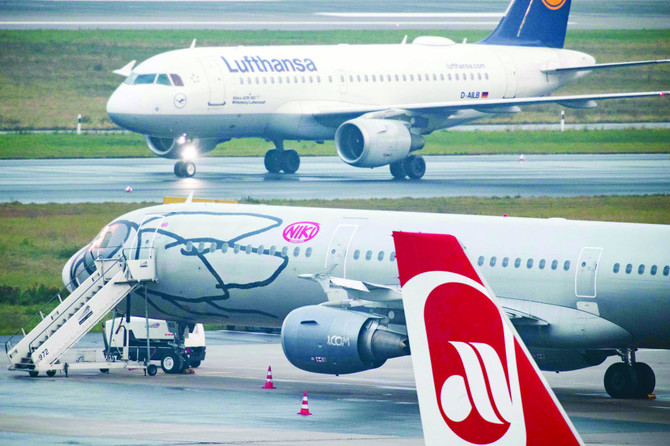
BRUSSELS: The EU said Friday it was concerned about the impact on competition of German airline Lufthansa’s plan to take over routes operated by failed rival Air Berlin.
“We have quite deep competition concerns because there is a risk that on some routes Lufthansa becomes de facto a monopoly,” EU competition commissioner Margrethe Vestager said at a news conference.
The warning comes a week after Lufthansa offered concessions to encourage the European Commission to green-light its planned purchase of parts of Air Berlin.
The Frankfurt-based airline group hopes to pay €210 million ($250 million) for 81 aircraft from Air Berlin’s 140-strong fleet, plus takeoff and landing slots, as well as Austrian subsidiary Niki.
But Vestager said she now wanted input from customers and competitors in the European aviation market to dispel any anti-trust doubts concerning the purchase.
Vestager previously said that, given its dominant position in domestic air travel, Lufthansa might have to give up certain routes in exchange for approval.
Lufthansa chief executive Carsten Spohr responded by saying that he would be “ready” to meet her demands.
Air Berlin triggered bankruptcy proceedings in August after losing a cash lifeline from its biggest shareholder Etihad Airways.
Its aircraft were kept aloft by a €150 million emergency loan from the German government while it negotiated the sale of its assets.
Since the October deal the EU has allowed Lufthansa to operate some of Air Berlin’s planes to make sure there was no short-term negative impact on travelers.
Vestager made clear she is now focusing on the longer term impact on customers.
In “the long term it is important for the passengers in Germany and in Austria to have choice and also have businesses competing in order to keep prices down because the risk of any monopoly of course is that prices go up,” she said.
— AFP

EU has ‘deep competition concerns’ over Lufthansa Air Berlin bid
Morocco flood evacuees still shaken, waiting to return home
- More than 150,000 people have been evacuated over the past week as heavy rainfall battered provinces in Morocco’s north
- Authorities have set up a vast camp of small blue tents sheltering nearly 40,000 people 50km north of Rabat
KENITRA, Morocco: It was through a call from her local mosque’s loudspeakers that Kasia El Selami learnt it was time to flee as floodwaters rose in her Moroccan village of Ouled Ameur.
Selami is among more than 150,000 people to have been evacuated over the past week as heavy rainfall battered provinces in Morocco’s north.
“We felt immense fear... especially for our children,” said the 67-year-old while hanging a blanket by the tent in which she now lives.
Some residents, including children and elderly people, were seen stranded on rooftops before being rescued, at times with small boats.
Others were rescued by helicopter as floodwaters inundated roads and farmland in several areas.
Near Kenitra, some 50 kilometers north of Rabat, authorities have set up a vast camp of small blue tents sheltering nearly 40,000 people, including Selami and her children.
At the camp, evacuees make do with little while waiting to be able to return home.
One woman scrubbed laundry in a small basin just a few meters away from an enclosure where evacuated cows, horses, chickens and sheep were penned.
Nearby, sick or lightly injured men and women queued outside a mobile clinic.
‘Terrified’
Despite the relative quiet, Ali Al Aouni said these were “very difficult days.”
The 60-year-old complained about the cold and anxiety, adding that his children were still “terrified” after what had happened.
“The water level got about a meter and a half high” in his village, he recalled. “We’re afraid to go home if the flood comes back.”
Aouni said his eldest son stayed behind to watch over their property, updating him over the phone that the water kept rising.
Not far away, the civil defense was handing out mattresses, warm clothing and food to the rescued families.
These came “in addition to health care and veterinary check-ups for livestock,” Adil Al-Khatabi, an official, told AFP.
Selami is already thinking about going home.
“We’re waiting for this ordeal to end as soon as possible, so we can return to our homes,” she said.
Last December 37 people were killed in sudden floods in Safi, in Morocco’s deadliest weather-related disaster in the past decade.
In recent weeks, severe weather and flooding in neighboring Algeria killed two people, including a child.
In Tunisia, at least five people died, while others were still missing after the country experienced its heaviest rainfall in over 70 years last month.
And further north, Portugal and Spain have also endured storms and torrential rains in recent days.
Selami is among more than 150,000 people to have been evacuated over the past week as heavy rainfall battered provinces in Morocco’s north.
“We felt immense fear... especially for our children,” said the 67-year-old while hanging a blanket by the tent in which she now lives.
Some residents, including children and elderly people, were seen stranded on rooftops before being rescued, at times with small boats.
Others were rescued by helicopter as floodwaters inundated roads and farmland in several areas.
Near Kenitra, some 50 kilometers north of Rabat, authorities have set up a vast camp of small blue tents sheltering nearly 40,000 people, including Selami and her children.
At the camp, evacuees make do with little while waiting to be able to return home.
One woman scrubbed laundry in a small basin just a few meters away from an enclosure where evacuated cows, horses, chickens and sheep were penned.
Nearby, sick or lightly injured men and women queued outside a mobile clinic.
‘Terrified’
Despite the relative quiet, Ali Al Aouni said these were “very difficult days.”
The 60-year-old complained about the cold and anxiety, adding that his children were still “terrified” after what had happened.
“The water level got about a meter and a half high” in his village, he recalled. “We’re afraid to go home if the flood comes back.”
Aouni said his eldest son stayed behind to watch over their property, updating him over the phone that the water kept rising.
Not far away, the civil defense was handing out mattresses, warm clothing and food to the rescued families.
These came “in addition to health care and veterinary check-ups for livestock,” Adil Al-Khatabi, an official, told AFP.
Selami is already thinking about going home.
“We’re waiting for this ordeal to end as soon as possible, so we can return to our homes,” she said.
Last December 37 people were killed in sudden floods in Safi, in Morocco’s deadliest weather-related disaster in the past decade.
In recent weeks, severe weather and flooding in neighboring Algeria killed two people, including a child.
In Tunisia, at least five people died, while others were still missing after the country experienced its heaviest rainfall in over 70 years last month.
And further north, Portugal and Spain have also endured storms and torrential rains in recent days.
© 2026 SAUDI RESEARCH & PUBLISHING COMPANY, All Rights Reserved And subject to Terms of Use Agreement.