

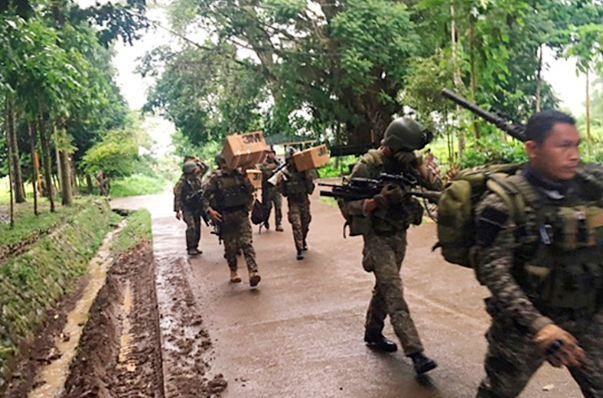
Philippine military extends martial law in troubled Mindanao

Local officials have agreed to extend martial law on the island, but stressed that this should not be used to curtail the movement of people. (AP)
Updated 08 December 2017
Follow

Philippine military extends martial law in troubled Mindanao

MANILA: The Philippine military and police have recommended the extension of martial law in Mindanao because of what they describe as continuing threats by militant groups and violent incidents by the Maoist New People’s Army (NPA).

Local officials have agreed to extend martial law on the island, but stressed that this should not be used to curtail the movement of people.

Speaking to Arab News, Zia Alonto Adiong, Lanao Del Sur first district assemblyman, said that verified information had been received that there was recruitment activity by Daesh-inspired militants groups.

Maj. Gen. Restituto Padilla, spokesman for the Armed Forces of the Philippines (AFP), also confirmed the recruitment by the Maute Group and the Abu Sayyaf Group (ASG), which were responsible for the Marawi siege.

According to Adiong, the aftermath of the Marawi siege and the liberation of the city from Daesh-back militants does not end the battle against violent extremism.

“The peace and order situation has yet to be stabilized as we proceed with the early recovery efforts for Marawi. If it requires martial law to be extended to guarantee the security of our communities and the safety of our people, and the assurance that recovery efforts will not be interrupted, then by all means let’s have it extended,” he said.

However, Adiong said that the main concern of local government was the safety of constituents. If martial law was extended, “it should serve its real purpose faithfully” to find the “culprits and the suspected supporters (of terror groups). It should not be used as a means to curtail the movement of the people.”

Efforts were currently focused on helping those affected by the crisis to start up businesses and go back to normal life, he said. “I think the martial law today, as we have observed, should be maintained in a way that will not impose more limitations or additional security protocol and ... limit the movement (of the people).”

He said that martial law as a security response to the Marawi siege has its own limitations based on the 1987 Philippine constitution.
“It only suspends the privilege of the writ of habeas corpus. Its primary objective is to arrest and apprehend suspected financiers and supporters of the Maute Group. It doesn’t replace civilian authority, compared to the previous martial law regime in the 1970s,” he said.

On the continued presence of terror groups in Mindanao, Adiong said: “The threat is still there. Because these violent, violent extremists, these people don’t know when to stop unless they think they are successful in putting up their own political system based on a caliphate that they want to set up.”

“Unless they are able to do that and be successful enough to establish it in at least in some parts of the country, then they will not stop. We know that for a fact, so that’s why the threat is still there,” he said.

Zamboanga City Mayor Maria Isabel Climaco Salazar also reportedly recommended extending martial law in Mindanao to strengthen the fight against terrorism and threats from the NPA.

In a press briefing in Malacanang, Maj. Gen. Padilla said the AFP has recommended the extension of martial law in Mindanao, but could not say for how long the extension would be.

Padilla cited continuing threats by Daesh, Bangsamoro Islamic Freedom Fighters (BIFF), and Abu Sayyaf Group (ASG) as reasons for the extension. He said increasing violent incidents perpetrated by the communist rebels, following the president’s declaration to formally end peace talks with them, was something the government needed to be vigilant about.

Department of National Defense (DND) spokesman Arsenio Andolong said that the recommendation was based on the assessment provided by ground commanders in Mindanao, which was carefully considered against the backdrop of the prevailing and future security environment. “It is now up to the president to decide whether to adopt it or not,” he said.

World welcomes 2026 with fireworks after year of turmoil

Updated 14 min 14 sec ago
Follow

World welcomes 2026 with fireworks after year of turmoil

  • Australia holds defiant celebrations after its worst mass shooting in nearly 30 years
  • Hong Kong holds a subdued event after a deadly fire in tower blocks

PARIS, France: People around the globe toasted the end of 2025 on Wednesday, bidding farewell to one of the hottest years on record, packed with Trump tariffs, a Gaza truce and vain hopes for peace in Ukraine.
Russian President Vladimir Putin used his traditional New Year address to tell his compatriots their military “heroes” would deliver victory in Europe’s deadliest conflict since World War II, while his Ukrainian counterpart Volodymyr Zelensky said his country was “10 percent” away from a deal to end the fighting.
Earlier, New Year celebrations took on a somber tone in Sydney as revellers held a minute of silence for victims of the Bondi Beach shooting before nine tons of fireworks lit up the harbor city at the stroke of midnight.
Seeing in the New Year in Moscow, Natalia Spirina, a pensioner from the central city of Ulyanovsk, said that in 2026 she hoped for “our military operation to end as soon as possible, for the guys to come home and for peace and stability to finally be established in Russia.”
Over the border in Vyshgorod, Ukrainian beauty salon manager Daria Lushchyk said the war had made her work “hell” — but that her clients were still coming regardless.
“Nothing can stop our Ukrainian girls from coming in and getting themselves glam,” Lushchyk said.
Back in Sydney, heavily armed police patrolled among hundreds of thousands of people lining the shore barely two weeks after a father and son allegedly opened fire on a Jewish festival at Bondi Beach, killing 15 people in Australia’s deadliest mass shooting for almost 30 years.
Parties paused for a minute of silence an hour before midnight, with the famed Sydney Harbor Bridge bathed in white light to symbolize peace.
Pacific nations including Kiribati and New Zealand were the first to see in 2026, with Seoul and Tokyo following Sydney in celebrations that will stretch to glitzy New York via Scotland’s Hogmanay festival.
More than two million people are expected to pack Rio de Janeiro’s Copacabana Beach for what authorities have called the world’s biggest New Year’s Eve party.
In Hong Kong, a major New Year fireworks display planned for Victoria Harbor was canceled in homage to 161 people killed in a fire in November that engulfed several apartment blocks.

Truce and tariffs 

This year has brought a mix of stress and excitement for many, war for others still — and offbeat trends, with Labubu dolls becoming a worldwide craze.
Thieves plundered the Louvre in a daring heist, and K-pop heartthrobs BTS made their long-awaited return.
The world lost pioneering zoologist Jane Goodall, the Vatican chose a new, American, pope and the assassination of right-wing activist Charlie Kirk laid bare America’s deep political divisions.
Donald Trump returned as US president in January, launching a tariff blitz that sent global markets into meltdown.
Trump used his Truth Social platform to lash out at his sliding approval ratings ahead of midterm elections to be held in November.
“Isn’t it nice to have a STRONG BORDER, No Inflation, a powerful Military, and great Economy??? Happy New Year!” he wrote.
After two years of war that left much of the Gaza Strip in ruins, US pressure helped land a fragile ceasefire between Israel and Hamas in October — though both sides have accused each other of flagrant violations.
“We bid farewell to 2025 with deep sorrow and grief,” said Gaza City resident Shireen Al-Kayali. “We lost a lot of people and our possessions. We lived a difficult and harsh life, displaced from one city to another, under bombardment and in terror.”
In contrast, there was optimism despite abiding internal challenges in Syria, where residents of the capital Damascus celebrated a full year since the fall of Bashar Assad.
“There is no fear, the people are happy, all of Syria is one and united, and God willing ... it will be a good year for the people and the wise leadership,” marketing manager Sahar Al-Said, 33, told AFP against a backdrop of ringing bells near Damascus’s Bab Touma neighborhood.
“I hope, God willing, that we will love each other. Loving each other is enough,” said Bashar Al-Qaderi, 28.

Sports, space and AI

In Dubai, thousands of revellers queued for up to nine hours for a spectacular fireworks and laser display at the Burj Khalifa, the world’s tallest building.
After a build-up featuring jet skis and floating pianos on an adjacent lake, a 10-minute burst of pyrotechnics and LED effects lit up the needle-shaped, 828-meter tall (2,717-feet) tower.
The coming 12 months promise to be full of sports, space and questions over artificial intelligence.
NASA’s Artemis II mission, backed by tech titan Elon Musk, will launch a crewed spacecraft to circle the moon during a 10-day flight, more than 50 years since the last Apollo lunar mission.
After years of unbridled enthusiasm, AI is facing scrutiny and nervous investors are questioning whether the boom might now resemble a market bubble.
Athletes will gather in Italy in February for the Milano Cortina Winter Olympics.
And for a few weeks in June and July, 48 nations will compete in the biggest football World Cup in history in the United States, Mexico and Canada.