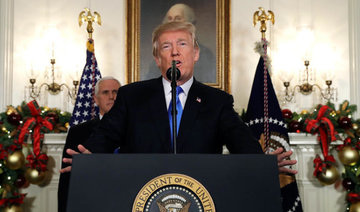
GAZA CITY: Gaza Strip witnessed a general strike of government institutions and schools as shops remained open to protest President Trump's decision to recognize Jerusalem as the capital of Israel and move the US embassy to Jerusalem.
On Wednesday evening and on Thursday the Gaza Strip's cities experienced various marches called by the Palestinian factions to denounce the American decision, during which the demonstrators burned pictures of US President Donald Trump and American and Israeli flags.
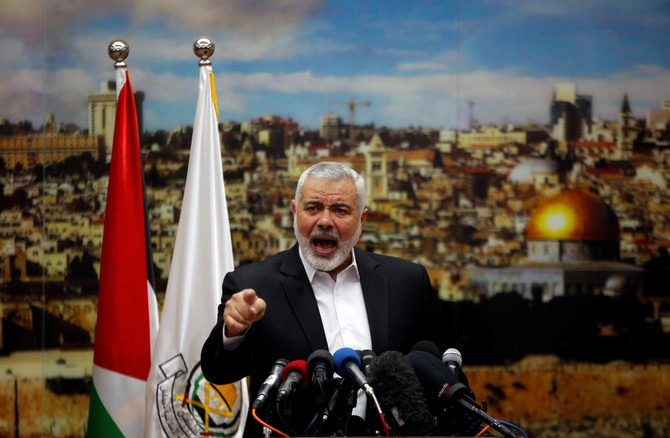
Hamas leader Ismail Haniyeh called for a new Intifada (uprising) in the Palestinian territories and to mark Friday as "a day of outrage".
“Let tomorrow be a day of rage and the beginning of a broad movement for an uprising that I call “the intifada of freedom of Jerusalem”, such as that which our people in occupied Jerusalem recently blew up in which they mourned the nose of the occupation,” he said in a televised speech.
He called on the Palestinian Authority to stop security coordination with Israel and “enable the resistance in the occupied West Bank to respond to this blatant aggression.”
“We say clearly that Jerusalem is united, not Eastern or Western, it is an Arab Palestinian Islamic and the capital of the state of Palestine, all of Palestine. Today I say that Palestine is one and united from the sea to the river, which cannot be divided by two states or two entities. Palestine is ours and Jerusalem, all Jerusalem to us. We do not recognize the legitimacy of the occupation and the existence of Israel on the land of Palestine to get a capital” Haniya said
“We must speed up the pace of alleviating the Palestinian people and take a decision to lift the sanctions on the Gaza Strip. The wounded people will not be able to face the occupier if they do not have the factors of steadfastness. I call for the cessation of security coordination with the enemy in the West Bank.”
At a press conference in Gaza, Hamas' military wing Islamic Jihad called for the withdrawal of the Arab peace initiative and an end to normalization with Israel. It also called on the Palestinian Authority to withdraw its recognition of Israel and revoke the Oslo Accords.
"We ask the Arabs and Muslims to stop considering the United States as an ally and a friend,” the group said.
Ahmed Bahr, the first deputy speaker of the Palestinian Legislative Council (PLC), stressed the need to write off the Oslo agreement, calling on the resistance to respond to the “American crime against Jerusalem.”
“The response to the American decision will not be achieved with dreams, not with slogans and declarations, but through an effective Arab and Islamic national resistance movement that will hurt the occupation and exert political diplomacy that will be able to isolate the occupation and besiege its policies in international organizations and forums and criminal courts.” Bahr said during an emergency session of the PLC in Gaza.
On Thursday, Palestinian Prime Minister Rami al-Hamdallah visited the Gaza Strip as part of reconciliation efforts between Fatah and Hamas.
“We will devote reconciliation. If we fail, we will rise again in a spirit of determination and steadfastness, so that together we can face the greatest challenge before us, the Israeli occupation and the need to end it, the establishment of an independent and sovereign State of Palestine on the 1967 borders and Jerusalem as its eternal capital,” Al-Hamdallah told a news conference in Gaza.
Akram Attallah, a Palestinian columnist, told Arab News that “Palestinians have been occupied for years by internal conflict that has become a priority and has become the main issue that has drained their administrative, political and media efforts. The partisan and personal issues are a priority for Palestinian forces and parties national project.”
“The beginning from here from Palestine is a courageous decision to put an end to these differences that have afflicted us and to rebuild the political system on new foundations. Trump sheds the curtain on the role of the United States. This may be a different beginning.”
“The Palestinians are going through a difficult period and a real danger. When nations are exposed to dangers, they unite,” he said.