Rohingya refugee crisis a ‘grave security risk’, ICG warns

The Arakan Rohingya Salvation Army may “shift to cross-border attacks” using Bangladesh as a base for recruitment and training, conflict analysts ICG warned on Thursday. Above, a young Rohingya refugee holds a toy gun at the Shamlapur camp in Cox’s Bazar, Bangladesh. (AP)
Updated 07 December 2017
Follow

Rohingya refugee crisis a ‘grave security risk’, ICG warns

YANGON: Prolonged displacement of Rohingya refugees in squalid Bangladeshi camps poses a “grave security risk,” conflict analysts ICG warned Thursday, raising the specter of militants recruiting among the displaced and launching cross-border attacks on Myanmar.
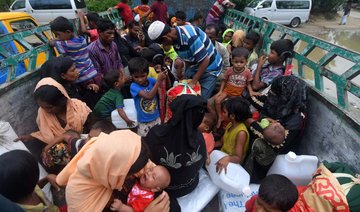
Raids by the Arakan Rohingya Salvation Army (ARSA) on August 25 sparked the vicious Myanmar army response, which has forced more than 620,000 Rohingya to flee Rakhine state for Bangladesh.
ARSA “appears determined to regroup and remain relevant” and may draw on desperate Rohingya refugees languishing in camps for future operations, the ICG International Crisis Group said in the report.
The group may “shift to cross-border attacks” using Bangladesh as a base for recruitment and training, the study said, cautioning the risk of an ever-deepening cycle of violence is all too real.
“Such attacks would have profoundly negative consequences,” straining Myanmar-Bangladesh relations and worsening contempt for the Rohingya “that would further diminish prospects of an eventual refugee return.”
Global outcry over the refugee crisis, one of the worst in recent history, has triggered a hyper-defensive response inside the country, where anti-Rohingya attitudes have hardened since ARSA’s emergence.
Myanmar does not recognize the Rohingya as a distinct ethnic group eligible for citizenship, instead calling them “Bengali,” suggesting they are illegal immigrants.
In another serious looming risk, ICG warned that Rohingya’s plight has become a “cause celebre of the Muslim world” with Al-Qaeda, Daesh and other global jihadi groups calling for attacks on Myanmar.
Myanmar’s military has repeatedly used the terror threat to justify its campaign in northern Rakhine state.
ARSA has distanced itself from any wider global cause for jihad, saying it is only fighting to protect Rohingya rights.
International pressure is ratcheting up on Myanmar.
This week the UN rights chief said Myanmar’s crackdown on the Rohingya showed possible “elements of genocide,” as calls for the safe and sustainable repatriation of refugees grows.
Myanmar refutes any wrongdoing saying it was forced into a defensive action by ARSA attacks.
It has agreed with Bangladesh to start repatriation of “eligible” refugees within a few months.
But there are widespread doubts over how many Rohingya can prove they are entitled to return to Rakhine, or want to go back to areas riddled with communal mistrust and where their villages were razed.
China, a key strategic ally of Myanmar, is pitching itself as an arbiter in the crisis, and has repeatedly urged the international community to take a softline on Myanmar.
But pressure is mounting in the West — particularly Washington — to reimpose targeted sanctions on Myanmar military figures.
Sanctions were slowly rolled back in recent years as reward for democratic gains after decades of outright junta rule.
The ICG study said any fresh sanctions would backfire by isolating Myanmar and calcifying hatred toward the Rohingya.


German school students rally against army recruitment drive

Updated 4 sec ago
Follow

German school students rally against army recruitment drive

BERLIN: Thousands of German teenagers skipped school Thursday to join protests against a stepped-up military recruitment drive that many fear may in future involve a form of conscription.
About 3,000 students gathered on Berlin’s Potsdamer Platz square, with smaller demonstrations held across Germany as part of a nationwide “school strike.”
“I don’t see why anyone should have to go to the front lines for politicians,” Alex Krzeszka, a 15-year-old student, told AFP at the Berlin rally.
“I don’t see it as morally right, and I think war should never be the solution. Problems should be solved diplomatically.”
Germany, like other European countries, has sought to build up its armed forces in response to Russia’s 2022 full-scale invasion of Ukraine and the threat of further aggression against NATO members.
Chancellor Friedrich Merz has vowed to turn the Bundeswehr into Europe’s largest conventional army, banking initially on a voluntary recruitment drive.
The government this year started requiring all 18-year-old men to fill out questionnaires about their interest and fitness for short-term military service.
Women are also being asked to fill out the forms, but cannot be compelled to do so under current German law.
Among the signs being waved by protesters in Berlin was a poster that read “We are not cannon fodder” while another demanded: “Send Friedrich Merz to the front line!” For now at least, German lawmakers have decided against bringing back mandatory conscription, which Germany suspended in 2011. But some politicians have expressed doubts about whether ambitious recruiting targets can be achieved without some from of conscription.

BACKGROUND

The government this year started requiring all 18-year-old men to fill out questionnaires about their interest and fitness for short-term military service.

Plans call for strengthening the Bundeswehr from about 185,000 active-duty troops now to 260,000 by 2030, while roughly quadrupling the size of the reserves to 200,000.
The Bundeswehr shrank dramatically after the end of the Cold War as countries across Europe slashed defense budgets.
In the 1980s, West Germany alone had fielded a military of nearly 500,000 troops.
“I think they should definitely advertise for the Bundeswehr, but it absolutely shouldn’t be compulsory,” Leander Martinez, a 16-year-old student from Berlin, told AFP.
“Reintroducing conscription is nothing other than rearmament,” Leon Reinemann, a student who helped organize the school strike in the western city of Koblenz, told broadcaster NTV.
He defended the fact students were skipping classes, saying that “a single day of absence from school is significantly less serious than six months in the barracks.”
Others took a more staunchly pacifist stance at the Berlin demonstration.
“I’m against conscription and against war propaganda,” Tillmann, a 19-year-old student who declined to give his last name, told AFP.
“And I think murdering someone is always wrong, even if the state says that someone should be murdered. There’s nothing more important than human life.”