

Women in rural Tunisia mix hot sauce with business

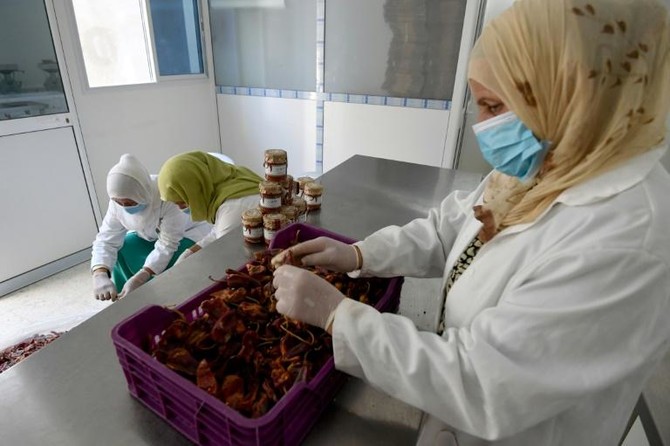
A group of women farmers in Menzel Mhiri near Kerouan in rural central Tunisia banded together in 2013 to form a cooperative and marketed their harissa under the “Errim” trade name. (AFP)
Updated 06 December 2017
Follow

Women in rural Tunisia mix hot sauce with business

MENZEL MHIRI, Tunisia: These Tunisian women have some sauce, pooling their resources and a seasoned culinary expertise handed down the centuries from mother to daughter.
Their secret? Harissa — the spicy hot pepper paste used to add zing to dishes traditionally prepared in North Africa’s Maghreb region.
These days, when Najoua Dhiflaoui prepares harissa, it is no longer just for her family. She and another 150 women are now making money by producing and even exporting their ancestral savoir faire.
Harissa, made from sun-dried chili peppers, freshly prepared spices and olive oil to both preserve and soften its heat, is added to most dishes in restaurants in Tunisia, and is also popular abroad.
In 2013, a group of women farmers in Menzel Mhiri near Kerouan in rural central Tunisia banded together to form a cooperative they dubbed “Tahadi” — Arabic for “challenge.”
Dhiflaoui and her co-workers certainly rose to it.
They went “door-to-door to convince others to join them, to combine their knowledge and sell their products together,” the dynamic fortysomething said.
The women were able to take advantage of an official project to support local produce and were given training in the technical, hygienic and commercial aspects of their venture.
For the past two years, they have marketed their harissa under the “Errim” trade name. That’s Arabic for small gazelle, also a symbol of feminine beauty.
“It’s a way of representing the Tunisian woman — hard-working, authentic and fiery,” said Dhiflaoui with a smile, her forehead beaded with sweat from both the heat and the peppers.
Tahadi now has 164 people working for it, and is one of the first firms in Tunisia to work exclusively with local rural women under a rotational system — its members work according to a flexible schedule.
In a spotless white laboratory lined with machinery that grinds, kneads and fills, the gloved women wash and prepare locally harvested ingredients to make the red paste.
Women play a key role in the Tunisian economy, said Farouk Ben Salah of PAMPAT, a UN, Swiss and Tunisian project aimed at getting rural products such as harissa onto the market.
“The main thing is to create working conditions for them as soon as possible,” he said.

The harissa makers are paid “slightly more than the agricultural wage, around 15 dinars” (€5) per working day, said Ben Salah.
Others work from home, performing essential tasks for the project and generating some income by cleaning and drying peppers on the roofs of their houses.
Dhiflaoui is full of enthusiasm. “This work allows women a certain financial autonomy,” she said, boosting their confidence and enabling them “to move forward.”
Since the launch of the cooperative, the farmers “have encouraged each other to make their mark. No longer do you have to be a teacher or doctor, now they too can work and feel they have a place in society.”
Women in rural Tunisia are particularly affected by gender discrimination and lack of job security.
While female unemployment is 22.5 percent at a national level, the rate exceeds 35 percent in rural provinces, according to a 2015 report by the National Institute of Statistics.
Dhiflaoui said that many of the women who now work at Tahadi used to labor in the fields in “terrible conditions” or “waited until their husbands brought money home.”
Their new role has “made them bloom” and given them “liberty,” she added.
“There’s a big difference between a woman with her own monthly salary and a woman who relies on a husband,” said Chelbia Dhiflaoui, Najoua’s cousin who also works at Tahadi.
“She feels a sense of responsibility, she sets goals she can reach — and she’s working to improve her living conditions.”
Ben Salah said PAMPAT could help Tahadi diversify its production to give the cooperative more opportunities to employ women who live in rural areas.
Errim Harissa is already making a name for itself.
Sold in gourmet food stores nationally, it can also be found in Switzerland and Germany, and orders have been dispatched to France and Italy.
Talks are also underway to export the delicacy to Canada.


What MENA’s wild 2025 funding cycle really revealed  

Updated 26 December 2025
Follow

What MENA’s wild 2025 funding cycle really revealed  

RIYADH: The Middle East and North Africa startup funding story in 2025 was less a smooth arc than a sequence of sharp gears: debt-led surges, equity-led recoveries, and periodic quiet spells that revealed what investors were really underwriting.   

By November, the region had logged repeated bursts of activity — culminating in September’s $3.5 billion spike across 74 deals — yet the year’s defining feature was not just the size of the peaks, but the way capital repeatedly clustered around a handful of markets, instruments, and business models.  

Across the year’s first eleven months, funding totals swung dramatically: January opened at $863 million across 63 rounds but was overwhelmingly debt-driven; June fell to just $52 million across 37 deals; and September reset expectations entirely with a record month powered by Saudi fintech mega facilities.   

The net result was a market that looked expansive in headline value while behaving conservatively in underlying risk posture — often choosing structured financing, revenue-linked models, and geographic familiarity over broad-based, late-stage equity appetite.  

Debt becomes the ecosystem’s shock absorber  

If 2024 was about proving demand, 2025 was about choosing capital structure. Debt financing repeatedly dictated monthly outcomes and, in practice, became the mechanism that let large platforms keep scaling while equity investors stayed selective.  

Founded in 2019 by Osama Alraee and Mohamed Jawabri, Lendo is a crowdlending marketplace that connects qualified businesses seeking financing with investors looking for short-term returns. Supplied

January’s apparent boom was the clearest example: $863 million raised, but $768 million came through debt financing, making the equity picture almost similar to January 2024.   

The same pattern returned at larger scale in September, when $3.5 billion was recorded, but $2.6 billion of that total was debt financing — dominated by Tamara’s $2.4 billion debt facility alongside Lendo’s $50 million debt and Erad’s $33 million debt financing.    

October then reinforced the playbook: four debt deals accounted for 72 percent of the month’s $784.9 million, led by Property Finder’s $525 million debt round.    

By November, more than half the month’s $227.8 million total again hinged on a single debt-backed transaction from Erad.   

Tamara was founded in 2020 by Abdulmajeed Alsukhan, Turki Bin Zarah, and Abdulmohsen Albabtain, and offers buy-now-pay-later services. Supplied

This isn’t simply ‘debt replacing equity.’ It is debt acting as a stabilizer in a valuation-reset environment: late-stage businesses with predictable cash flows or asset-heavy models can keep expanding without reopening price discovery through equity rounds.  

A two-speed geography consolidates around the Gulf  

The regional map of venture capital in 2025 narrowed, widened, then narrowed again — but the center of gravity stayed stubbornly Gulf-led.    

Saudi Arabia and the UAE alternated at the top depending on where mega deals landed, while Egypt’s position fluctuated between brief rebounds and extended softness.  

In the first half alone, total investment reached $2.1 billion across 334 deals, with Saudi Arabia accounting for roughly 64 percent of capital deployed.   

Saudi Arabia’s rise was described as ‘policy-driven,’ supported by sovereign wealth fund-backed VC activity and government incentives, with domestic firms such as STV, Wa’ed Ventures, and Raed Ventures repeatedly cited as drivers.   

Erad co-founders (left to right): Faris Yaghmour, Youssef Said, Salem Abu Hammour, and Abdulmalik Almeheini. Supplied

The UAE still posted steady growth in the first half — $541 million across 114 startups, up 18 percent year-on-year — but it increasingly competed in a market where the largest single cheques were landing elsewhere unless the Emirates hosted the region’s next debt mega round.  

The concentration became stark in late-year snapshots. In November, funding was ‘tightly concentrated in just five countries,’ with Saudi Arabia taking $176.3 million across 14 deals and the UAE $49 million across 14 deals, while Egypt and Morocco each sat near $1 million and Oman had one undisclosed deal.    

Even in September’s record month, the top two markets — Saudi with $2.7 billion across 25 startups and the UAE with $704.3 million across 26 startups — absorbed the overwhelming majority of capital.  

A smaller but notable subplot was the emergence of ‘surprise’ markets when a single deal was large enough to change rank order.   

Iraq briefly climbed to third place in July on InstaBank’s $15 million deal, while Tunisia entered the top three in June entirely via Kumulus’ $3.5 million seed round.   

These moments mattered less for the totals than for what they suggested: capital can travel, but it still needs an anchor deal to justify attention.  

Events, narrative cycles, and the ‘conference effect’  

2025 also showed how regional deal flow can bunch around events that create permission structures for announcements.   

February’s surge — $494 million across 58 deals — was explicitly linked to LEAP 2025, where ‘many startups announced their closed deals,’ helping push Saudi Arabia to $250.3 million across 25 deals.  

September’s leap similarly leaned on Money20/20, where 15 deals were announced and Saudi fintechs dominated the headlines.  

This ‘conference effect’ does not mean deals are created at conferences, but it does change the timing and visibility of closes.   

Sector leadership rotates, but utility wins  

Fintech retained structural dominance even when it temporarily lost the top spot by value.   

It led January on the back of Saudi debt deals; dominated February with $274 million across 15 deals; remained first in March with $82.5 million across 10 deals; topped the second quarter by capital raised; and reclaimed leadership in November with $142.9 million across nine deals — again driven by a debt-heavy transaction.   

Even when fintech fell to ninth place by value in October with $12.5 million across seven rounds, it still remained ‘the most active sector by deal count,’ a sign of persistent baseline demand.  

Proptech was the year’s other headline sector, but its peaks were deal-specific. Nawy’s $75 million round in May helped propel Egypt to the top that month and pushed proptech up the rankings.   

Property Finder’s debt round in October made proptech the month’s top-funded sector at $526 million. In August, proptech led with $96 million across four deals, suggesting sustained investor appetite for real-estate innovation even beyond the megadeal.   

Outside fintech and proptech, the year offered signals rather than dominance. July saw deeptech top the sector charts with $250.3 million across four deals, reflecting a moment of investor appetite for IP-heavy ventures.   

AI repeatedly appeared as a strategic narrative — especially after a high-profile visit by US President Donald Trump alongside Silicon Valley investors and subsequent GCC AI initiatives — yet funding didn’t fully match the rhetoric in May, when AI secured just $25 million across two deals.   

By late year, however, expectations were already shifting toward mega rounds in AI and the industries built around it, positioning 2025 as a runway-building year rather than a breakout year for AI funding in the region.  

Stage discipline returns as valuations reset  

In 2025, MENA’s funding landscape tried to balance two priorities: sustaining early-stage momentum while selectively backing proven scale. Early-stage rounds dominated deal flow. October saw 32 early-stage deals worth $95.2 million, with just one series B at $50 million. November recorded no later-stage rounds at all, while even September’s record month relied on 55 early-stage startups raising $129.4 million.  

When investors did commit to later stages, the cheques were decisive. February featured Tabby’s $160 million series E alongside two $28 million series B rounds, while August leaned toward scale with $112 million across three series B deals. Late-stage equity was not absent — it was episodic, appearing only when scale economics were defensible. 

Hosam Arab, CEO of Tabby. File

B2B models remained the default. In the first half, B2B startups raised $1.5 billion, or 70 percent of total funding, driven by clearer monetisation and revenue visibility.  

The gender gap remained structural. Despite isolated spikes, capital allocation continued to overwhelmingly favour male-led startups.  

What 2025 actually said about 2026  

Taken together, 2025 looked like a year of capital market pragmatism. The region demonstrated capacity for outsized rounds, but much of that capacity ran through debt, a handful of megadeals, and a narrow set of markets — primarily Saudi Arabia and the UAE.   

Early-stage deal flow stayed active enough to keep the pipeline moving, even as growth-stage equity became intermittent and increasingly selective.   

By year-end, the slowdown seen in November read less like a breakdown than a deliberate pause: a market in consolidation mode preserving firepower, waiting for clearer valuation anchors and the next wave of platform-scale opportunities.   

If 2025 was about proving the region can absorb large cheques, 2026 is shaping up to test where those cheques will go — especially as expectations build around AI-led mega rounds and the industries that will form around them.