Hariri revokes resignation after consensus deal

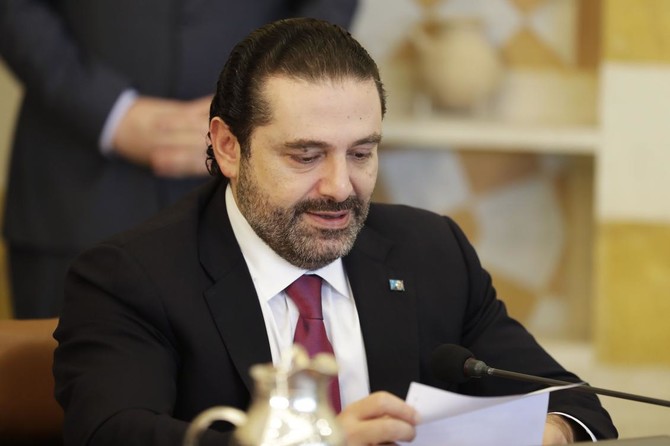
Lebanese Prime Minister Saad Hariri attends a cabinet meeting at the presidential palace of Baabda, east of the capital Beirut, on Dec. 5, 2017. (AFP/Joseph Eid)
Updated 05 December 2017
Follow

Hariri revokes resignation after consensus deal

BEIRUT: Lebanese Prime Minister Saad Hariri has withdrawn his resignation, a month after his shock resignation announcement in Saudi Arabia.

Hariri's decision to rescind came after a consensus deal reached with rival political parties.

The announcement came at the end of the first Cabinet meeting since Lebanon was thrown into a political crisis after Hariri's stunning move a month ago.

The Cabinet assured in an emergency meeting "the commitment of the Lebanese government in all its political components to dissociate itself from any disputes, conflicts, wars or internal affairs of Arab countries in order to preserve Lebanon's political and economic relations with its Arab brothers."

The draft of the statement was agreed after numerous communications and meetings held quietly in the past few days, involving President Michel Aoun, Parliament Speaker Nabih Berri, Hariri, Hezbollah and other parties.

In a statement, Hariri hoped that "the Cabinet meeting would present a new opportunity for solidarity to protect the country. We all can see how the region is boiling, and we should not have any illusions that any miscalculated step could lead the country down a dangerous path."

Hariri said in the statement: "I am the prime minister of Lebanon and today there is a death sentence against me in Syria, and Hezbollah has been classified as a terrorist (organization) in the Gulf countries. All I am saying is that we need to spare the country from getting involved in the regional conflicts and preserve our stability.”

He added: “However, this does not relieve us from realizing the current problem and the concerns of many brotherly countries, especially Gulf countries, which sent us many clear messages concerning interference in their internal affairs. This means that there is a problem which we cannot ignore, and which should not continue. Attacking the Gulf countries in the media and in politics threatens the interests of Lebanon, especially the Lebanese expatriates working in the Gulf."

Hariri stressed: “Our interest lies in the protection of our historical relations with Saudi Arabia and all the Gulf (countries), and depriving those who do not wish us well from a pretext to draw Lebanon into chaos."

Hariri noted that "we are not in the business of confirming Lebanon's Arabism. This is a settled issue, and the Taif agreement is as clear as the sun. But we want to send a message to our Arab brothers that Lebanon does not want to damage its relations Arab countries or harm any Arab country.

"The Lebanese government, in all its political components, has committed to distance itself from all conflicts, wars, and internal affairs of Arab states," according to the Cabinet statement read out by Hariri.

Minutes after Hariri's announcement, Paris said the Lebanese premier would attend talks on Friday in France on the situation in Lebanon, which US Secretary of State Rex Tillerson will also attend.

"The aim is to support the political process (in Lebanon) at a crucial moment," the French Foreign Ministry said, according to Agency France-Presse. ”It will send a message both to the various parties in Lebanon and to countries in the region."​


Aid workers find little life in El-Fasher after RSF takeover

Updated 10 sec ago
Follow

Aid workers find little life in El-Fasher after RSF takeover

  • First UN visit to the devastated Sudanese city finds traumatized civilians in ‘unsafe conditions’

PORT SUDAN: Traumatized civilians left in Sudan’s El-Fasher after its capture by paramilitary forces are living without water or sanitation in a city haunted by famine, UN aid coordinator Denise Brown said on Monday.
El-Fasher fell to the paramilitary Rapid Support Forces in October after more than 500 days of siege, and last Friday, a small UN humanitarian team was able to make its first short visit in almost two years.
Mass atrocities, including massacres, torture, and sexual violence, reportedly accompanied the capture of the city. Satellite pictures reviewed by AFP show what appear to be mass graves.

FASTFACT

From a humanitarian point of view, UN aid coordinator Denise Brown said, El-Fasher remains Sudan’s ‘epicenter of human suffering’ and the city — which once held more than a million people — is still facing a famine.

Brown described the city as a “crime scene,” but said human rights experts would carry out investigations while her office focuses on restoring aid to the survivors.
“We weren’t able to see any of the detainees, and we believe there are detainees,” she said.
From a humanitarian point of view, she said, El-Fasher remains Sudan’s “epicenter of human suffering” and the city — which once held more than a million people — is still facing a famine.
“El-Fasher is a ghost of its former self,” Brown said in an interview.
“We don’t have enough information yet to conclude how many people remain there, but we know large parts of the city are destroyed. The people who remain, their homes have been destroyed.”
“These people are living in very precarious situations,” warned Brown, a Canadian diplomat and the UN’s humanitarian coordinator in Sudan.
“Some of them are in abandoned buildings. Some of them ... in very rudimentary conditions, plastic sheeting, no sanitation, no water. So these are very undignified, unsafe conditions for people.”
Since April 2023, Sudan has been gripped by a conflict between the regular army and its former allies, the RSF, which has triggered a humanitarian catastrophe.
Brown said the team “negotiated hard with the RSF” to obtain access and managed to look around, visit a hard-pressed hospital, and some abandoned UN premises — but only for a few hours.
Their movements were also limited by fears of unexploded ordnance and mines left behind from nearly two years of fighting.
“There was one small market operating, mostly with produce that comes from surrounding areas, so tomatoes, onions, potatoes,” she said.
“Very small quantities, very small bags, which tells you that people can’t afford to buy more.”
“There is a declared famine in El-Fasher. We’ve been blocked from going in. There’s nothing positive about what’s happened in El-Fasher.
“It was a mission to test whether we could get our people safely in and out, to have a look at what remains of the town, who remains there, what their situation is,” she said.
The war in Sudan has killed tens of thousands of people, driven 11 million from their homes, and caused what the UN has declared “the world’s worst humanitarian disaster.”