AMMAN: A state security court in Jordan on Monday sentenced one Syrian militant to death and handed life sentences to three others for their role in a suicide bombing attack on a Jordanian military border post that killed seven guards last year.
Military judge Col. Mohammad Al-Afif said the men, in their early twenties, were involved in helping Daesh stage the suicide bombing that shook the kingdom in June last year.
Afif said the four had provided photos and intelligence about the Jordanian military post to a Daesh leader in the former de facto capital of the militants, Raqqa in Syria. The Daesh leader then sent the suicide bomber.
The military outpost was located a few hundred meters away from Rukban camp in a no-man’s land where thousands of Syrian refugees were stranded and near where the frontiers of Iraq, Syria and Jordan meet.
The court found the four, who were residents of the camp, guilty of “abetting terrorist acts that led to the death of human beings” and other charges of committing “terrorist acts using automatic weapons.”
A fifth defendant was acquitted. They had all pleaded not guilty when the trial began last March.
Officials said at the time the suicide bomber drove an explosive-laden car at full speed from behind a berm and evaded troops to reach the Jordanian post and detonate his car.
The blast, for which Daesh claimed responsibility a few days later, also left 15 soldiers wounded, officials said.
The area was later declared a closed military zone and the incident disrupted aid to tens of thousands of Syrian refugees.
Jordan, which has kept tight control of its frontier with Syria since the outbreak of war in its neighbor, is a partner in a US-led coalition fighting militants in Syria and Iraq, and has been the target of attacks before.
Tens of thousands of Syrian refugees fleeing violence and Russian airstrikes in the eastern Homs desert had sought shelter at Rukban, a remote desert camp. King Abdallah had said there were militants among them and Jordan refused to allow them to enter on security grounds.


Jordan sentences Syrian to death over border attack
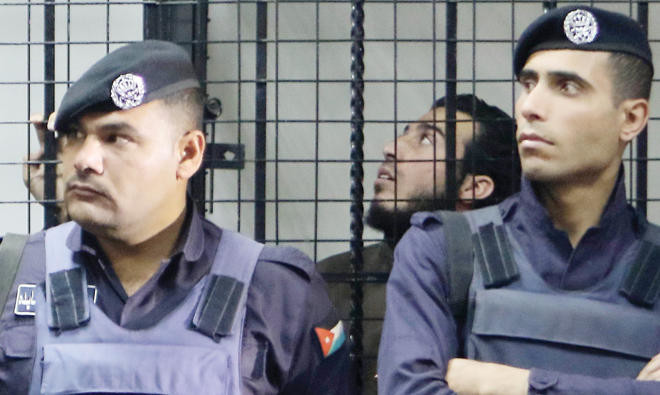
Jordan sentences Syrian to death over border attack


GCC states ‘face reliance on Saudi Arabia for food imports’
- With 70 percent of food coming through Strait of Hormuz, analysts warn of inevitable shortages
DUBAI: Some Gulf states may have to rely on overland food deliveries from Saudi Arabia if the US-Israel-Iran war continues to disrupt shipping through the Strait of Hormuz and restrict regional airspace, analysts warned on Thursday.
The region is up to 90 percent dependent on food imports, and price surges and scarcity of some goods are expected.
“With over 70 percent of GCC foodstuffs being imported through the Strait of Hormuz, Gulf states face shortages if the war persists,” said Neil Quilliam of the Chatham House think tank.
“While GCC countries have taken steps to diversify suppliers and ensure sufficient stores to withstand disruption, this can only last several months. At this point, price increases and longer lead times will start to hit the markets.”
Commodities analyst Ishan Bhanu said: “The biggest immediate effect will be due to the blockade of Jebel Ali in Dubai, serving about 50 million people. Qatar, Kuwait, Bahrain and Iraq effectively become landlocked and will depend on overland routes through Saudi Arabia.”
Bottlenecks are yet to show and the UAE has said its strategic reserves of vital goods cover four to six months of needs. It urged residents to report unjustified price increases through a dedicated hotline.
Supermarket staff throughout the Gulf said shelves remain largely stocked, though suppliers are taking longer to replenish certain products. Iran’s strikes on the Gulf since Saturday prompted panic buying in supermarkets, a dry run for what could come.
“Perception of risk matters, and even if stocks are sufficient now, public runs on supermarkets can spook the public,” Quilliam said.


