WASHINGTON: Thousands of years ago, cats successfully managed to wrap us around their little paws. Nowhere is this clearer than in Ancient Egyptian art and culture, from paintings of felines to mummified cats buried with their masters’ remains.
In around 1950 BCE, a feline was painted on the back wall of a limestone tomb some 250 kilometers south of Cairo. It is clearly a domestic cat and seems ready to pounce on an approaching field rat. This is first inkling that cats were beginning to gain in stature and prestige in Ancient Egypt.
In the centuries that followed, cats became a fixture of Egyptian paintings and sculptures and were revered as they rose in prominence from rodent killer to eventually gain the stature of a divine being.
A collection of feline artwork is now on display at the Smithsonian Institution’s Arthur M. Sackler Gallery in Washington, DC. “Divine Felines: Cats of Ancient Egypt” is a superb collection that explores feline themes in mythology, kingship and even everyday life.
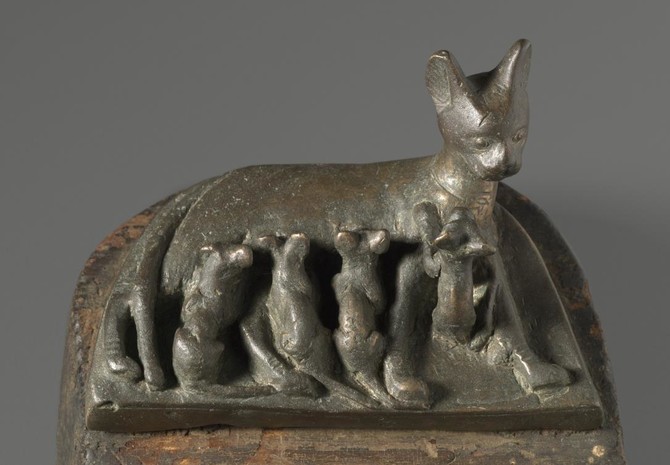
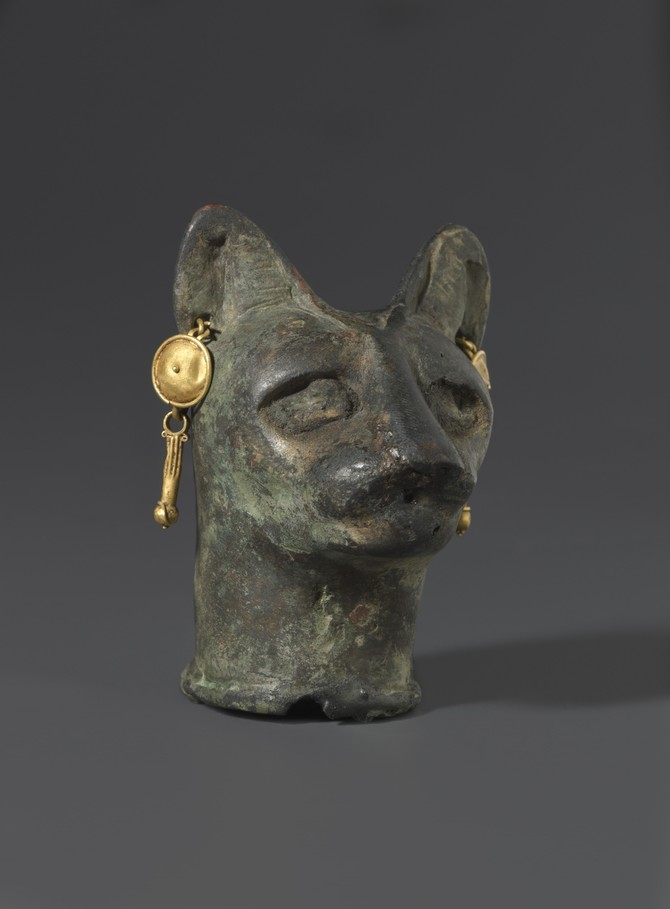
Images of a mother cat nursing her kittens, or an attentive cat wearing gold earrings, help emphasize felines’ shift from domesticated cats to symbols of divinity in Ancient Egypt.
These now-immortalized Egyptian cats played an important role in Ancient Egyptian imagery for thousands of years and the Smithsonian’s temporary exhibition — most of the cats are on loan from the Brooklyn Museum’s world-famous Egyptian collection — features more than 80 objects that explore both wild and domestic cats, feline deities, mummified cats in burial practices and luxury items decorated with feline imagery.
“This exciting temporary exhibit is devoted to Ancient Egyptian cats, from the time of the pharaohs,” Massumeh Farhad, chief curator of Islamic Art and the Freer/Sackler Galleries for Ancient Near Eastern Art at the Smithsonian Institution, told Arab News during the exhibition’s recent press preview.
“The reason we became interested in the exhibition is because Mr. Sackler was extremely interested in Egyptian art, so much so that he traveled to Egypt three times during his lifetime.
“Here in the museum, the Islamic galleries promote the theme of ‘engaging in the senses’,” said Farhad. “They examine how sound, sight, taste and touch can affect a person. These senses lead inward to one’s inner senses which one hopes will lead to increased knowledge, memory and understanding.”
Lions and power
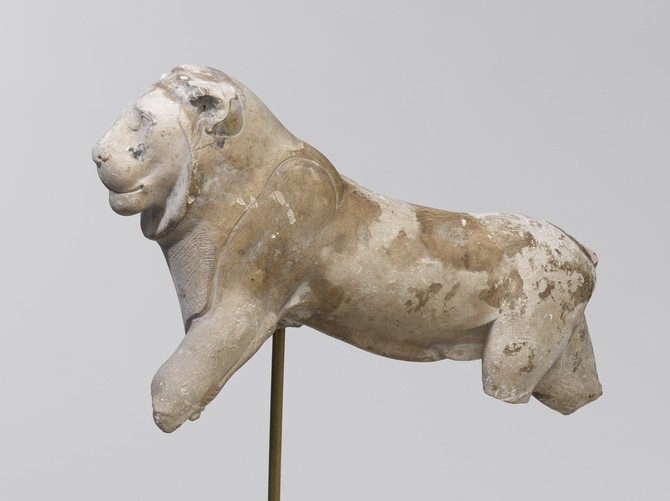
Whether hunting for food or protecting their cubs, felines — and most especially lions — captured the imagination of the Ancient Egyptians. They were venerated because of their power, ferocity and speed and also their graceful majesty.
Pharaohs and Egyptian kings used the imagery of felines to convey the divine, along with royalty and superiority.
Many kings felt the need demonstrate their control and superiority over these mighty animals in a bid to demonstrate their strength and dominance over all, including these large felines.
Pharaohs, especially during the New Kingdom period between 1550 BCE to 712 BCE, were displayed on murals as organizing lion hunts and royal places kept captured lions and other large felines in zoo-like enclosures on their palace property.
Image after image displays these powerful symbols throughout the exhibition.
“Look at this large cat with (a) paw over its other paw, it is meant to project confidence,” said Antonietta Catanzariti, the curatorial fellow at the Smithsonian’s Freer and Sackler Galleries. “Think of the lions’ paws you’ve seen on the feet of chairs,” said Catanzariti, “these were a symbol of status that indicated both power and protection for the person sitting in the chair.”
Cats: From amulets to furniture
Images of felines were also used for protection — not only do we see them on furniture, but also on major points of structures. Cats, displayed on jewelry, were even commonly worn as amulets.
Statues of protective lions pre-dated the use of gargoyles, which we would later see on cathedrals throughout Europe. As for amulets, feline figurines were commonly worn in Ancient Egypt by the middle and upper classes, Catanzariti said.
“Bastet was one of Ancient Egypt’s most famous felines. (She was) a mother-goddess with protective and maternal attributes,” Catanzariti added. Bastet was worshipped in homes and temples, “just think of how a docile mother cat can become ferocious to protect her kittens,” Catanzariti said, explaining why the animal was revered.
“Sakhemet was another feline goddess (and) she was known as the ‘the powerful one,’ so powerful that she was thought to even be able to protect the king while in battle and also in his everyday life,” Catanzariti told Arab News.
“In ancient Egypt, the king or pharaoh would always travel with objects that represented his status and strength. Lions were used for protection and power during his war activities in other countries.”
To have a lion at his side was viewed as the ultimate power. “The king wanted to control the lions to demonstrate to his citizens that he was in control of all — even over lions — which was why they were portrayed in hunting scenes with the pharaohs, they represented royalty.”
Bes is another cat deity, venerated because she was thought to help during transitional moments, such as childbirth.
“Bes was seen as a more intimate deity and was associated with mothers. Women wore images of her and used her as an amulet,” said Catanzariti, whose passion for the objects at the exhibition is contagious.
Succinct descriptions throughout the exhibition guide and enlighten visitors on various feline themes, so even if you wander around without a guide, you are sure to leave with some interesting facts.
The exhibition is on display at the Smithsonian’s Arthur M. Sackler Gallery and closes on Jan. 15, 2018.


![]()
![]()
![]()
![]()
Cat lover? US museum explores the power of felines in Ancient Egypt

Cat lover? US museum explores the power of felines in Ancient Egypt

Latest updates


© 2026 SAUDI RESEARCH & PUBLISHING COMPANY, All Rights Reserved And subject to Terms of Use Agreement.