2 mass graves found in Yazidi district of Iraq

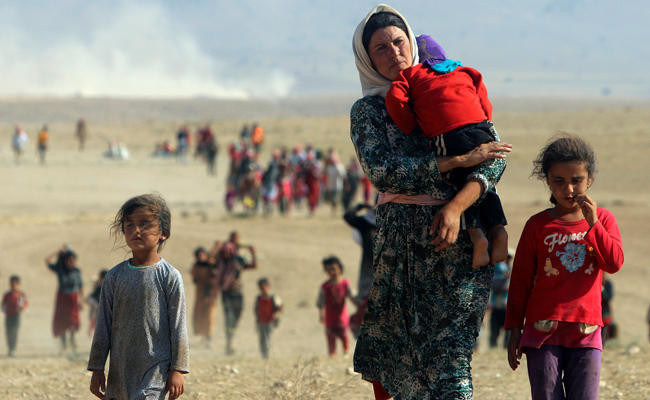
In this August 11, 2014 photo, Yazidis walk toward the Syrian border on the outskirts of Sinjar mountain to escape violence from Daesh terrorists. Daesh militants killed thousands of Yazidis in Sinjar and kidnapped thousands of women and girls from the community to abuse them as sex slaves. (REUTERS/Rodi Said/File Photo)
Updated 03 December 2017
Follow

2 mass graves found in Yazidi district of Iraq

BAGHDAD: Iraqi paramilitary forces have uncovered two more mass graves containing the bodies of 140 civilians, including women and children, in an area home to the Yazidi religious minority, they said Saturday.
In 2014, Daesh killed thousands of Yazidis in Sinjar and kidnapped thousands of women and girls from the community to abuse them as sex slaves.
Al-Hashd Al-Shaabi paramilitary alliance said it had found “a mass grave with the bodies of 20 women and about 40 children in the village of Kabusi, south of Sinjar.”
Elsewhere, “in the Jazira residential complex, also south of Sinjar, 80 other bodies, mostly Yazidis, were discovered,” it said.
Kurdish fighters backed by the US-led coalition against Daesh captured Sinjar from the terrorists in November 2015 before Iraqi security forces took control of the region in October.
As government troops have advanced across Iraq they have uncovered dozens of mass graves holding hundreds of bodies in areas that fell under the militants’ brutal rule.
Iraqi officials said on Nov. 22 they had found a mass grave in Sinjar containing the bodies of dozens of members of the minority killed by Daesh.
Sinjar Mayor Mahma Khalil said that since 2015, around 40 mass graves have been discovered in the region and that “all the victims were Yazidis.”
The Yazidis are Kurdish-speaking but follow their own non-Muslim faith that earned them the hatred of the extremists of Daesh.


Egypt’s parliament approves cabinet reshuffle: state media

Updated 4 sec ago
Follow

Egypt’s parliament approves cabinet reshuffle: state media

CAIRO: Egypt’s parliament approved a limited cabinet reshuffle on Tuesday, endorsing changes proposed by President Abdel Fattah El-Sisi, state media reported.
The reshuffle brings in 14 new ministers and creates a new post for a deputy prime minister in charge of economic affairs, according to the state-owned Al-Ahram newspaper.
The former head of parliament’s budget and planning committee, Hussein Issa, was appointed to that post.
Ahmed Rostom, a former specialist at the World Bank, was appointed minister of planning.
Mohamed Farid Saleh, who was executive chairman of Egypt’s Financial Regulatory Authority, was named minister of investment and foreign trade.
The changes also include the revival of the Ministry of Information, which will be headed by Diaa Rashwan, the current head of the State Information Service (SIS).
The ministry, tasked with overseeing media policy, had been dissolved several times following the 2011 uprising that toppled former president Hosni Mubarak, with its functions transferred later to media regulatory bodies.
As part of the reshuffle, the transport and industry ministries were separated.
Kamel Al-Wazir will continue as minister of transport only, having previously overseen both portfolios.
Planning was also separated from international cooperation, with Rania Al-Mashat remaining as minister of international cooperation.
Several key ministers retained their posts, including the ministers of finance, foreign affairs, defense, interior, petroleum and health.
The new government is expected to be sworn in on Wednesday, Egyptian media reported.