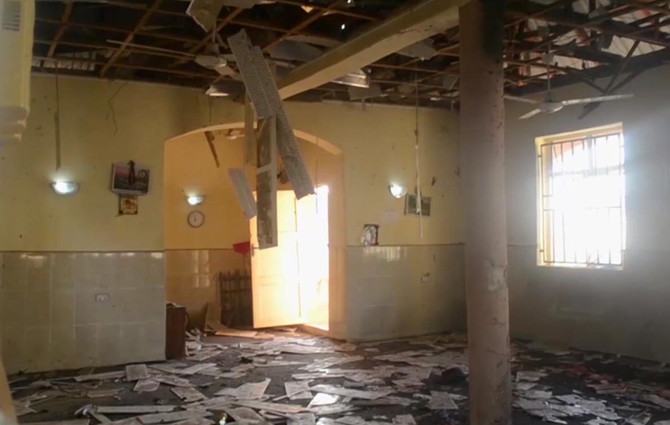
KANO, Nigeria: At least 13 people were killed and more than 50 wounded in a dual suicide bomb attack at a busy morning market in northeast Nigeria on Saturday, according to local sources.
The attacks occurred in the town of Biu, about 185 kilometers (115 miles) south of the Borno State capital, Maiduguri, which has been at the epicenter of Boko Haram’s Islamist insurgency.
“Two female suicide bombers infiltrated and gained entry into Biu,” a local police spokesman said.
“One of the bombers detonated an IED (improvised explosive device) strapped to her body within Biu’s main market, while the other one detonated outside the market square,” the spokesman said.
The police said 13 people were killed, while a spokesman for a local civilian militia, Ibrahim Saidu Maniya, said the death toll was as high as 18.
No one has claimed responsibility for the attack, but the Boko Haram group, led by Abubakar Shekau, has previously used women and adolescent suicide bombers to carry out attacks in the area.
“They were powerful blasts which were heard all over the town,” Biu resident Ahmad Babagana, who lost a friend in the attack, told AFP.
“I heard huge blasts that came in succession and saw plumes of black smoke coming from the direction of the market,” said another resident, Zakari Tiko.
“I instantly knew the market had been attacked,” Tiko said.
Biu and neighboring villages have been repeatedly hit by suicide and bomb attacks blamed on Boko Haram over the last eight years. In August 2015, a suicide bomber killed at least 50 people at a market in a nearby village.
Despite increased military success in the fight to dislodge Boko Haram, the group continues to launch deadly attacks in the country.
At least 20,000 people have been killed and more than 2.6 million others made homeless in its quest to establish a hard-line Islamic state in northeast Nigeria.

Twin suicide bombings in Nigeria kill at least 13, wounds 50
Norway says Russia, China seek to up presence on Svalbard
- The second-largest town on Svalbard is almost entirely populated by Russian nationals
- China’s presence was becoming more visible in the Arctic
OSLO: While global tensions have focused on Greenland, Norway’s military intelligence service said on Friday that Russia and China were looking to increase their presence on the Norwegian Arctic archipelago of Svalbard.
In its annual threat assessment, the Norwegian Intelligence Service said that “from Moscow’s perspective, Svalbard’s strategic location makes it necessary to maintain a Russian presence there.”
The second-largest town on Svalbard, the coal mining settlement of Barentsburg, is almost entirely populated by Russian nationals.
“There are signs that the Kremlin is looking to make the Barentsburg settlement less dependent on Norwegian supply and transport infrastructure
“Regular port visits by ships from Russia constitute one planned step in this direction,” the agency said.
It said Beijing was “also expected to work toward enhancing the Chinese presence in Svalbard.”
“The archipelago is strategically placed for future shipping routes and polar research, which are central to cementing China’s role as an Arctic actor,” it said in its report.
It noted that China’s presence was becoming more visible in the Arctic and that five Chinese research vessels had operated in the Arctic Ocean in 2025, compared to three in 2024 and one in previous years.
The service also noted that tensions between the United States and Europe over Greenland and security in the Arctic “could serve both Russian and Chinese interests.”
- ‘Crumbling’ world order -
Andreas Stensones, head of the service, said in the report that Moscow and Beijing stood to benefit as “international cooperation and institutions are being undermined.”
“The same dynamic is evident in the Arctic. Much of the foundation for Norwegian security is being challenged and we must accept that the world order as we have known it is crumbling,” Stensones said.
Speaking at a press conference, Norwegian Defense Minister Tore Sandvik noted: “2026 has so far been characterised by great uncertainty.”
He pointed in particular to US President Donald Trump’s vocally stated desire to take over Greenland.
Trump’s threats against Greenland last month plunged NATO — of which Norway is a member — into its deepest crisis in years.
“There is no denying that relations across the Atlantic are more unpredictable,” Sandvik said.
Stensones told the same press conference that Washington’s actions affected how both Moscow and Beijing were thinking and acting.
“In their view, western unity has already begun to crack, and they see great opportunities to strengthen their influence and secure control in their neighboring areas,” he told reporters.